Home
Class 12
PHYSICS
A square plate has a moment of inertia l...

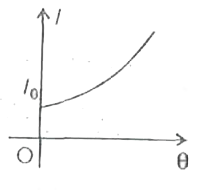
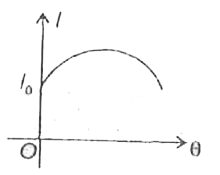
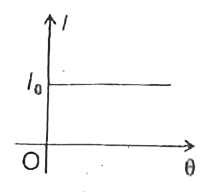
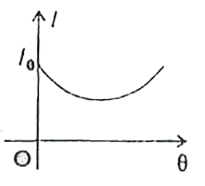
A square plate has a moment of inertia `l_(0)` about an axis lying in its plane, passing through its centre and making an angle `theta` with one of the sides. Which graph represents the variation of l with `theta` ?

A

B

C

D

Text Solution

AI Generated Solution

The correct Answer is:

To solve the problem of the moment of inertia \( I \) of a square plate about an axis lying in its plane and making an angle \( \theta \) with one of its sides, we can follow these steps: ### Step 1: Understand the Moment of Inertia The moment of inertia \( I \) of an object about an axis depends on the mass distribution relative to that axis. For a square plate, the moment of inertia about an axis through its center and parallel to one of its sides is given by: \[ I_0 = \frac{1}{6} m a^2 \] where \( m \) is the mass of the plate and \( a \) is the length of one side of the square. ### Step 2: Consider the Axis of Rotation When the axis of rotation is tilted at an angle \( \theta \) with respect to one of the sides, we need to consider how this affects the distribution of mass relative to the new axis. However, since the square plate is symmetric, the mass distribution does not change with the angle \( \theta \). ### Step 3: Apply the Perpendicular Axis Theorem For a flat plate, the perpendicular axis theorem states that the moment of inertia about an axis perpendicular to the plane of the plate is equal to the sum of the moments of inertia about two perpendicular axes in the plane of the plate. However, since we are rotating about an axis that is in the plane of the plate, we can conclude that the moment of inertia remains constant. ### Step 4: Conclusion Thus, the moment of inertia \( I \) about the tilted axis remains equal to \( I_0 \) regardless of the angle \( \theta \). This means that the moment of inertia does not vary with \( \theta \). ### Final Expression \[ I(\theta) = I_0 \] ### Graph Representation The graph representing the variation of \( I \) with \( \theta \) would be a horizontal line, indicating that \( I \) remains constant as \( \theta \) changes. ---
Promotional Banner

Similar Questions

Explore conceptually related problems

The moment of inertia of a thin uniform rod of mass M, length L, about an axis passing through its centre and making an angle theta with the rod is

Find the moment of inortia of ring of mass m and radius R about an axis passing through its centre and making an angle of 45^(@) with its plane:

The moment of inertia of a uniform rod of length 2l and mass m about an axis xy passing through its centre and inclined at an angle alpha is

The moment of inertia of a copper disc, rotating about an axis passing through its centre and perpendicular to its plane

Derive an expression for moment of inertia of a thin circular ring about an axis passing through its centre and perpendicular to the plane of the ring.

A uniform rectangular plate has moment of inertia about its longer side, equal to I. The moment of inertia of the plate about an axis in its plane, passing through the centre and parallel to the shorter sides is also equal to I. Find its moment of inertia about an axis passing through its centre and perpendicular to its plane.
