Home
Class 11
CHEMISTRY
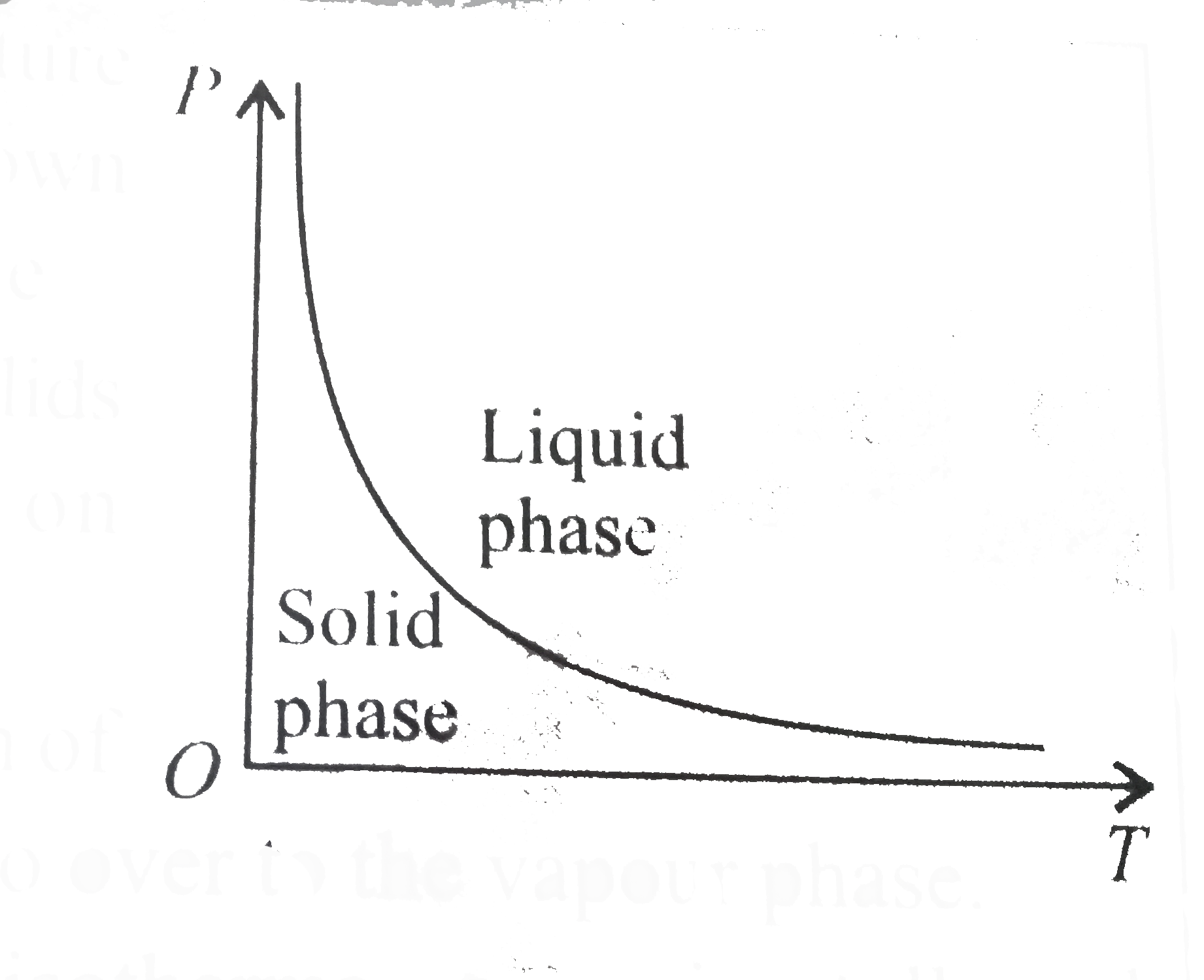
The pressure -temperature (P-T) phase di...

The pressure -temperature `(P-T)` phase diagram shown below corresponds to the
a. Curve of fusion of solids that expand on solidification.
b. Curve of sublimation of solides that directly go over to the vapour phase.

A

curve of fusion of solids that expand on solidification

B

curve of sublimation of solids that directly go over to the vapour phase

C

curve of fusion of solids that contract on solidification

D

curve of fusion of solids that do not change in volume upon solidification

Text Solution

Verified by Experts

The correct Answer is:

C
Promotional Banner

Topper's Solved these Questions

  • MISCELLANEOUS (TOPICS OF GENERAL INTEREST)

    OP TANDON|Exercise SET-V: Matching type Questions|37 Videos
  • INTRODUCTION TO ORGANIC CHEMISTRY

    OP TANDON|Exercise SINGLE INTEGER ANSWER TYPE|4 Videos
  • OXIDATION AND REDUCTION (REDOX REACTIONS)

    OP TANDON|Exercise SECTION V|3 Videos

Similar Questions

Explore conceptually related problems

Assertion : In pressure-temperature (P-T) phase diagram of water, the slope of the melting curve is found to be negative. Reason : Ice contracts on melting to water.

P-T diagram is shown below then choose the corresponding V-T diagram

Assertion : In pressure-temperature ( P - T ) phase diagram of water, the slope of the melting curve is found to be negative. Reason : Ice contracts on melting to water

According to the phase diagram shown, where does a mixture of solid and liquid exist at equilibrium ?

Each phase of a material can exits only in certain regions of pressure and temperature . P-T phase diagrams, in which pressure is plotted versus temperature, show the regions corresponding to various phases and phase transformations . P-V diagrams, on the other hand , can be used to study pressure volume relationship at a constant temperature. If the liquid and gaseous phases of a pure substances are heated together in a closed container, both the temperature and the vapor pressure will increase until a point is reached at which the two phases can no longer be distinguished from one another. The temperature and pressure at which this occurs are called the critical temperature and pressure. Exceeding either of these parameters, by itself ,will cause the "gas"//"liguid" phase transition to disappear. if the other variable is then changed as well, while the first variable is maintained above its critical point , a gradual transition will occur between the gaseous and liquid phases, with no clear boundary.(The liquid and solid phases, on the other hand , maintain a distinct boundary at all pressure above the triple point). Shown in figure is a combined P-T phase diagram for material A and B . If heat is added to solids A and B , each in a container that is open to the atmosphere :-

Each phase of a material can exits only in certain regions of pressure and temperature . P-T phase diagrams, in which pressure is plotted versus temperature, show the regions corresponding to various phases and phase transformations . P-V diagrams, on the other hand , can be used to study pressure volume relationship at a constant temperature. If the liquid and gaseous phases of a pure substances are heated together in a closed container, both the temperature and the vapor pressure will increase until a point is reached at which the two phases can no longer be distinguished from one another. The temperature and pressure at which this occurs are called the critical temperature and pressure. Exceeding either of these parameters, by itself ,will cause the "gas"//"liguid" phase transition to disappear. if the other variable is then changed as well, while the first variable is maintained above its critical point , a gradual transition will occur between the gaseous and liquid phases, with no clear boundary.(The liquid and solid phases, on the other hand , maintain a distinct boundary at all pressure above the triple point). Shown in figure is a combined P-T phase diagram for material A and B . Which is true about the substance in figure?

Raoult’s Law for a Solution of Two Miscible Liquid || Vapour Pressure and Liquid Composition Curve || Calculation of Mole Fraction in Vapour Phase

The vapour pressure curves of the same solute in the same solvent are shown below. The curves are parallel to each other andnot intersectt. The concentrations of solutions are in order of :

The pressure at equilibrium over solid A is 50 atm and over solid D is 68 atm if both solid A and D are heated simultaneously .Find: relative number of moles of A ′and B in the vapour phase over a mixture of the solids A and B.

OP TANDON-MISCELLANEOUS (TOPICS OF GENERAL INTEREST)-SET-VI: Problems on graphical aptitude
  1. In the pressure-volume diagram given below, the isochoric, isothermal,...

    Text Solution

    |

  2. Heat energy absorbed by a system in going through a cyclic process sho...

    Text Solution

    |

  3. The pressure -temperature (P-T) phase diagram shown below corresponds ...

    Text Solution

    |

  4. Graph for specific heat at constant volume for a monoatomic gas

    Text Solution

    |

  5. A cyclic process ABCD is shown in the P-V diagram. Which of the follow...

    Text Solution

    |

  6. A system is taken from state A to B through three different paths 1,2 ...

    Text Solution

    |

  7. In the cyclic process shown in P-V diagram the magnitude of work done ...

    Text Solution

    |

  8. A cyclic process is shown in the p-T diagram. Which of the curves show...

    Text Solution

    |

  9. Heat is supplied to a certain homogeneous sample of matter, at a unifo...

    Text Solution

    |

  10. An ideal gas is taken from the state A (pressure P, volume V) to the s...

    Text Solution

    |

  11. The radioactive nucleus of an element X decays to a stable nucleus of ...

    Text Solution

    |

  12. In photoelectric effect the slope of straight line graph between stopp...

    Text Solution

    |

  13. The stopping potential as a function of the frequency of the incident ...

    Text Solution

    |

  14. Which of the following is the graph between the frequency (v) of the i...

    Text Solution

    |

  15. Which of the following figure represents the variation of particle mom...

    Text Solution

    |

  16. The follwing diagram indicates the energy levels of a certain atom whe...

    Text Solution

    |

  17. The maximu kinetic energy (E(k)) of the photoelectron varies with freq...

    Text Solution

    |

  18. The following graphs illustrate:

    Text Solution

    |

  19. In the following graph:

    Text Solution

    |

  20. The variation of ^^(m) of acetic acid with concentration is correctly ...

    Text Solution

    |
