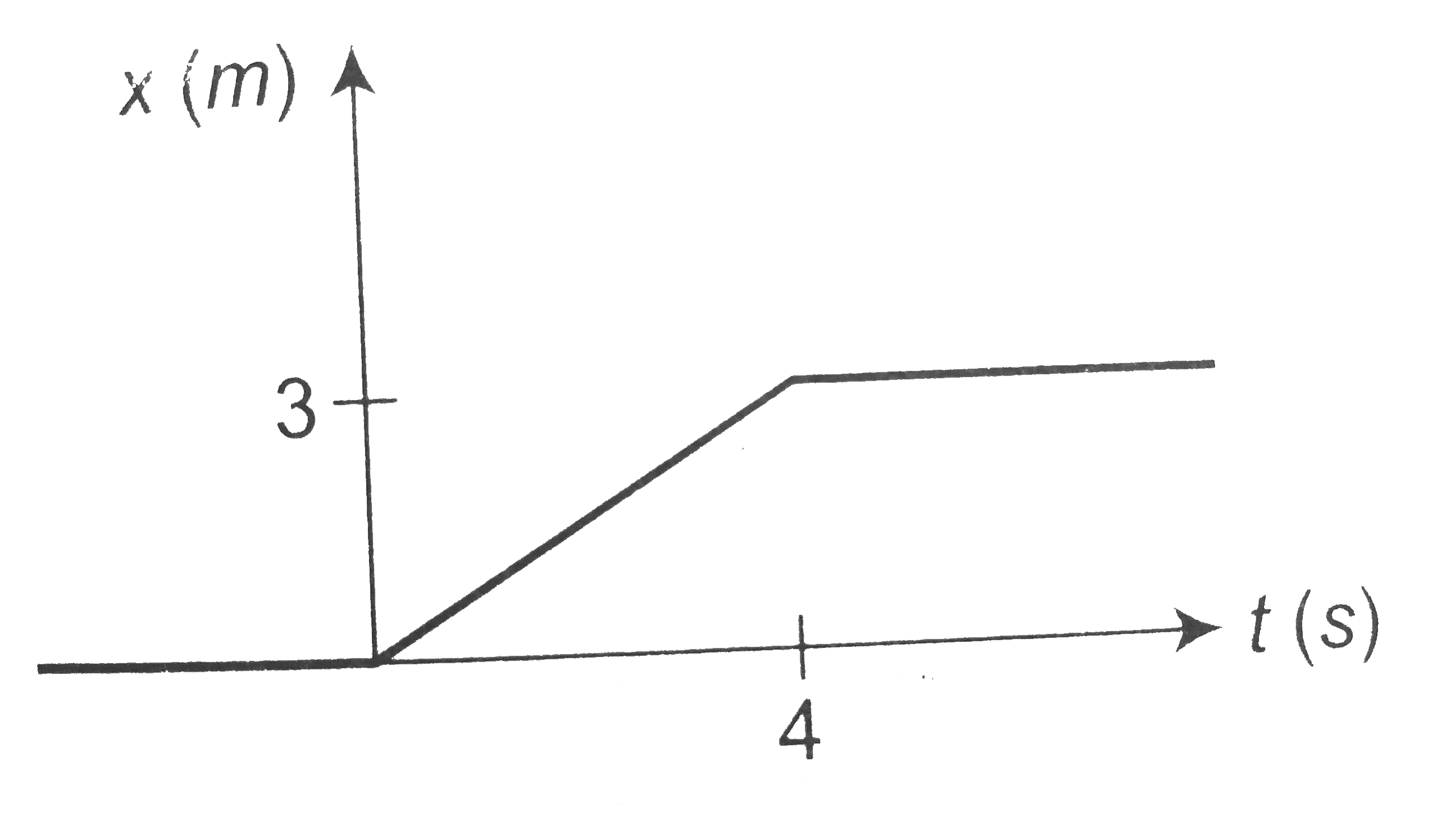
A
B
C
D
Text Solution
Verified by Experts
The correct Answer is:



Topper's Solved these Questions
LAWS OF MOTION
NCERT FINGERTIPS|Exercise Newton'S Third Law Of Motion|15 VideosLAWS OF MOTION
NCERT FINGERTIPS|Exercise Conservation Of Momentum|4 VideosLAWS OF MOTION
NCERT FINGERTIPS|Exercise Newton'S First Law Of Motion|2 VideosKINETIC THEORY
NCERT FINGERTIPS|Exercise Assertion And Reason|10 VideosMECHANICAL PROPERTIES OF FLUIDS
NCERT FINGERTIPS|Exercise Assertion And Reason|15 Videos
Similar Questions
Explore conceptually related problems
NCERT FINGERTIPS-LAWS OF MOTION-Newton'S Second Law Of Motion
- Newton's second law of motion is
Text Solution
|
- Which one of the following statement is not ture about Newton's second...
Text Solution
|
- The relation vec(F)=vec(ma) , cannot be deduced from Newton's second l...
Text Solution
|
- A large force is acting on a body for a short time. The impulse impart...
Text Solution
|
- Which one of the following is not force
Text Solution
|
- The motion of a particle of mass m is described by y =ut + (1)/(2) g t...
Text Solution
|
- A constant force acting on a body of mass of 5 kg change its speed fro...
Text Solution
|
- A bullet of mass 40g moving with a speed of 90ms^(-1) enters a heavy w...
Text Solution
|
- A body under the action of a force vec(F)=6hat(i)-8hat(j)N acquires an...
Text Solution
|
- A constant retarding force of 50N is apllied to a body of mass 10kg mo...
Text Solution
|
- A body of mass 5 kg starts from the origin with an initial velocity ve...
Text Solution
|
- A body of mass 0.4kg starting at origin at t=0 with a speed of 10ms^(-...
Text Solution
|
- The force on a rocket moving with a veloctiy 300 m/s is 210N. The rate...
Text Solution
|
- A ball of mass m strikes a rigid walJ with speed u and rebounds with t...
Text Solution
|
- A batsman hits back a ball straight in the direction of the bowler wit...
Text Solution
|
- Figure shows (x,t) (y,t) diagram of a particle moving in 2-dimensions...
Text Solution
|
- Figure shows the position-time graph of a particle of mass 4kg. Let th...
Text Solution
|
- Figure shows the position-time (x-t) graph of one dimensional motion o...
Text Solution
|
- The position time graph of a body of mass 2 kg is as given in What is ...
Text Solution
|