Home
Class 11
PHYSICS
A string of negligible mass going over a...

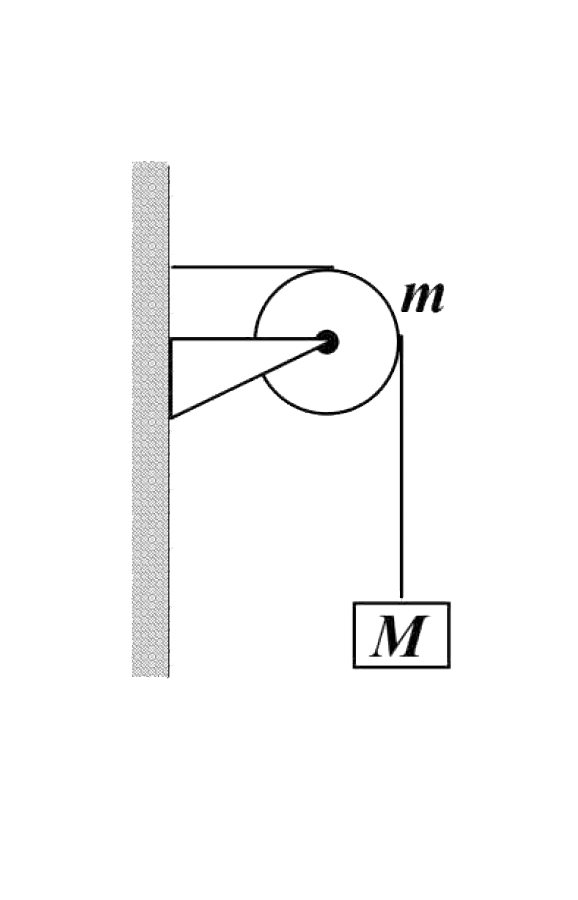
A string of negligible mass going over a clamped pulley of mass m supports a block of mass M as shown in the figure. The force on the pulley by the clamp is given by

A

`sqrt2 Mg`

B

`sqrt2 mg`

C

`sqrt((M+m)^(2)+m^(2)g)`

D

`sqrt((M+m)^(2)+M^(2)g)`

Text Solution

Verified by Experts

The correct Answer is:
D

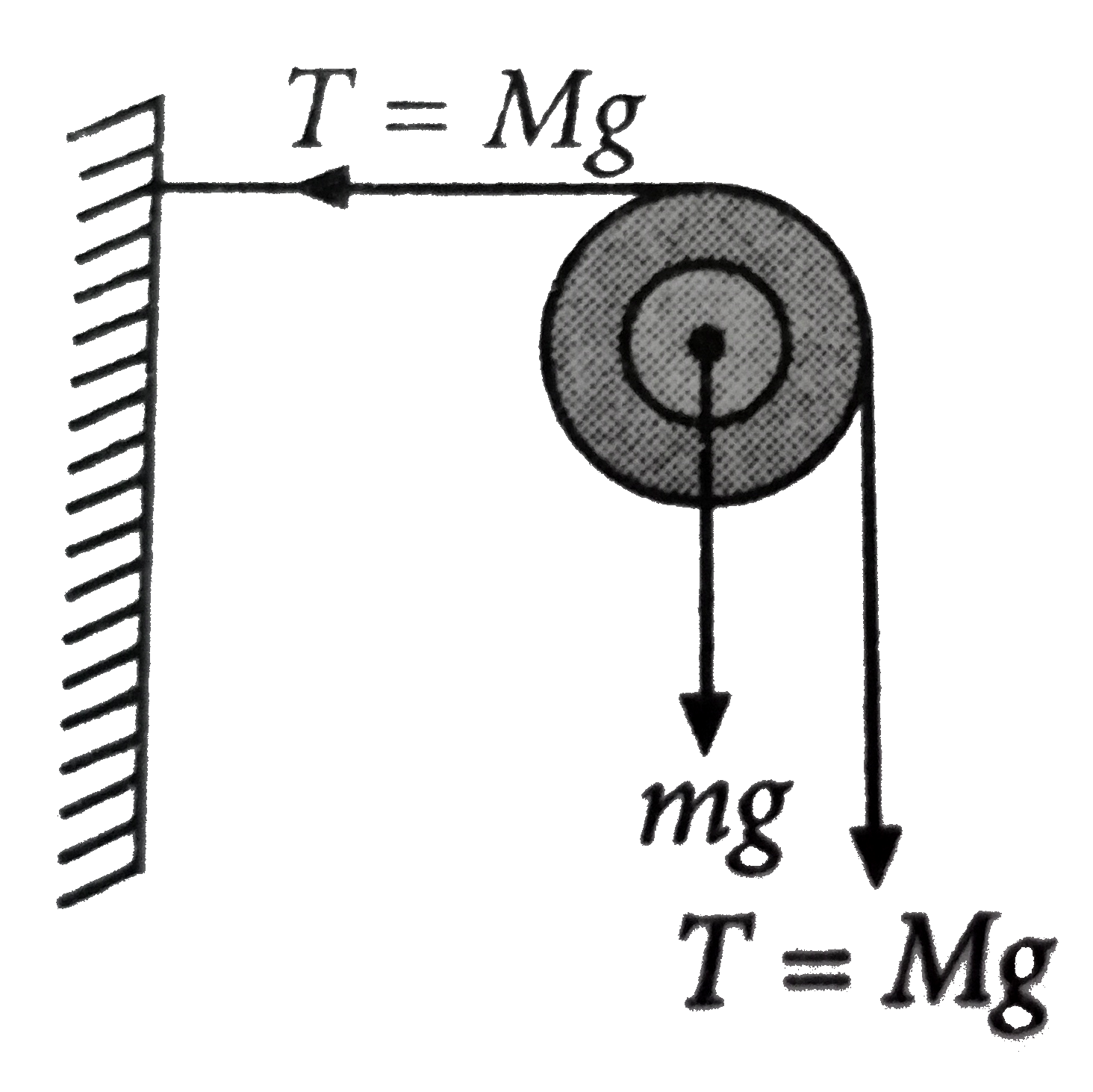
Weight of the pulley mg acts downwards. Weight of the block Mg acts downwards. Total downward force. `F_(1)=(m+M)g`
Tension in the string T=Mg.
The force on the pulley by reaction of the clamp is equal to the resultant of `F_(1)` and T. Let it be F.
`F^(2)=T^(2)=F_(2)^(1)=(Mg)^(2)+[(m+M)g]^(2)`
`or F^(2)=[M^(2)+(M+m)^(2)]g^(2)`
`or F=sqrt((M+m)^(2)+M^(2)g)`
Promotional Banner

Topper's Solved these Questions

  • LAWS OF MOTION

    NCERT FINGERTIPS|Exercise NCERT Exemplar|9 Videos
  • LAWS OF MOTION

    NCERT FINGERTIPS|Exercise Assertion And Reason|15 Videos
  • LAWS OF MOTION

    NCERT FINGERTIPS|Exercise Solving Problem In Mechanics|16 Videos
  • KINETIC THEORY

    NCERT FINGERTIPS|Exercise Assertion And Reason|10 Videos
  • MECHANICAL PROPERTIES OF FLUIDS

    NCERT FINGERTIPS|Exercise Assertion And Reason|15 Videos

Similar Questions

Explore conceptually related problems

A string of negligible mass going over a clamped puley of mass m supports a block of mass Mas shown in the figure. The force on the pulley by the clamp is given

A mass string going over a clamped pulley of mass m supports a block of mass M as shown in the figure. The force on the pulley by the clamp is given

A spring of negligible mass going over a clamped pulley of mass m supports a block of mass M as shown in the figure. The force on the pulley by the clamp at the time of equilibrium is given by

Two blocks of masses M_(1)=4 kg and M_(2)=6kg are connected by a string of negligible mass passing over a frictionless pulley as shown in the figure below. The coefficient of friction between the block M_(1) and the horizontal surface is 0.4. when the system is released, the masses M_(1) and M_(2) start accelrating. What additional mass m should be placed over M_(1) so that the masses (M_(1)+m) slide with a uniform speed?

Two blocks of masses m_(1) and m_(2) are connected by a string of negligible mass which pass over a frictionless pulley fixed on the top of an inclined plane as shown in figure. The coefficient of friction between m_(1) and plane is mu .

Two blocks of masses 2m and m are connected by a light string going over a pulley of mass 2m and radius R as shown in the figure. The system is released from rest. Find the angular momentum of system when the mass 2m has descended through a height h . Assume no slipping.

A string of negligible mass is wrapped on a cylindrical pulley of mass M and radius R. The other end of string is tied to a bucket of mass m. If the pulley rotates about a horizontal axis then the tension in the string is :

Both the blocks shown in figure have same mass 'm' . All the pulley and strings are massiess.

A constant force F=m_2g/s is applied on the block of mass m_1 as shown in figure. The string and the pulley are light and the surface of the table is smooth. Find the acceleration of m_1

