Home
Class 11
PHYSICS
A hockey player is moving northward and ...

A hockey player is moving northward and suddenly turns westward with the same speed to avoid an opponet. The force that acts on the player is.

A

frictional force along westward.

B

muscle force along southward.

C

frictional force along south-west.

D

muscle force along south-west.

Text Solution

Verified by Experts

The correct Answer is:
C

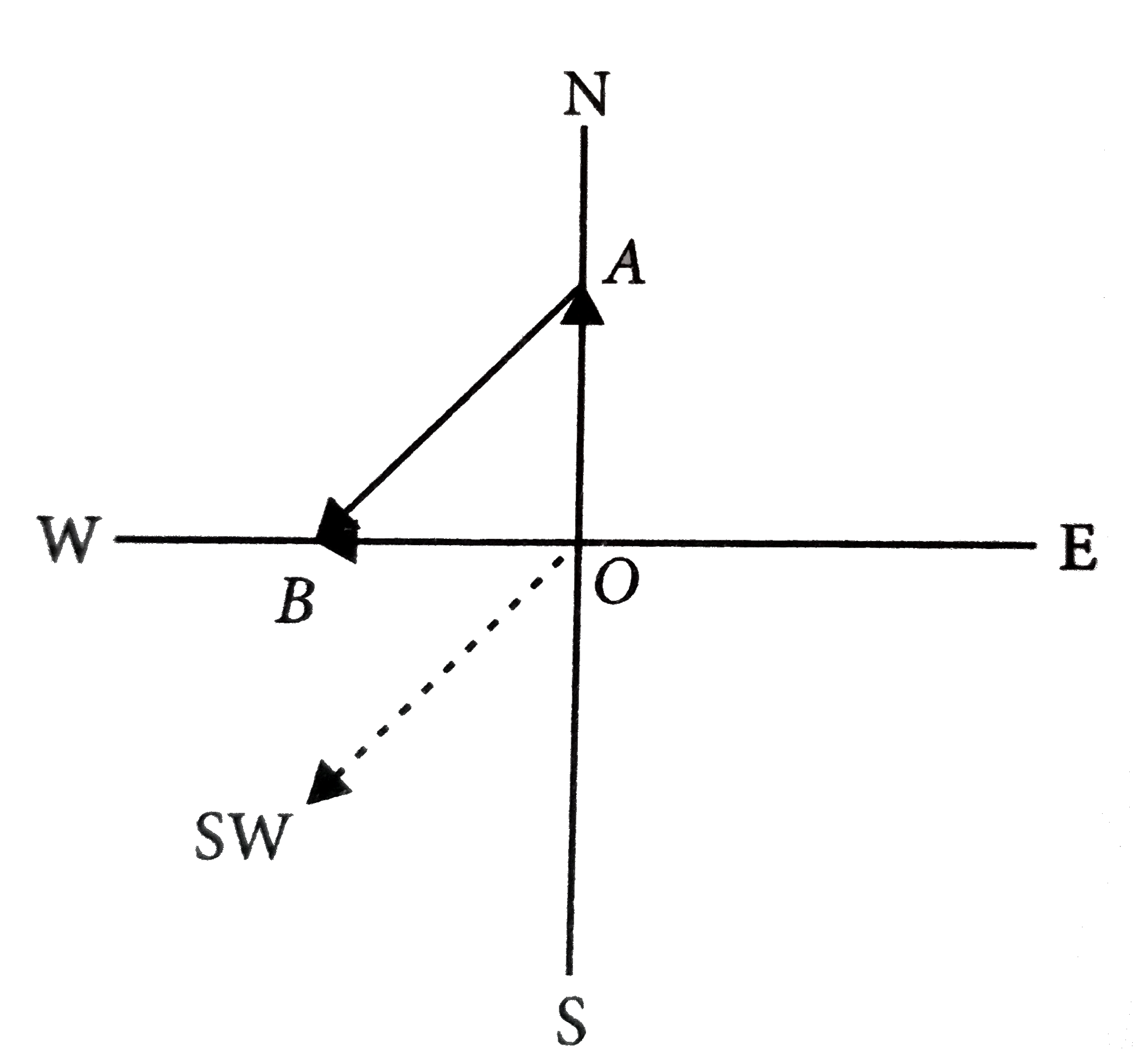
In figure `overset(rightarrow)(OA)=bar(p)_(1)` =initial momentum of player northward.
`overset(rightarrow)(OB)=bar(p)_(2)` = final momentum of player westward.
According to the triagle law of vectors. `overset(rightarrow)(OA)+overset(rightarrow)(AB)=overset(rightarrow)(OB)`
`overset(rightarrow)(AB)=overset(rightarrow)(OB)-overset(rightarrow)(OA)=bar(p)_(2)-bar(p)_(1)`= change in momentum
The change in momentum of player is along south west. As motion is due to frictional force of reaction of the ground, therefore force that acts on the player is frictional force along south west.
Promotional Banner

Topper's Solved these Questions

  • LAWS OF MOTION

    NCERT FINGERTIPS|Exercise Assertion And Reason|15 Videos
  • LAWS OF MOTION

    NCERT FINGERTIPS|Exercise Higher Order Thinking Skills|8 Videos
  • KINETIC THEORY

    NCERT FINGERTIPS|Exercise Assertion And Reason|10 Videos
  • MECHANICAL PROPERTIES OF FLUIDS

    NCERT FINGERTIPS|Exercise Assertion And Reason|15 Videos

Similar Questions

Explore conceptually related problems

A train is moving north with speed 20 m s. If it turns west with same speed

A car is moving along a road with a uniform speed of 20 km/hour. The net force acting on the car is

A particle of mass m moving eastward with a velocity V collides with another particle of same mass moving northwards with the same speed V . The two particles coalesce and the new particle moves in NE direction. Calculate magnitude and direction of velocity of new particle.

A particle is moving eastwards with a velocity 15 ms^(-1) .Suddenly it moves towards north and moves with the same speed in time 10 sec .The average acceleration during this time is

A body is moving with a unifrorm speed along a circle . Is there any force acting on the body ?

An object of mass 20 kg moves at a constant speed of 5ms^(-1) . A constant force, that acts for 2 sec on the object, gives it a speed of 3ms^(-1) in opposite direction. The force acting on the object is

An object of mass 10kg moves at a constant speed of 10 ms^(-1) . A constant force, that acts for 4 sec on the object, gives it a speed of 2ms^(-1) in opposite direction. The force acting on the object is :

A body is moving along a circular path such that its speed is always constant. Should there be a force acting on the body?

