Home
Class 11
PHYSICS
A track has two inclined surface AB and ...

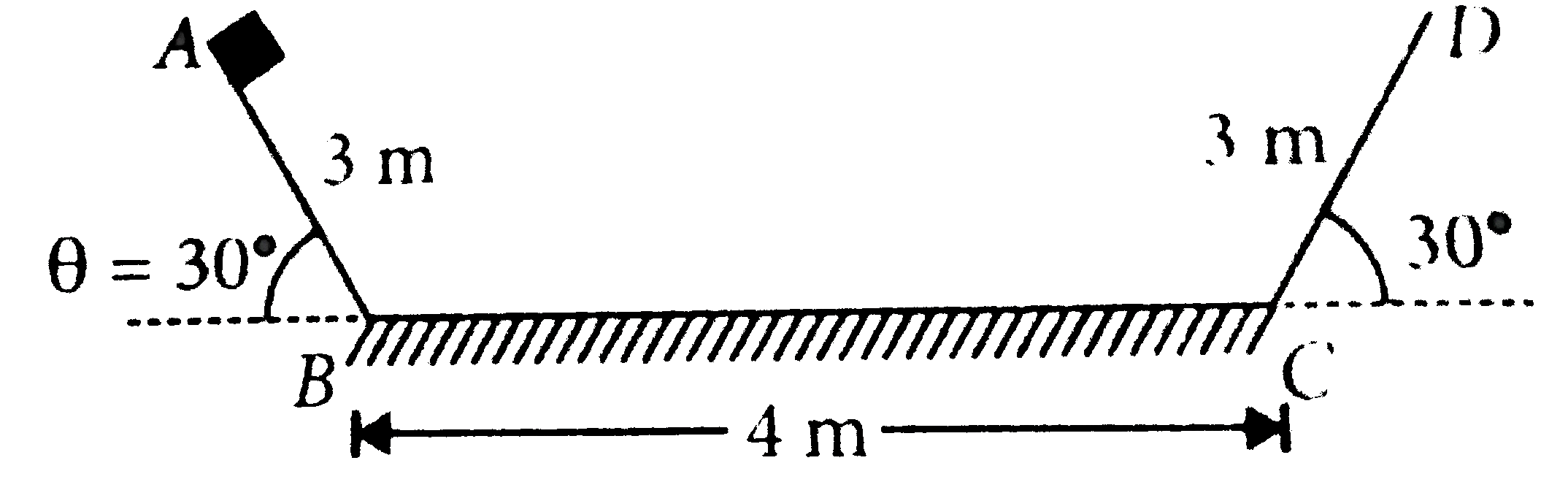
A track has two inclined surface AB and DC each of length 3 m and angle of inclination of `30^@` with the horizontal and a central horizontal part of length 4m shown in figure. A block of mass 0.2 kg slides from rest from point A. The inclined surfaces are frictionless. If the coefficient of friction between the block and the horizontal flat surface is 0.2, where will the block finally come to rest ? [in `10^(-1) m`]

A

0.5 m away from point B

B

3.5 m away from point B

C

0.5 m away from point C

D

1.5 m away from point C

Text Solution

Verified by Experts

The correct Answer is:
A

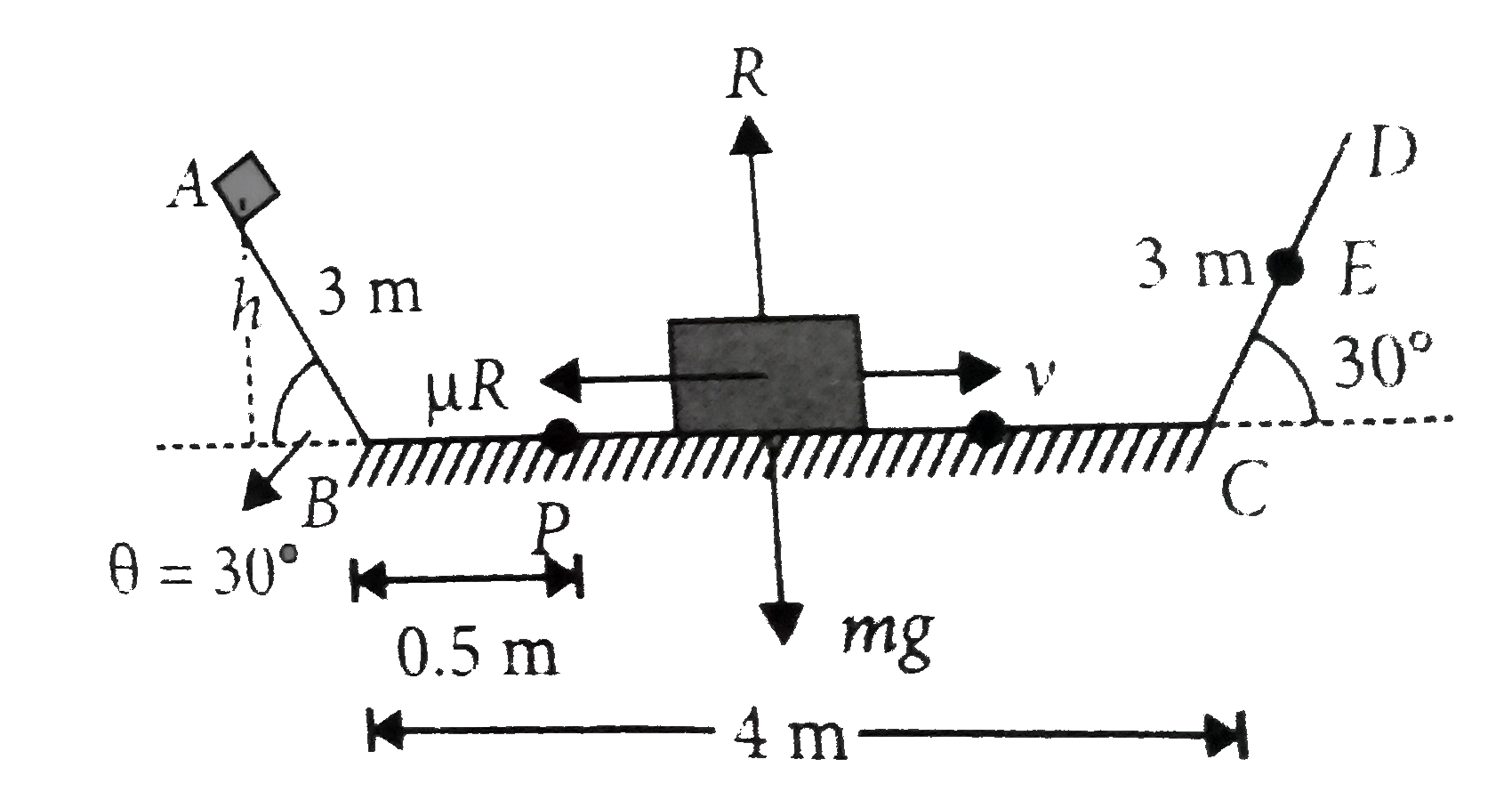
At point A, the energy of the block is entirely potential =mgh, where h is the height of A above the horizontal surface = `AB sintheta= 3 m xx sin 30^@= 1.5 m`. When the block is released, it reaches point B where the entire potential energy is converted into kinetic energy. It will, move on track BC. On reaching C, it will rise on the surface CD to a point E and will then return to C moving towards B and the process goes on until the block loses all its energy and comes to rest. The body loses energy while moving on the horizontal part BC of the track. If s is the total distance travelled on the horizontal part, the work done against friction is `WmuR x s = mumgs`

From the principle of conservation of energy, we have
`mgh = mumgs`
`s=h/mu=(1.5 m)/(0.2)=7.5 m = 750 xx 10^(-2) m`
i.e., the block travels a total distance of 7.5 m on the horizontal track BC before coming to rest, starting from B. It travels 4 km from B to C And 3.5 m from C to a point where it comes to rest. Hence the block comes to rest at point P at a distance of 0.5 m from B.
Promotional Banner

Topper's Solved these Questions

  • WORK , ENERGY AND POWER

    NCERT FINGERTIPS|Exercise NCERT Exemplar|18 Videos
  • WORK , ENERGY AND POWER

    NCERT FINGERTIPS|Exercise Assertion And Reason|15 Videos
  • WORK , ENERGY AND POWER

    NCERT FINGERTIPS|Exercise Collisions|15 Videos
  • WAVES

    NCERT FINGERTIPS|Exercise Assertion And Reason|15 Videos

Similar Questions

Explore conceptually related problems

A block of mass 0.5 kg has an initial velocity of 10ms^(-1) down an inclined plane of angle 30^@ , the coefficient of friction between the block and the inclined surface is 0.2. The velocity of the block after it travels a distance of 10 m is

A block of mass m is placed at rest on an inclination theta to the horizontal.If the coefficient of friction between the block and the plane is mu , then the total force the inclined plane exerts on the block is

A block of mass 2kg rests on a rough inclined plane making an angle of 30^@ with the horizontal. The coefficient of static friction between the block and the plane is 0.7. The frictional force on the block is

A block of mass 10 kg is sliding on a surface inclined at 30^(@) with horizontal . If coefficient of friction between the block and the surface is 0.5 , find acceleration produced in the block . Take g = 9.8 m //^(2) .

Block A of mass M in the system shown in the figure slides down the incline at a constant speed. The coefficient of friction between block A and the surface is 1 3 3 . The mass of block B is-

A block of mass 5 kg is at rest on a rough inclined surface. If angle of inclination of plane is 60^(@) , then force applied by it on block is

A block of mass 5 kg slides down a rough inclined surface. The angle of inclination is 45^(@) . The coefficient of sliding friction is 0.20. When the block slides 10 cm, the work done on the block by force of friction is

A block of mass 1 kg lies on a horizontal surface in a truck. The coefficient of static friction between the block and the surface is 0.6. If the acceleration of the truck is 5m//s^2 , the frictional force acting on the block is…………newtons.

A horizontal force of 20 N is applied to a block of 10 kg resting on a rough horizontal surface. How much additional force is required to just move the block, if the coefficient of static friction between the block and the surface is 0.4 ?

A block is kept on a rough horizontal surface as shown. Its mass is 2 kg and coefficient of friction between block and surface (mu)=0.5. A horizontal force F is acting on the block. When

