Home
Class 11
PHYSICS
Three elastic wires PQ, PR and PS suppor...

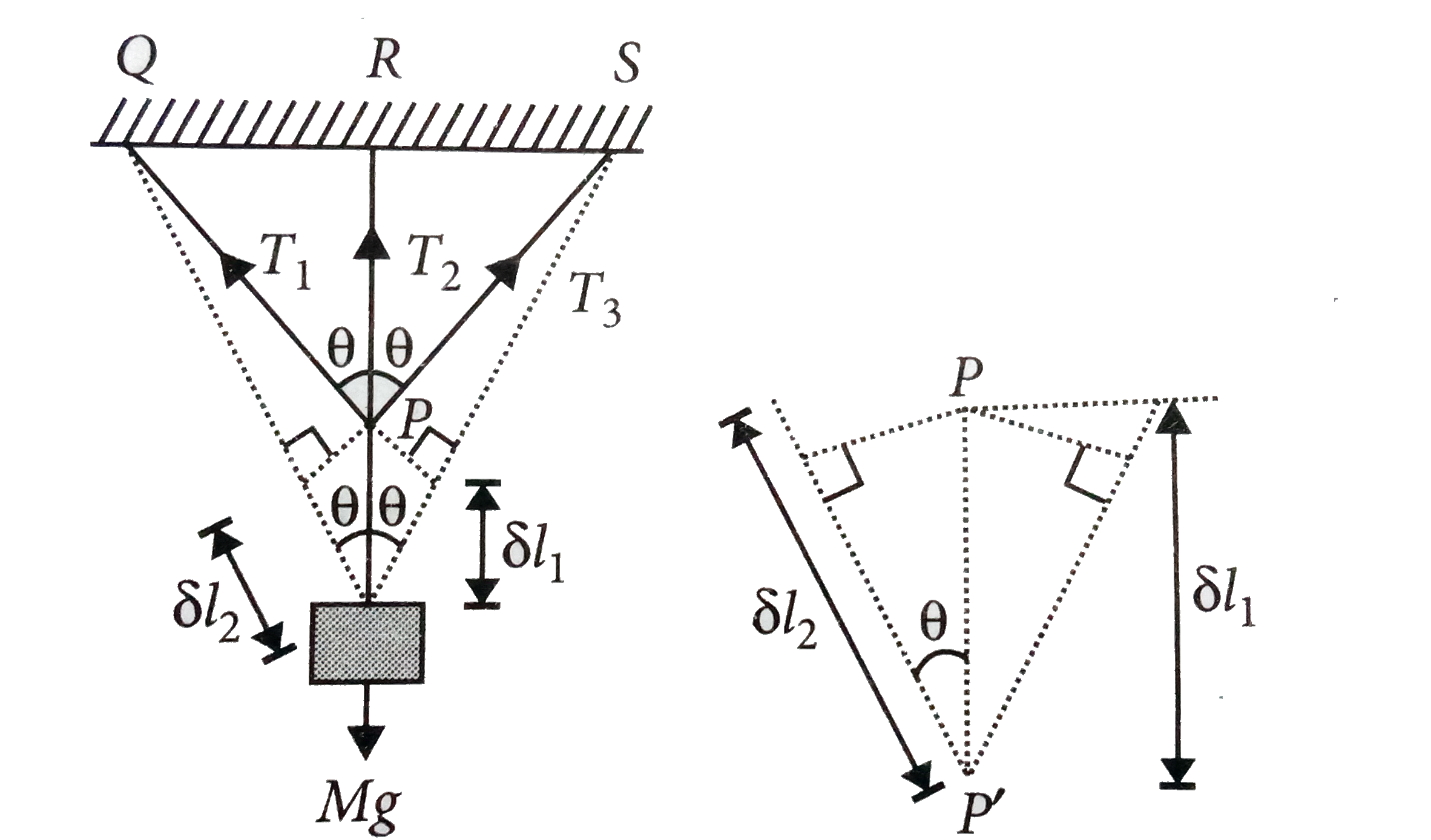
Three elastic wires `PQ, PR` and `PS` support a body `P` of mass `M`, as shown in figure. The wires are of the some material and cross sectional area, the middle one being vertical. Find the loads by each wire.

A

`Mg//1+ 2 cos^(2)theta`

B

`Mg//1+ 2 cos^(3)theta`

C

`Mg cos^(2)theta//1+ 2cos^(3)theta`

D

`Mg costheta//1+ 2cos^(3)theta`

Text Solution

Verified by Experts

The correct Answer is:
B

Figure shows the situation when the load (boby P) descends due to the stretch in load wires. The new positions of wires PQ and Ps are shown by the dotted lines. Let `T_(1), T_(2)` and `T_(3)` be the loads (tensions) carried by the three wires PQ, PR and PS respectively with the wires PQ and PS making angle `theta` with the vertical .

Considering the horizontal equilibrium of pointP,
`T_(1) sin theta= T_(3) sin rArr T_(1) = T_(3) = T("say")`
Considering the veritcal equilibrium of point P, `T_(2) +2T cos theta = Mg" "......(i)`
PR =a
`therefore ` PQ = PS = a sec`theta`
I f`deltal_(1)` and `deltal_(2)` be the elongations in the wires PR and PQ (or Ps ) respectively then
`deltal_(2) = deltal_(1) cos theta` (from geometry)
If A nd Y be the cross- sectional area and Young's modaulus of reach of the each of the three wires, then
`(T)/(AY)(a sec theta) = (T_(2))/(AY ) a cos theta rArr T =T_(2) cos ^(2) theta" "....(ii)`
Sloving eqns. (i) and (ii) we get `T_(2) = (Mg)/(1+2 cos^(3) theta)`
Promotional Banner

Topper's Solved these Questions

  • MECHANICAL PROPERTIES OF SOLIDS

    NCERT FINGERTIPS|Exercise NCERT Exemplar|8 Videos
  • MECHANICAL PROPERTIES OF SOLIDS

    NCERT FINGERTIPS|Exercise Assertion And Reason|15 Videos
  • MECHANICAL PROPERTIES OF SOLIDS

    NCERT FINGERTIPS|Exercise Applications Of Elastic Behaviour Of Materials|8 Videos
  • MECHANICAL PROPERTIES OF FLUIDS

    NCERT FINGERTIPS|Exercise Assertion And Reason|15 Videos
  • MOTION IN A PLANE

    NCERT FINGERTIPS|Exercise Assertion And Reason|15 Videos

Similar Questions

Explore conceptually related problems

Three vertical wires, I,II and III are supporting a block of mass M in horizontal positon. The wires are to equal length and cross-sectional area. It is given that Young's modulus of wire II, Y_(2) = Y_(3) (Yong's modulus of wire III ). The wire I and III and attached at extreme ends of the block.

The V – I graph for a wire of copper of length L and cross -section area A is shown in the figure below . The slope of the graph will be

A block of mass M is suspended from a wire of length L, area of cross-section A and Young's modulus Y. The elastic potential energy stored in the wire is

A current of 4.8 A is flowing in a copper wire of cross-sectional area 3xx10^(-4) m^(2) . Find the current density in the wire.

A bar of mass m and length l is hanging from point A as shown in the figure . If the Young's modulus of elasticity of the bar is Y and area of cross - section of the wire is A, then the increase in its length due to its own weight will be

A metal wire of length L_1 and area of cross section A is ttached to a rigid support. Another metal wire of length L_2 and of the same cross sectional area is attached to the free end of the first wire. A body of mass M is then suspended from the free end of the second wire, if Y_1 and Y_2 are the Young's moduli of the wires respectively the effective force constant of the system of two wires is

