Home
Class 11
PHYSICS
Two opposite forcesF(1) = 120 N and F(2)...

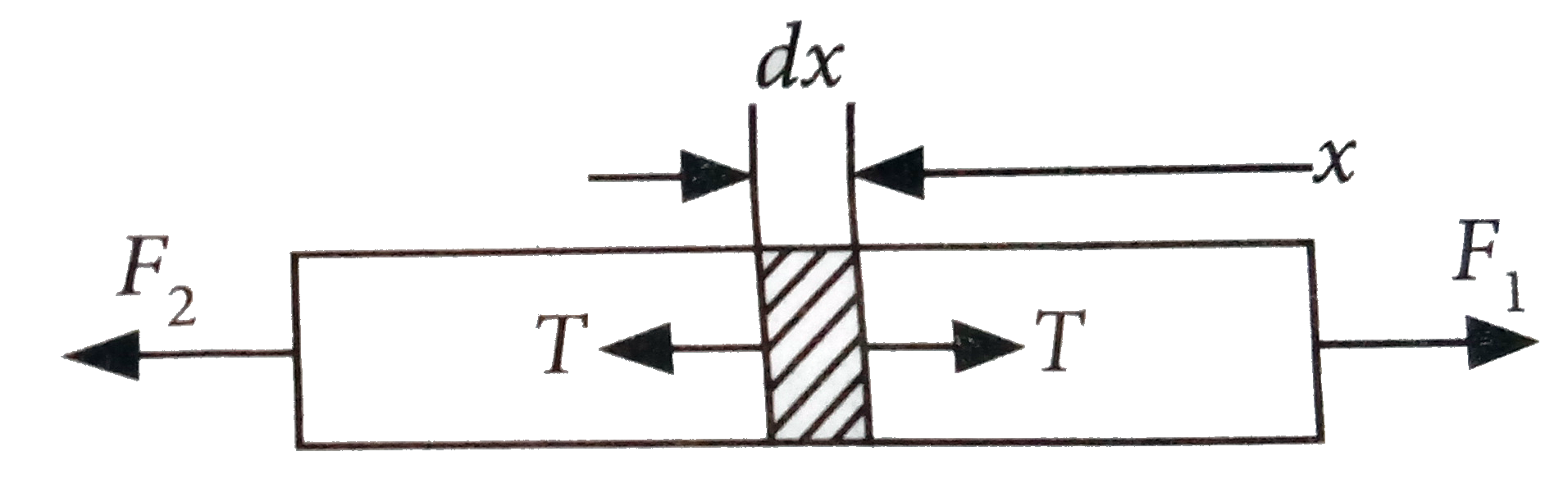
Two opposite forces`F_(1) = 120 N` and `F_(2) = 80 N` act on an elastic plank of modulus of elasticity `Y= 2 x 10^(11) N//m^(2)` and length `l=1m` placed over a smooth horizontal surface. The cross-sectional area of the plank is `S = 0.5 m^(2)`. The change in length of the plank is `x xx 10^(-11)m`. Find the value of `x`.

A

1

B

1.5

C

1.4

D

1.1

Text Solution

Verified by Experts

The correct Answer is:
A

Consider an element of thickness dx, Change in the length of the element is `dl=(T)/(S)(dx)/(Y)` and `T = F_(1) - (F_(1) - F_(2)) (x)/(l)`
`underset(0) overset(Deltal)int dl underset(0)overset(l)int(F_(1)-((F_(1) -F_(2))dx)/(l)dx)/(SY)`

`Deltal = ((F_(1)+F_(2)))/(2SY) = (200xx 1)/(2xx0.5xx2xx10^(11)) = 1xx10^(-9)m`
`therefore x =1`
Promotional Banner

Topper's Solved these Questions

  • MECHANICAL PROPERTIES OF SOLIDS

    NCERT FINGERTIPS|Exercise NCERT Exemplar|8 Videos
  • MECHANICAL PROPERTIES OF SOLIDS

    NCERT FINGERTIPS|Exercise Assertion And Reason|15 Videos
  • MECHANICAL PROPERTIES OF SOLIDS

    NCERT FINGERTIPS|Exercise Applications Of Elastic Behaviour Of Materials|8 Videos
  • MECHANICAL PROPERTIES OF FLUIDS

    NCERT FINGERTIPS|Exercise Assertion And Reason|15 Videos
  • MOTION IN A PLANE

    NCERT FINGERTIPS|Exercise Assertion And Reason|15 Videos

Similar Questions

Explore conceptually related problems

A uniform plank of Young's modulus Y is moved over a smooth horizontal surface by a constant horizontal force F. The area of cross section of the plank is A. The compressive strain on the plank in the direction of the force is

If young's modulus of steel is 2xx10^(11)N//m^(2) , then the force required to increase the length of a wire of cross section 1 cm^(2) by 1% will be

Young modulus of elasticity of brass is 10^(11)N//m^(2) . On pressing the rod of length 0.1 m. and cross section area 1 cm^(2) made from brass with a force of 10 N. along its length, the increase in its energy will be……………………

A wire of length 1m is stretched by a force of 10N. The area of cross-section of the wire is 2 × 10^(–6) m^(2) and Y is 2 xx 10^(11) N//m^(2) . Increase in length of the wire will be -

A sphere of mass m and radius r is placed on a rough plank of mass M . The system is placed on a smooth horizontal surface. A constant force F is applied on the plank such that the sphere rolls purely on the plank. Find the acceleration of the sphere.

A block of mass'm' it kept over the smooth surface of the plank of mass M. the plank of length l is kept over the smooth horizontal surface. A constant horizontal force F is applied onto the plank as shown in figure. Calculate the time after which the block falls off the plank?

The area of a cross-section of steel wire is 0.1 cm^(-2) and Young's modulus of steel is 2 x 10^(11) N m^(-2) . The force required to stretch by 0.1% of its length is

A 20 N stone is suspended from a wire and its length changes by 1% . If the Young's modulus of the material of wire is 2xx10^(11)N//m^(2) , then the area of cross-section of the wire is 2xx10^(11)N//m^(2) , then the area of cross-section of the wire will be

When a force is applied on a wire of uniform cross-sectional area 3xx10^-6m^2 and length 4 m, the increase in length is 1mm. Energy stored in it will be (Y=2xx10^(11)(N)/(m^2) )

A block A of mass m is placed over a plank B of mass 2m plank B is placed over a smooth horizontal surface .The coefficient of friction between A and B is 0.4 Block A is given a velocity v_(0) toward right Find acceleration (in ms^(-2) of B relative to A

