Home
Class 11
PHYSICS
Two chunks of metal with heat capacities...

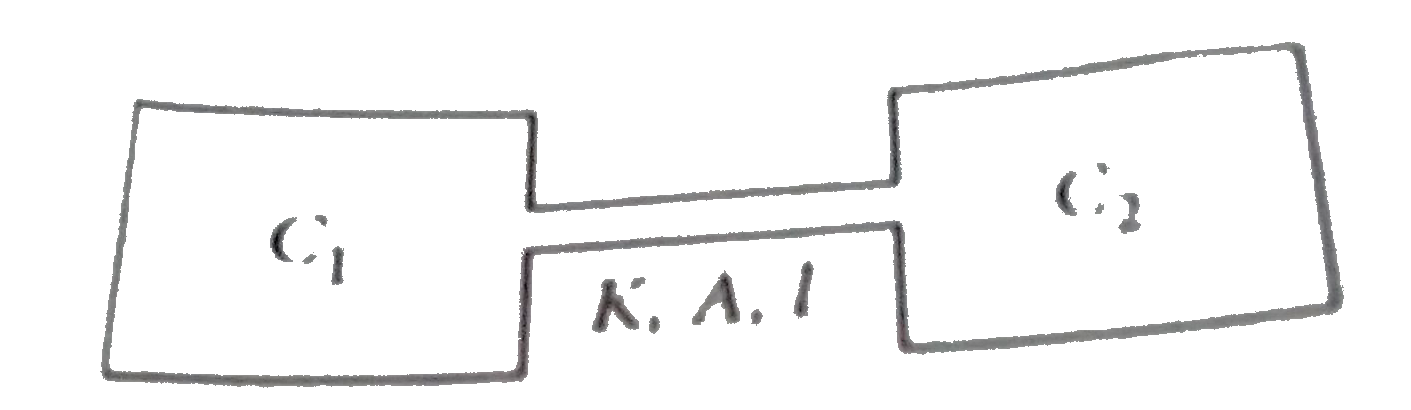
Two chunks of metal with heat capacities `C_(1)` and `C_(2)`, are interconnected by a rod length `l` and cross-sectional area `S` and fairly low heat conductivity `K`. The whole system is thermally insulated from the environment. At a moment `t = 0` the temperature difference between the two chunks of metal equals `(DeltaT)_(0)`. Assuming the heat capacity of the rod to be negligible, find the temperature difference between the chucks as a function of time.

A

`T_(0) e^((-KA(C_(1) + C_(2))t)/(C_(1)C_(2)))`

B

`T_(0) e^((-KA(C_(1) + C_(2)))/(C_(1)C_(2)))`

C

`T_(0) e^((KA(C_(1) + C_(2))t)/(C_(1)C_(2)))`

D

`T_(0) e^((KA(C_(1) + C_(2))t^(2))/(C_(1)C_(2)))`

Text Solution

Verified by Experts

The correct Answer is:
A

Let T be the tempeature difference between two block at time t.

Heat transferred per second,
`(dQ)/(dt) = (KAT)/(l) "….."(i)`
Also, `dT = dT_(1) + dT_(2)"….."(ii)`
Heat lost by one block is equal to the heat gained by the other, `C_(1)dT_(1) = C_(2)"......."(iii)`
From equations, (ii) and (iii), we get
`dT = ((C_(1) + C_(2))/(C_(2))) dT_(1)"......"(iv)`
If a block loses heat, `dQ = - C_(1)dT_(1)`,
From equation, (i), `(dQ)/(dt) = - C_(1) (dT)/(dt) = - C_(1)(dT_(1))/(dt) = (KAT)/(l) "....."(v)`
From equations (iv) and (v), we get
`(-C_(1)C_(2))/(C_(1) + C_(2)) (dT)/(dt) = (KA)/(l) T`
`(dT)/(t) = (-KA(C_(1) + C_(2)))/(C_(1)C_(2))dt`
or `underset(T_(0))overset(T)(int) (dT)/(dt) = (-KA(C_(1)+C_(2)))/(C_(1)C_(2)) underset(0)overset(t)(int)dt`
`"ln"(T)/(T_(0)) = ((-KA(C_(1) + C_(2)))/(C_(1)C_(2)))t`
or `T = T_(0) "exp" ((-KA(C_(1)+C_(2))t)/(C_(1)C_(2)))`
Promotional Banner

Topper's Solved these Questions

  • THERMAL PROPERTIES OF MATTER

    NCERT FINGERTIPS|Exercise NCERT Exemplar|8 Videos
  • THERMAL PROPERTIES OF MATTER

    NCERT FINGERTIPS|Exercise Assertion And Reason|10 Videos
  • THERMAL PROPERTIES OF MATTER

    NCERT FINGERTIPS|Exercise Newton'S Law Of Cooling|3 Videos
  • SYSTEM OF PARTICLES AND ROTATIONAL MOTIONS

    NCERT FINGERTIPS|Exercise Assertion And Reason|15 Videos
  • THERMODYNAMICS

    NCERT FINGERTIPS|Exercise Assertion And Reason|15 Videos

Similar Questions

Explore conceptually related problems

Two bodies of masses m_(1) and m_(2) and specific heat capacities S_(1) and S_(2) are connected by a rod of length l, cross-ssection area A, thermal conductivity K and negligible heat capacity. The whole system is thermally insulated. At time t=0 , the temperature of the fisrt body is T_(1) and the temperature of the second body is T_(2)(T_(2)gtT_(1)) . Find the temperature difference between the two bodies at time t.

Two rods of length l and 2l thermal conductivities 2K and K are connected end to end. If cross sectional areas of two rods are eual, then equivalent thermal conductivity of the system is .

A metal rod of area of cross section A has length L and coefficient of thermal conductivity K the thermal resistance of the rod is .

" A metal rod of area of cross section A has length L and coefficient of thermal conductivity K The thermal resistance of the rod is "

Find the difference between heat capacity and specific heat capacity of a substance.

Two adiabatic vessels, each containing the same mass m of water but at different temperatures, are connected by a rod of length L, cross-section A, and thermal conductivity K. the ends of the rod are inserted into the vessels, while the rest of the rod is insulated so that .there is negligible loss of heat into the atmosphere. The specific heat capacity of water is s, while that of the rod is negligible. The temperature difference between the two vessels reduces to l//e of its original value after a time, delta t . The thermal conductivity (K) of the rod may be expressed by:

A metal rod of length 'L' and cross-sectional area 'A' is heated through 'T'^(@)C What is the force required to prevent the expansion of the rod lengthwise ?

A rod of length l and cross-section area A has a variable thermal conductivity given by K = alpha T, where alpha is a positive constant and T is temperature in kelvin. Two ends of the rod are maintained at temperature T_(1) and T_(2) (T_(1)gtT_(2)) . Heat current flowing through the rod will be

Two identical adiabatic containers of negligible heat capacity are connected by conducting rod of length L and cross sectional area A. Thermal conductivity of the rod is k and its curved cylindrical surface is well insulated from the surrounding. Heat capacity of the rod is also negligible. One container is filled with n moles of helium at temperature T_(1) and the other one is filled with equal number of moles of hydrogen at temperature T_(2) (lt T_(1)) . Calculate the time after which the temperature difference between two gases will becomes half the initial difference.

