Home
Class 12
PHYSICS
A circuit has a section ABC if the poten...

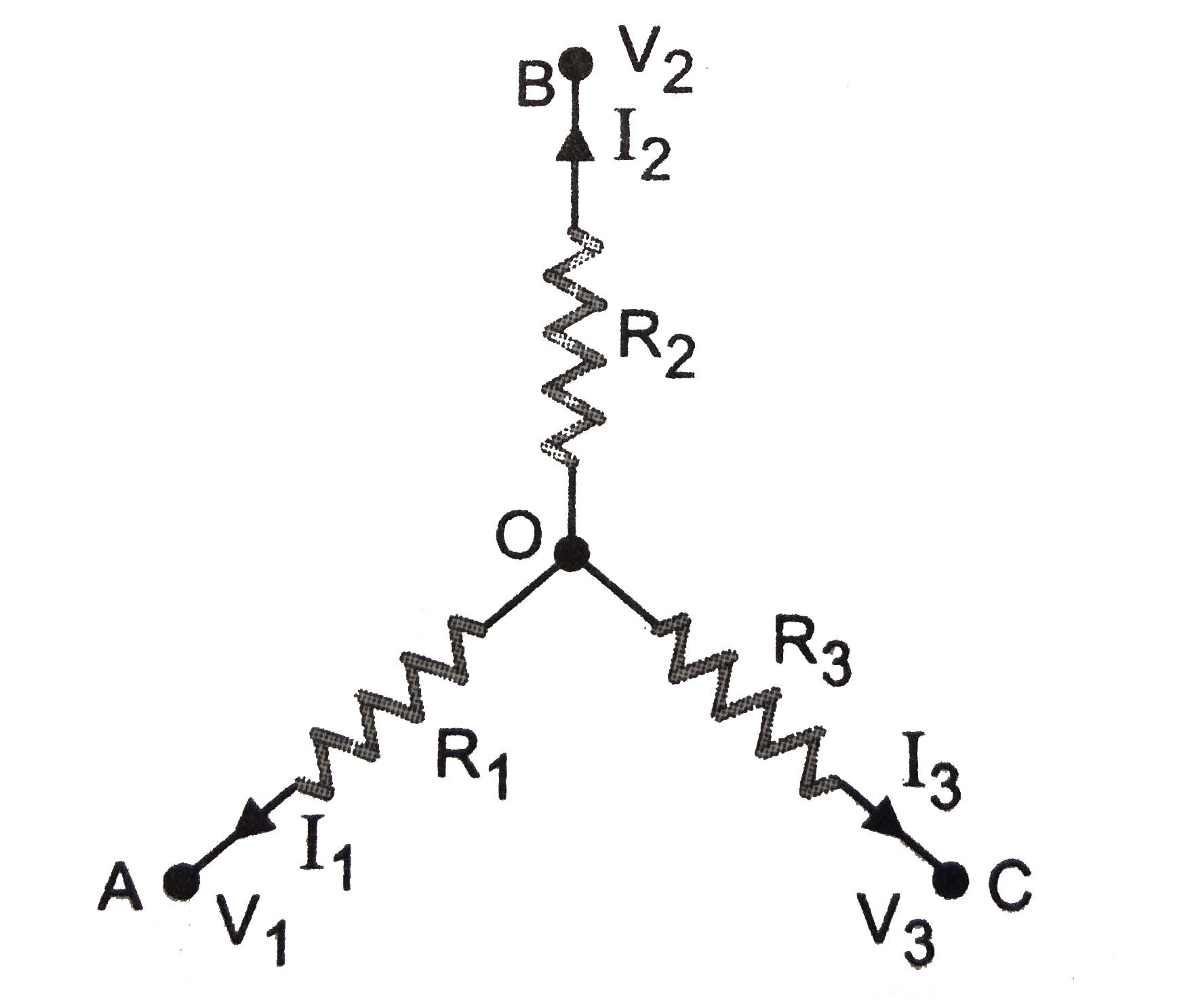
A circuit has a section `ABC` if the potential at point `A,B and C` are `V_(1) , V_(2) and V_(3)` respectively , calculate the potential at point `O`

A

`V_(1)+V_(2)+V_(3)`

B

`[(V_(1))/(R_(1))+(V_(2))/(R_(2))+(V_(3))/(R_(3))] [(1)/(R_(1))+(1)/R_(2)+(1)/(R_(3))]^(-1)`

C

zero

D

`[(V_(1)+V_(2)+V_(3))/(R_(1)+R_(2)+R_(3))](R_(1)+R_(2)+R_(3))`

Text Solution

Verified by Experts

The correct Answer is:
B

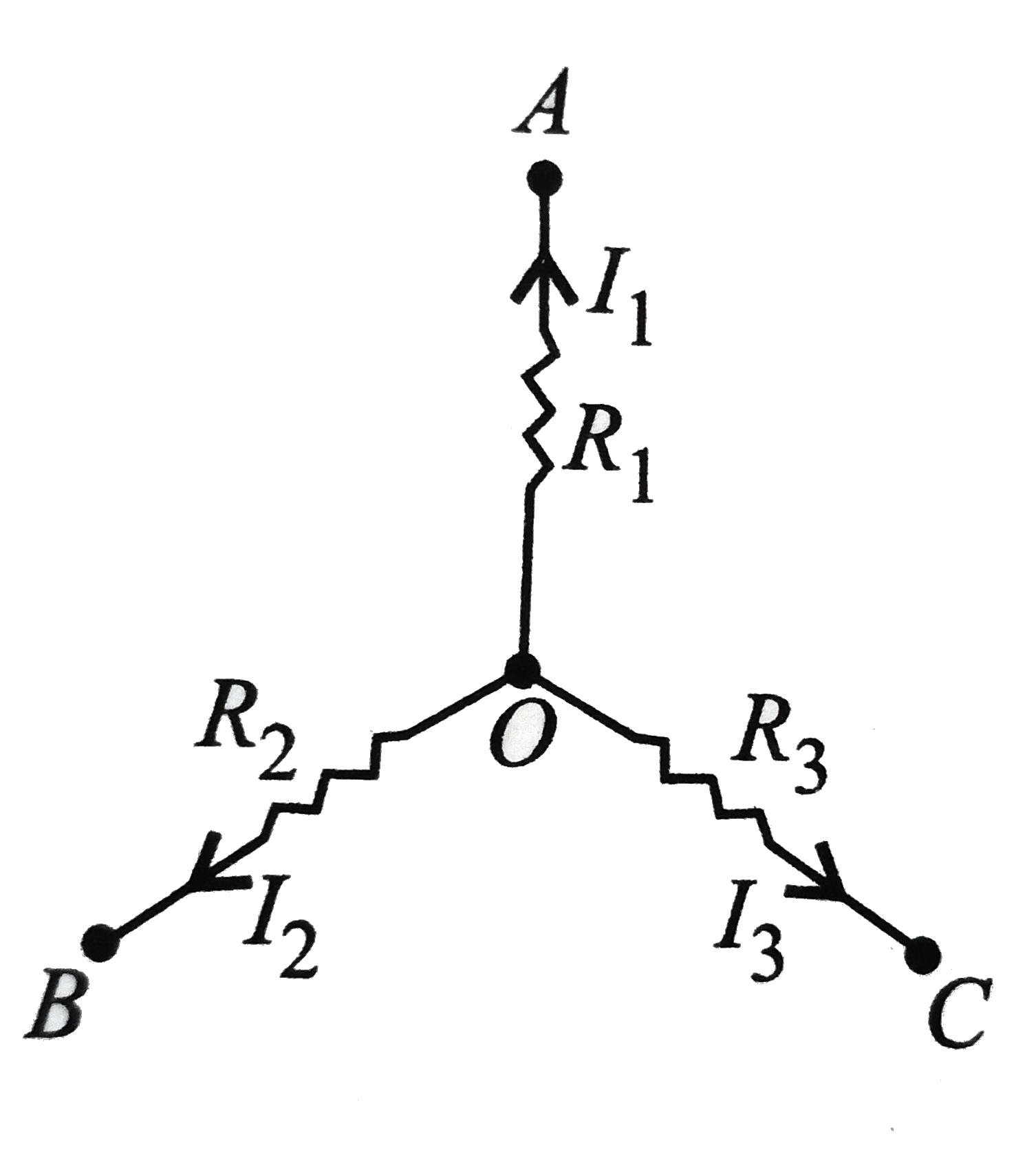
Applying juction rule `-I_(1)-I_(2)-I_(3)=0`
i.e., `I_(1)+I_(2)+I_(3)=0…(i)`
Let, `V_(0)` bet the potential at point O. By Ohm's law for resistance, `R_(1),R_(2) and R_(3)` respectively, we get
`(V_(0)-V_(1))=I_(1)R_(1),(V_(0)-V_(2))=I_(2)R_(2) and (V_(0)-V_(3))=I_(3)R_(3)`
`or I_(1)=((V_(0)-V_(1)))/(R_(1)), I_(2)=((V_(0)-V_(2)))/(R_(2)), I_(3)=((V_(3)-V_(3)))/(R_(3))`
So substituting these values of `I_(1),I(2) and I_(3)` in eq. (i) , we get
`V_(0)[(1)/(R_(1))+(1)/R_(2)+(1)/(R_(3))]-[(V_(1))/(R_(1))+(V_(2))/(R_(2))+(V_(3))/(R_(3))]=0`
`V_(0)=[(V_(1))/(R_(1))+(V_(2))/(R_(2))+(V_(3))/(R_(3))] [(1)/(R_(1))+(1)/R_(2)+(1)/(R_(3))]^(-1)`
Promotional Banner

Topper's Solved these Questions

  • CURRENT ELECTRICITY

    NCERT FINGERTIPS|Exercise Wheatstone Bridge|6 Videos
  • CURRENT ELECTRICITY

    NCERT FINGERTIPS|Exercise Meter Bridge|4 Videos
  • CURRENT ELECTRICITY

    NCERT FINGERTIPS|Exercise Cell In Series And In Parallel|3 Videos
  • COMMUNITCATION SYSTEMS

    NCERT FINGERTIPS|Exercise HOTS|10 Videos
  • DUAL NATURE OF RADIATION AND MATTER

    NCERT FINGERTIPS|Exercise Assertion And Reason|15 Videos

Similar Questions

Explore conceptually related problems

The arrangement shows a part of complete circuit. The potentials at point A and B are V_(1) and V_(2) respectively . Find the potential at point P. Strategy : The two capacitors C_(1) and C_(2) are connected in series . Therefore the charge on both of the capacitors is same . Let the potential at P is V .

Three resistance are joined together to form a letter Y, as shown in figure. If the potentials of the terminals A, B and C are 6V, 3V and 2V respectively, then the potential of the point O will be

Three capacitors C_(1),C_(2) and C_(3) are connected as shown in, The potentials of P,Q , and R are V_(1),V_(2), and V_(3) , respectively. Find the potential V_(0) at the function O . .

Three uncharged capacitors of capacities C_(1),C_(2) and C_(3) are connected as shown in the figure to one another and the potentials V_(1),V_(2) and V_(3) respectively. Then the potential at O will be .

A uniform electric field exists in a region of space. Potential at potential O,A,B and C are V_(0)=0 and V_(A)=-1V,V_(B)=-6V and V_(C)=-3V respectively. Alll the cubes shown in fig have side length of 1m. ltbr. (a). Find V_(P)-V_(Q) (b). Find the smallest distance of a point from O where the potential is -2V

In the given network, the potential at point O is (Given VO = V_(s) = 18 V)

In the circuit shown in figure. If point B is earthed and A is kept at 1500 V, then calculate the potential at the point P.

Shown a part of an electric circuit, The potentials at the points a,b,and c are 30V,12V,and 2V respectively.Find the currents through the three resistors.

Figure shown three points A, B and C in a region of unifrom electric field vecE . The line AB is perpendicular and BC is parallel to the field lines. Then which of the following holds good. Where V_(A), V_(B) and V_(C) represenet the electric potential at points A, B and C respectively

