Home
Class 12
PHYSICS
A 100 W bulb B(1) and two 60 W bulbs B(2...


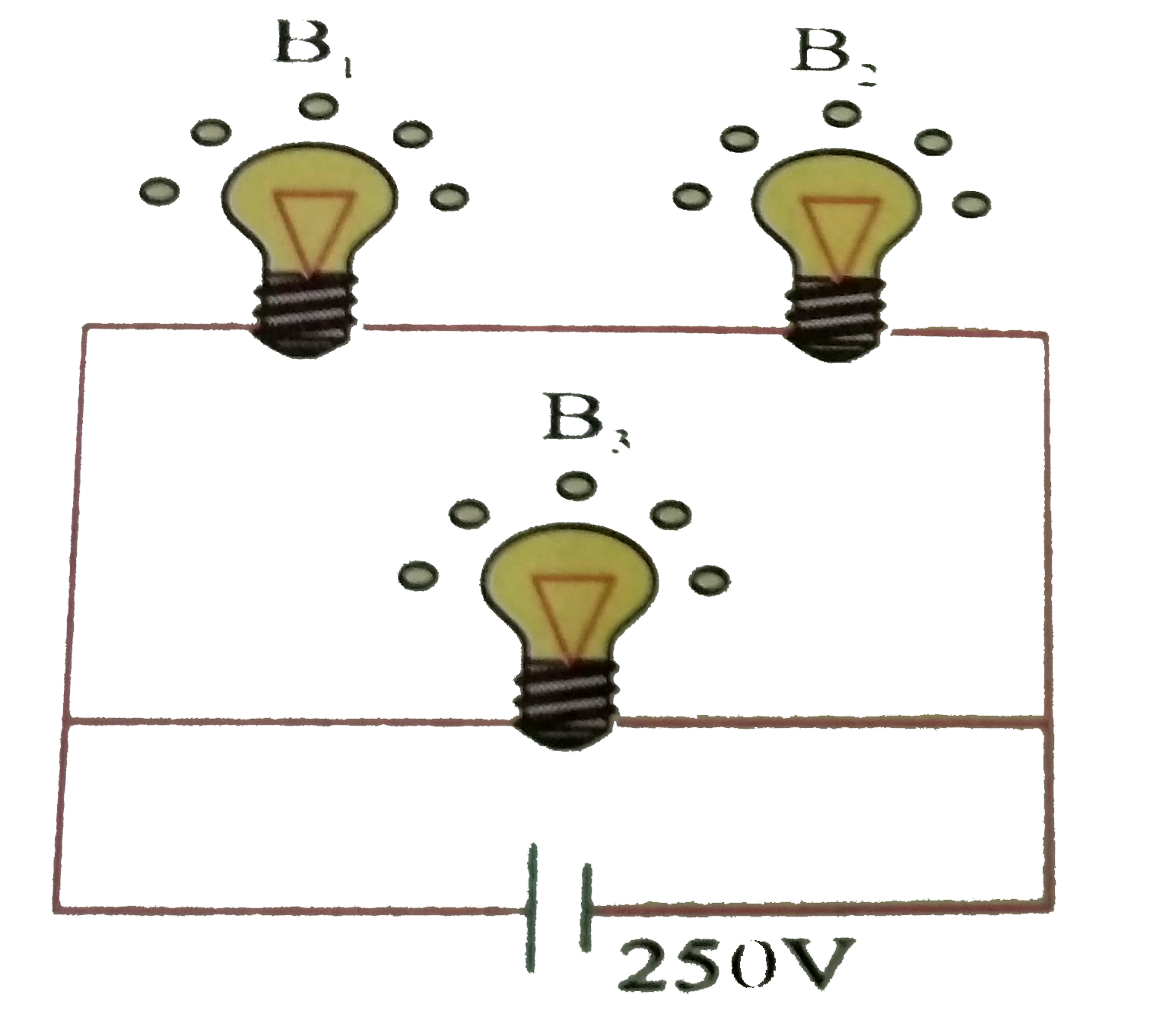
A 100 W bulb `B_(1)` and two 60 W bulbs `B_(2)` and `B_(3)`, are connected to a 250V source, as shown in the figure now `W_(1),W_(2)` and `W_(3)` are the output powers of the bulbs `B_(1),B_(2)` and `B_(3)` respectively then

A

`W_(1) gt W_(2)=W_(3)`

B

`W_(1) gt W_(2)gtW_(3)`

C

`W_(1) lt W_(2)=W_(3)`

D

`W_(1) lt W_(2)ltW_(3)`

Text Solution

Verified by Experts

The correct Answer is:

D

A bulb is essenetially a resistance `R=(V^(2))/(P)`
Where P denotes the power of the bulb.
`"Resistance of "B_(1)(R_(1))=V^(2)//100`
`"Resistance of "B_(2)(R_(2))=V^(2)//60`
`"Resistance of "B_(3)(R_(3))=V^(2)//60`
`therefore I_(1)="Current in"B_(1)=(250)/((R_(1)+R_(2)))=(250xx300)/(8V^(2))`
`I_(2)="Current in"B_(2)=I_(1)`
`I_(3)="Current in"B_(3)=(250)/(R_(3))=(250xx60)/(V^(2))`
`therefore W_(1)="output power of B"_(1)=I_(1)^(2)R_(1)`
`therefore W_(1)=I_(1)^(2)R_(1)=((250xx300)/(8V^(2)))^(2)xx(V^(2))/(100)`
`therefore W_(2)=I_(2)^(2)R_(2)=((250xx300)/(8V^(2)))^(2)xx(V^(2))/(60)`
`therefore W_(3)=I_(3)^(2)R_(3)=((250xx300)/(8V^(2)))^(2)xx(V^(2))/(60)`
`therefore W_(1) :W_(2):W_(3)=15:25:64 or W_(1)ltW_(2)ltW_(3)`
(b) As the betteries are connected in series, so
`I=(epsi_(1)+epsi_(2))/(r_(1)+r_(2)+R)`
When resistor R is connected to battery of emf `epsi_(1)`.
`I=(epsi_(1))/(r_(2)+R)`
When resistor R is connected to battery of emf `epsi_(2)`.
`I_(2)=(epsi_(2))/(r_(2)+R)`
Fore required condition to be filled
`I lt I_(1) and I lt I_(2)`
`therefore (epsi_(1)+epsi_(2))/(r_(1)+r_(2)+R)lt(epsi_(1))/(r_(1)+R)and (epsi_(1)+epsi_(2))/(r_(1)+r_(2)+R)lt(epsi_(2))/(r_(2)+R)`
`therefore (epsi_(2))/(epsi_(1))lt (r_(2))/(r_(1)+R)and(epsi_(2))/(epsi_(1))and (epsi_(2))/(epsi_(1))gt (r_(2)+R)/(r_(1))`
Thus, option (b) is correct.
Promotional Banner

Topper's Solved these Questions

  • CURRENT ELECTRICITY

    NCERT FINGERTIPS|Exercise NCERT Exemplar|6 Videos
  • CURRENT ELECTRICITY

    NCERT FINGERTIPS|Exercise Assertion And Reason|15 Videos
  • CURRENT ELECTRICITY

    NCERT FINGERTIPS|Exercise Potentiometer|7 Videos
  • COMMUNITCATION SYSTEMS

    NCERT FINGERTIPS|Exercise HOTS|10 Videos
  • DUAL NATURE OF RADIATION AND MATTER

    NCERT FINGERTIPS|Exercise Assertion And Reason|15 Videos

Similar Questions

Explore conceptually related problems

A 100 W bulb B_1 , and two 60 W bulbs B_2 and B_3 are connected to a 250 V source as shown in the figure. Now W_1,W_2 and W_3 are the output powers of the bulbs B_1, B_2 and B_3 respectively. Then

A 100 W bulb B_1 , and two 60 W bulb B_2 and B_3 , are connected to a 250 V source, as shown in figure. Now W_1, W_2 and W_3 are the output powers of the bulbs B_1, B_2 and B_3 , respectively. Then

Three bulbs B_(1), B_(2) and B_(3) are connected to the mains as shown in Fig. 7.28 . How will the brightness of bulb B_(1) be affected B_(2) or B_(3) are disconnected from the circuit?

Three bulbs of 40 W , 60 W and 100 W are connected in series with a 240 V source.

Three identical bulbs B_(1),B_(2) and B_(3) are connected to the mains as shown in figure. If B_(3) is disconnected for the from the circuit by opening switch S, then incandescence of bulb B_(1) will . ,

When two electric bulbs of 40W and 60W are connected in parallel, then the:

Bulb B_1(100W - 250W) and bulb B_2(100W - 200V) are connected across 250V. What is potential drop across B_2 ?

Two electric bulbs , rated at (25W,220V) and (100W,220V), are connected in series across a 220 V voltage source , if the 25W and 100W bulbs draw powers P_(1) and P_(2) Respectively , then :
