Home
Class 12
PHYSICS
A small transparent slab containing mate...


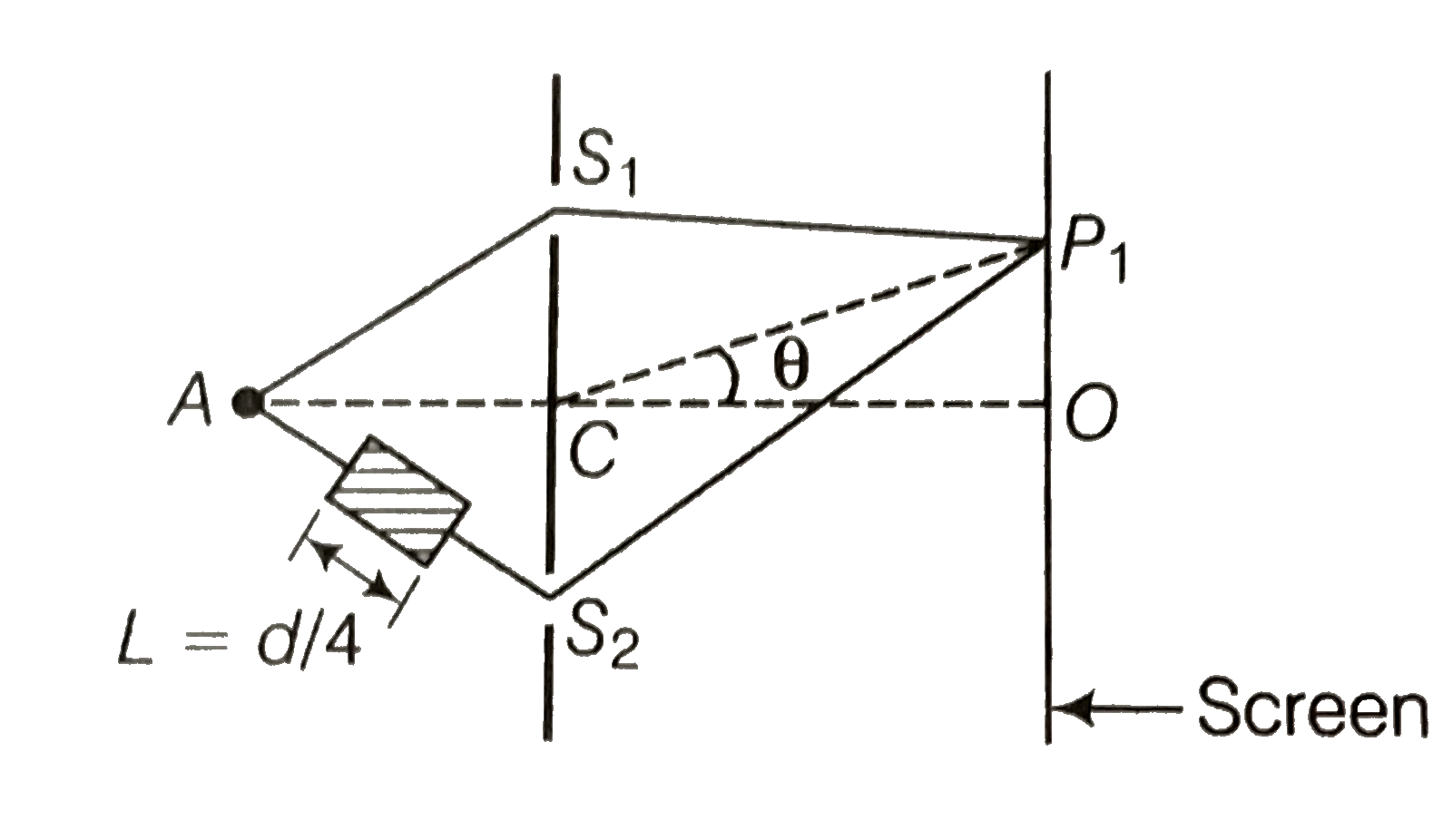
A small transparent slab containing material of `mu=1.5` is placed along `AS_(2)`(figure). What will be the distance from O of the principle maxima and of the first minima on either side of the principal maxima obtained in the absence of the glass slab ?

A

0.19 D and -0.33 D

B

0.19 D and -0.55 D

C

0.33 D and -0.65 D

D

0.33 D and -0.75 D

Text Solution

Verified by Experts

The correct Answer is:

A
Promotional Banner

Topper's Solved these Questions

  • WAVE OPTICS

    NCERT FINGERTIPS|Exercise Diffraction|22 Videos
  • WAVE OPTICS

    NCERT FINGERTIPS|Exercise Polarisation|18 Videos
  • WAVE OPTICS

    NCERT FINGERTIPS|Exercise Coherent And Incoherent Addition Of Waves|7 Videos
  • SEMICONDUCTOR ELECTRONICS : MATERIALS , DEVICES AND SIMPLE CIRCUITS

    NCERT FINGERTIPS|Exercise Assertion And Reason|15 Videos

Similar Questions

Explore conceptually related problems

A small transparent slab (mu = 1.5) is placed along AS_(2) as shown. AC=CO=D,S_(1)C=S_(2)S=d lt ltD The distance of princpal maxima front 'O' is

A small transparent slab (mu = 1.5) is placed along AS_(2) as shown. AC=CO=D,S_(1)C=S_(2)S=d lt ltD The distance of first minima below the point O is

A small transparent slab (mu = 1.5) is placed along AS_(2) as shown. AC=CO=D,S_(1)C=S_(2)S=d lt ltD The distance of first minima above O is

Light of wavelength 6 xx10^(-5) cm falls on screen at a distance of 100 cm from a narrow slit. Find the width of the slit if the first minima lies 1mm on either side of the central maximum

A point object O is placed at a distance of 41 cm from a convex lens of focal length f = 20 cm on its principal axis. A glass slab of thickness 3 cm and refractive index mu = 1.5 is placed between the lens and the object with its faces perpendicular to the principal axis of the lens. Image of the object is formed at point I_(1) . Now the glass slab is tilted by an angle of theta = 1° (as shown in the Figure) and the final image is formed at I_(2) . Calculate the distance between points I_(1) and I_(2) . Consider only paraxial rays for the lens and near normal incidence for the glass slab.

Light of wavelength lambda = 500 nm falls on two narrow slits placed a distance d = 50 xx 10^-4 cm apart, at an angle phi= 30^@ relative to the slits as shown in figure. On the lower slit a transparent slab of thickness 0.1 mm and refractive index 3/2 is placed. The interference pattern is observed at a distance D=2m from the slits. Then, calculate (a) position of the central maxima. (b) the order of maxima at point C of screen . (c)how many fringes will pass C, if we remove the transparent slab from the lower slit?

In YDSE arrangement as shown in figure, fringes are seen on screen using monochromatic source S having wavelength 3000 Å (in air). S_1 and S_2 are two slits seperated by d = 1 mm and D = 1m. Left of slits S_1 and S_2 medium of refractive index n_1 = 2 is present and to the right of S_1 and S_2 medium of n_2 = 3/2 , is present. A thin slab of thickness 't' is placed in front of S_1 . The refractive index of n_3 of the slab varies with distance from it's starting face as shown in figure. In order to get central maxima at the centre of screen, the thickness of slab required is :

NCERT FINGERTIPS-WAVE OPTICS-Interference Of Light Waves And Young'S Experiment
  1. In Young's double slit experiment , light waves of lambda = 5.4 xx 10^...

    Text Solution

    |

  2. The fringe width in YDSE is 2.4 xx 10^(-4)m, when red light of wavelen...

    Text Solution

    |

  3. In a double slit experiment, the distance between slits in increased t...

    Text Solution

    |

  4. Yellow light of wavelength 6000 Å produces fringes of width 0.8 mm in ...

    Text Solution

    |

  5. A small transparent slab containing material of mu=1.5 is placed along...

    Text Solution

    |

  6. Interference fringes were produced in Young's double slit experiment u...

    Text Solution

    |

  7. in a two-slit experiment with monochromatic light, fringes are obtaine...

    Text Solution

    |

  8. In a Young's double slit experiment an electron beam is used to obtain...

    Text Solution

    |

  9. In a double slit interference pattern, the first maxima for infrared l...

    Text Solution

    |

  10. In double slit experiment using light of wavelength 600 nm, the angula...

    Text Solution

    |

  11. In Young's double slit experiment, the distance between two sources is...

    Text Solution

    |

  12. In a double slit experiment the angular width of a fringe is found to ...

    Text Solution

    |

  13. In a Young's double slit experiment, the angular width of a fringe for...

    Text Solution

    |

  14. In a Young's double slit experiment, let S(1) and S(2) be the two slit...

    Text Solution

    |

  15. In a Young's double slit experiment, (slit distance d) monochromatic l...

    Text Solution

    |

  16. In Young's double slit experiment, the fringe width with light of wave...

    Text Solution

    |

  17. The colours seen in the reflected white light from a thin oil film are...

    Text Solution

    |

  18. What is the minimum thickness of a soap bubble needed for constructive...

    Text Solution

    |

  19. A parallel beam of sodium light of wavelength 6000 Å is incident on a ...

    Text Solution

    |

  20. On introducing a thin film in the path of one of the two interfering b...

    Text Solution

    |
