Home
Class 12
PHYSICS
Four identical monochromatic sources A,B...

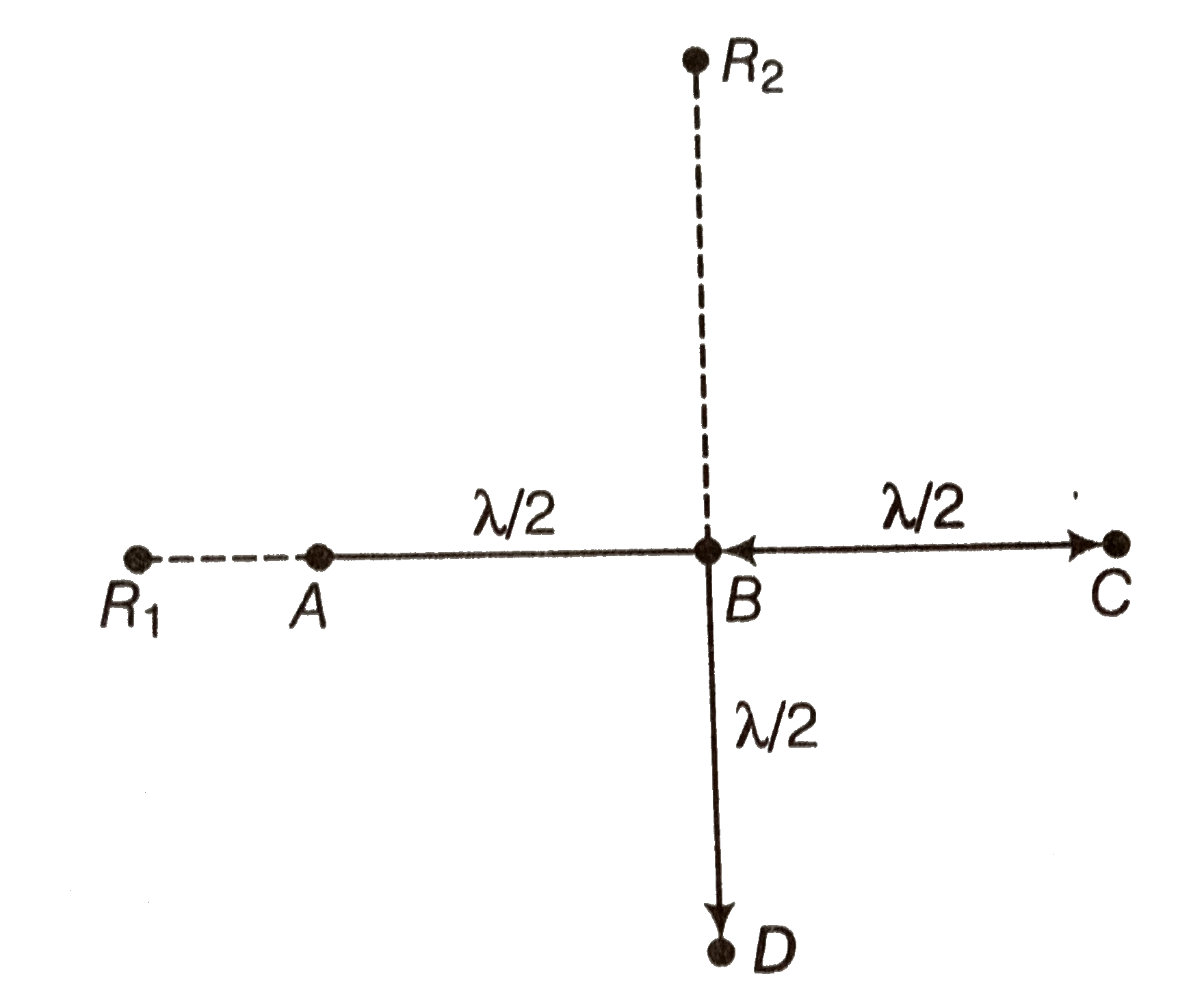
Four identical monochromatic sources A,B,C,D as shown in the (figure) produce waves of the same wavelength `lambda` and are coherent. Two receiver `R_(1)` and `R_(2)` are at great but equal distances from B.
(i) Which of the two receivers picks up the larger signal when B is turned off?
(iii) Which of the two receivers picks up the larger singnal when D is turned off ?
(iv) Which of the two receivers can distinguish which of the sources B or D has been turned off ?

A

`R_(1)`

B

`R_(2)`

C

`R_(1)` and `R_(2)`

D

None of these.

Text Solution

Verified by Experts

The correct Answer is:
B

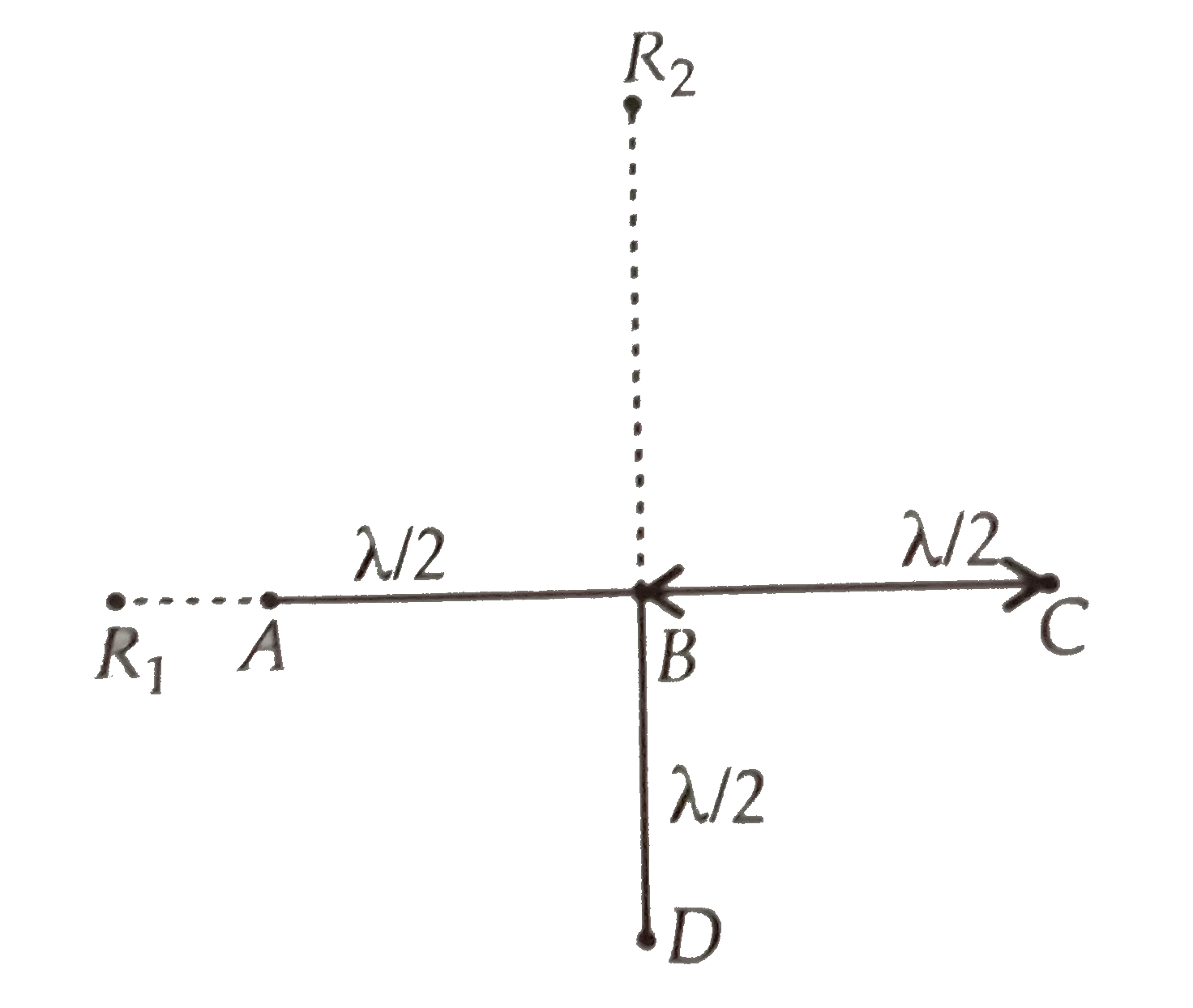
Consider the disturbances at `R_(1)` which is at distance d from A. Let the wave at `R_(1)` because of A be `y_(A)=a" cos" wt`. The path difference of the signal from A with that from B is `lambda//2` and hence the phase difference is `pi`.
Thus, the wave at `R_(1)` because of B is
`y_(B)=a" cos"(wt-pi)= -a" cos"wt.`
The path difference fo the signal from C with that from A is `lambda` adn hence, the phase difference is `2 pi`.
Thus, the wave at `R_(1)` because of C is `y_(c)=a" cos"wt.`
The path difference between the signals from D with that of A is
`P=R_(1)D-R_(1)A=sqrt((R_(1)B)^(2)+(BD)^(2))-(R_(1)B-AB)`

`=sqrt(d^(2)+((lambda)/(2))^(2))-(d-lambda//2)=d(1+(lambda^(2))/(4d^(2)))^(1//2)-d+(lambda)/(2)`
`=d(1+(lambda^(2))/(8d^(2)))-d+(lambda)/(2)=(lambda^(2))/(8d)+(lambda)/(2)`
If `d gt gt lambda,` the path difference `~(lambda)/(2)` and hence the phase difference is `pi`.
` :. y_(D)= -a" cos"wt.`
Thus, the signal picked up at `R_(1)` is
` "y"="y"_(A)+"y"_(B)+"y"_(C)+"y"_(D)=0`
Let the signal picked up at `R_(2)` from B be ` "y"_(B)^(')=a_(1)" cos"wt.`
The path difference between signal at D and that at B is `lambda//2.`
` :. "y"_(D)^(')= -a_(1)" cos"wt`
The path difference between signal at A and B is
`sqrt((d)^(2)+((lambda)/(2))^(2))-d=d(1+(lambda^(2))/(4d^(2)))^(1//2)-d=(lambda^(2))/(8d)`
` :. ` The phase difference is
`(2pi)/(lambda)*(lambda^(2))/(8d)=(pi lambda)/(4d)=phi~0.`
Hence, ` "y"_(A)^(')=a_(1)" cos"(wt-phi)`
Similarly, ` "y"_(C)^(')=a_(1)" cos"(wt-phi)`
` :.` Signal picked up by `R_(2)` is
` "y"_(A)^(')+"y"_(B)^(')+"y"_(C)^(')+"y"_(D)^(')="y"^(')=2a" cos"(wt-phi)`
` " " [ :' "y"_(B)^(')+"y"_(D)^(')=0]`
` |"y"|^(2)=4a_(1)^(2)" cos"^(2)(wt-phi)`
` :. lt I gt =2a_(1)^(2)`
Thus `R_(2)` picks up the large signal.
Promotional Banner

Topper's Solved these Questions

  • WAVE OPTICS

    NCERT FINGERTIPS|Exercise NCERT Exemplar|5 Videos
  • WAVE OPTICS

    NCERT FINGERTIPS|Exercise Assertion And Reason|15 Videos
  • WAVE OPTICS

    NCERT FINGERTIPS|Exercise Polarisation|18 Videos
  • SEMICONDUCTOR ELECTRONICS : MATERIALS , DEVICES AND SIMPLE CIRCUITS

    NCERT FINGERTIPS|Exercise Assertion And Reason|15 Videos

Similar Questions

Explore conceptually related problems

Four identical monochromatic source A, B, C, D as shown in figure produce waves of the same wavelength lambda and are coherent. Two receivers R_(1) and R_(2) are at great but equal distance from B. The choose the correct statements.

Which contents are lost when the computer turn off?

Two sources are called coherent if they produce waves

Two sources are called coherent if they produce waves

Two coherent point sources S_1 and S_2 are separated by a small distance d as shown. The fringes obtained on the screen will be

Four identical coherent sourc e emiting monochromatic light if same wavelength lambda are placed at A,B,C and D as shown. Two receivers R_(1) and R_(2) are at but equal distance from B. The path difference between signals reaching from A&D at R_(1) is (lambda)/(2) and between signals reaching from A & B at R_(2) is ~= 0 . Also assume that intensities of waves emitted by A,B,C &D reaching at R_(1) and R_(2) is same.

