Home
Class 12
PHYSICS
A silver of radius 1 cm and work functio...

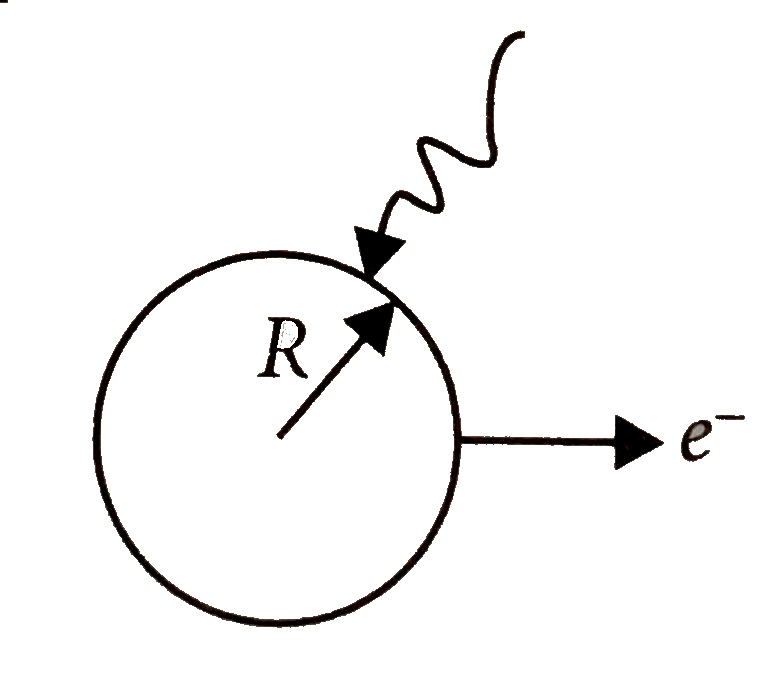
A silver of radius `1 cm` and work function `4.7 eV` is suspended from an insulating thread in free space. It is under continuous illumination of `200 nm` wavelength light. As photoelectron are emitted the sphere gas charged and acquired a potential . The maximum number of photoelectron emitted from the sphere is `A xx 10^(z) (where 1lt A lt 10)` The value of `z` is

A

6

B

7

C

8

D

9

Text Solution

Verified by Experts

The correct Answer is:
B

(b) : Here, radish of sphere `R=cm=1xx10^(-2)m`
Work function, W=4.7 eV
Energy of incident radiation `=(hc)/(lamda)=(1240eVnm)/(200nm)=6.2eV`
According to Einstein's photoelectric equation
`(hc)/(lamda)=phi+eV_(s)`
`6.2eV=4.7eV+eV_(s)`
`V_(s)=1.5V`
The sphere willl stop emitting photoelectrons, when the potential on surface becomes equal to 1.5 V.
`:.(1)/(4piepsilon_(0))(Q)/(R)=1.5rArr(1)/(4piepsilon_(0))(Ne)/(R)=1.5` where N=Number of photoelectrons emitted
e=charge of each electron
`N=(1.5xxR)/((1)/(4piepsilon_(0))xxe)=(1.5xx1xx10^(-2))/(9xx10^(9)xx1.6xx10^(19))`
`N=(15)/(16)xx(1)/(9)xx10^(8)=(5)/(48)xx10^(8)`
`N=(50)/(48)xx10^(7)=1.04xx10^(7)" ":.Z=7`
Promotional Banner

Topper's Solved these Questions

  • DUAL NATURE OF RADIATION AND MATTER

    NCERT FINGERTIPS|Exercise NCERT Exemplar|8 Videos
  • DUAL NATURE OF RADIATION AND MATTER

    NCERT FINGERTIPS|Exercise Assertion And Reason|15 Videos
  • DUAL NATURE OF RADIATION AND MATTER

    NCERT FINGERTIPS|Exercise Davisson And Germer Experiment|3 Videos
  • CURRENT ELECTRICITY

    NCERT FINGERTIPS|Exercise Assertion And Reason|15 Videos
  • ELECTRIC CHARGES AND FIELDS

    NCERT FINGERTIPS|Exercise Assertion And Reason|15 Videos

Similar Questions

Explore conceptually related problems

A silver of radius 1 cm and work function 4.7 eV is suspended from an insulating thread in freepace it is under continuous illumination of 200 nm wavelength light AS photoelectron are emitted the sphere gas charged and acquired a potential . The maximum number of photoelectron emitted from the sphere is A xx 10^(e) (where 1lt A lt 10) The value of z is

A light of wavelengt 1240Å falls on a metallic sphere of radius 1 m and work function W_(0) = 3eV . The maximum number of electron left from the sphere till photoelectric effest stops will be- (approximately)

Radiation of wavelength 310 nm is incidenton a metal surface of work function 1eV . Find maximum speed of photoelectrons emitted . ( Closed value )

A photon of energy 2.16eV is incident on the surface of a metal of photoelectric work function 1.25eV. If the maximum velocity of a photoelectron emitted is 0.566 xx 10^(6) ms^(-1) , calculate the mass of the electron.

Photons of energy 4eV are incident on a metal sphere of work function 2eV .If the radius of the sphere is 5mm ,the number of electrons emitted before photo-electric emission stops is N times10^(6) .Then N =

The work function of nickle is 5eV . When light of wavelength 2000A^(0) falls on it, emits photoelectrons in the circuit. The the potential difference necessary to stop the fastest electrons emitted is (given h=6.67xx10^(-34) Js )

Silver has a work function of 4.7 eV. When ultraviolet light of wavelength 100 mm is incident upon it, a potential of 7.7 V is required to stop the photoelectrons from reaching the collector plate. How much potential will be required to stop the photoelectrons when light of wavelength 200mm is incident upon silver?

A metal having work function 4.41xx10^(-19) J is sunjected to a light having wavelength 300nm, then maximum kinetic energy of the emitted photoelectron is ...........xx10^(-21)J

