Home
Class 12
PHYSICS
A parallel beam of monochromatic radiati...

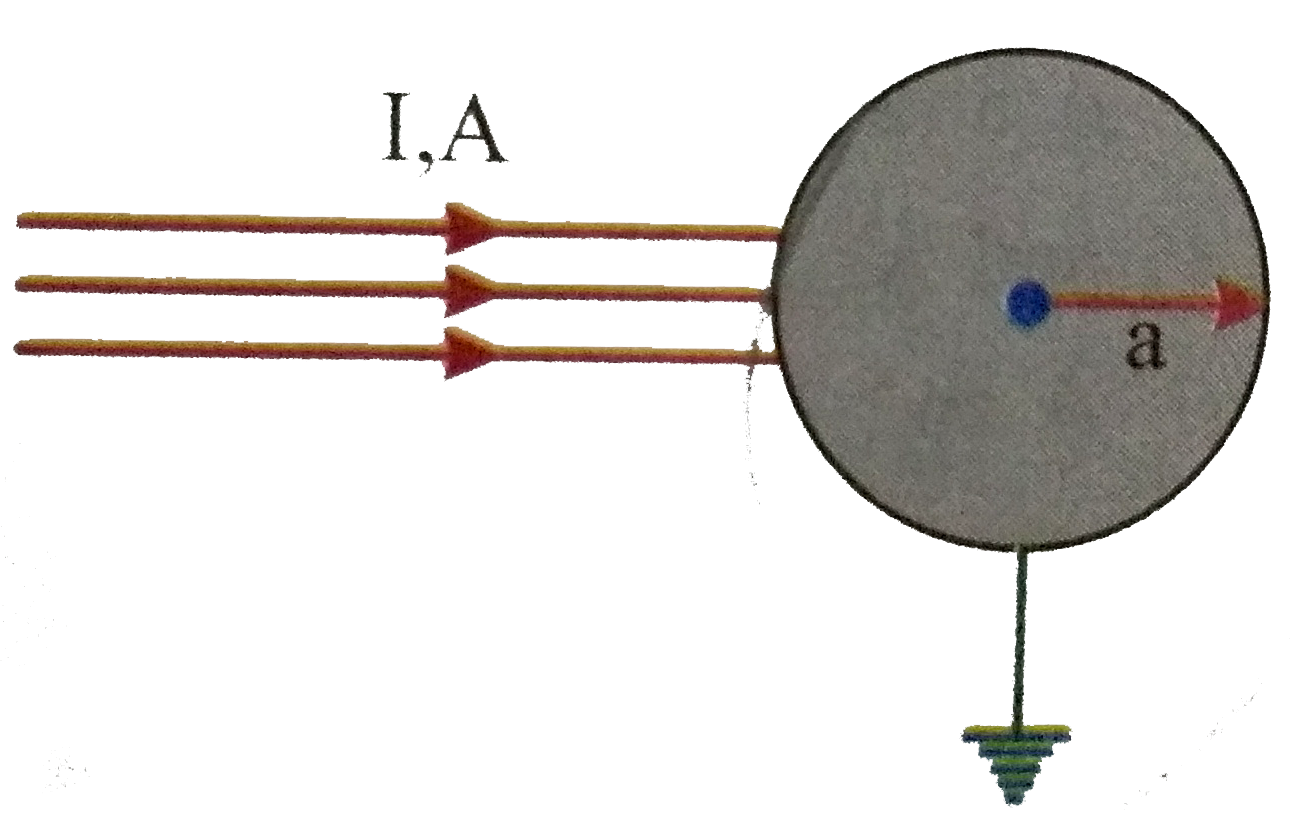
A parallel beam of monochromatic radiation of cross-section area `A(lt pi a^(2))`, intensity `I` and frequency `v` is incident on a solid conducting sphere of work function`phi_(0)[hv gt phi_(0)]` and radius `'a'`. The sphere is grounded by a conducting wire. Assume that for each incident photon one photoelectron is ejected. Just after this radiation is incident on initially unchanged sphere, the current through the conducting wire is:

A

`(IAe)/(hv)`

B

`(IAe)/(2hv)`

C

`(2IAe)/(hv)`

D

`(2)/(3)(IAe)/(hv)`

Text Solution

Verified by Experts

The correct Answer is:

A

(a) : Energy of each incident photon = hv.
Total energy incident per second on sphere = IA
`:."No. of photons incident on sphere per second"=(IA)/(hv)`
`:."No. of photoelectrons ejected per second"=(IA)/(hv)`
Current through the conducting wire = charge flowing per second through wire = `(IAe)/(hv)`
Promotional Banner

Topper's Solved these Questions

  • DUAL NATURE OF RADIATION AND MATTER

    NCERT FINGERTIPS|Exercise NCERT Exemplar|8 Videos
  • DUAL NATURE OF RADIATION AND MATTER

    NCERT FINGERTIPS|Exercise Assertion And Reason|15 Videos
  • DUAL NATURE OF RADIATION AND MATTER

    NCERT FINGERTIPS|Exercise Davisson And Germer Experiment|3 Videos
  • CURRENT ELECTRICITY

    NCERT FINGERTIPS|Exercise Assertion And Reason|15 Videos
  • ELECTRIC CHARGES AND FIELDS

    NCERT FINGERTIPS|Exercise Assertion And Reason|15 Videos

Similar Questions

Explore conceptually related problems

Two initially uncharged concentric than conducting spherical shells of radius a and 2a are as shown and the inner shell is grounded. The work function of outer shell is phi_(0) .At time t=0 , a continuous parallel beam of monochromatic radiation of cross-section area A and intensity I is incident on outer shell.The enerfy of each photon is hv such that hv gt phi_(0) Assuming for each incident photon one photoelectron is ejected, answer the following questions. The time after t=0 , at which charge on outer sphere becomes constant.

Two initially uncharged concentric than conducting spherical shells of radius a and 2a are as shown and the inner shell is grounded. The work function of outer shell is phi_(0) .At time t=0 , a continuous parallel beam of monochromatic radiation of cross-section area A and intensity I is incident on outer shell.The enerfy of each photon is hv such that hv gt phi_(0) Assuming for each incident photon one photoelectron is ejected, answer the following questions. The maximum potential difference between inner and outer shell is:

in an experimental set up to study the photoelectric effect a point soure fo light of power 3.2xx10^(-3) W was taken. The source can emit monoenergetic photons of energy 5eV and is located at a distance of 0.8 m from the centre of a stationary metallic sphere of work-function 3.0 eV. The radius of the sphere is r = 8..10^(-3) m. The efficiency of photoelectric emission is one for every 10^6 incident photons. Based on the information given above answer the questions given below. (Assume that the sphere is isolated and photoelectrons are instantly swepts away after the emission). de-Broglie wavelength of the fastest moving photoelectron is

in an experimental set up to study the photoelectric effect a point soure fo light of power 3.2xx10^(-3) W was taken. The source can emit monoenergetic photons of energy 5eV and is located at a distance of 0.8 m from the centre of a stationary metallic sphere of work-function 3.0 eV. The radius of the sphere is r = 8..10^(-3) m. The efficiency of photoelectric emission is one for every 10^6 incident photons. Based on the information given above answer the questions given below. (Assume that the sphere is isolated and photoelectrons are instantly swepts away after the emission). Time after which photoelectric emission stops is

in an experimental set up to study the photoelectric effect a point soure fo light of power 3.2xx10^(-3) W was taken. The source can emit monoenergetic photons of energy 5eV and is located at a distance of 0.8 m from the centre of a stationary metallic sphere of work-function 3.0 eV. The radius of the sphere is r = 8..10^(-3) m. The efficiency of photoelectric emission is one for every 10^6 incident photons. Based on the information given above answer the questions given below. (Assume that the sphere is isolated and photoelectrons are instantly swepts away after the emission). It was observed that after some time emission of photoelectrons from the sphere stopped. Charge on the sphere when the photon emission stops is

A parallel beam of ligth of intensity I and cross section area S is incident on a plate at normal incidence. The photoelectric emission efficiency is 100% , the frequency of beam is v and the work function of the plate is phi(hv gt phi) . Assuming all the electrons are ejected normal to the plane and with same maximum possible speed. The net force exerted on the plate only due to striking of photons and subsequent emission of electrons is

When a high frequency electromagnetic radiation is incident on a metallic surface, electrons are emitted from the surface. Energy of emitted photoelectrons depends only on the frequency of incident electromagnetic radiation and the number of emitted electrons depends only on the intensity of incident light. Einstein's protoelectron equation [K_(max)=hv-phi] correctly ecplains the PE, where upsilon= frequency of incident light and phi= work function. Q. For photoelectric effect in a metal, the graph of the stopping potential V_0 (in volt) versus frequency upsilon (in hertz) of the incident radiation is shown in Fig. The work function of the metal (in eV) is.

A monochromatic light of frequency f is incident on two identical metal spheres of threshold frequency f/2 and f/3 respectively. After some time, emission of photoelectron will stop on both spheres . Now both metal spheres are connected through wire. (radius of spherhes is R ) (a)What will be potential of spheres now ? (b)how many electron will flow through wire ?
