Home
Class 11
ECONOMICS
A consumer at present consumes a commodi...

A consumer at present consumes a commodity which he finds inferior as his present income does not allow him to move to his demand for normal good. If he shifts to a higher income group what changes will take place? Explain using suitable diagram.

Text Solution

Verified by Experts
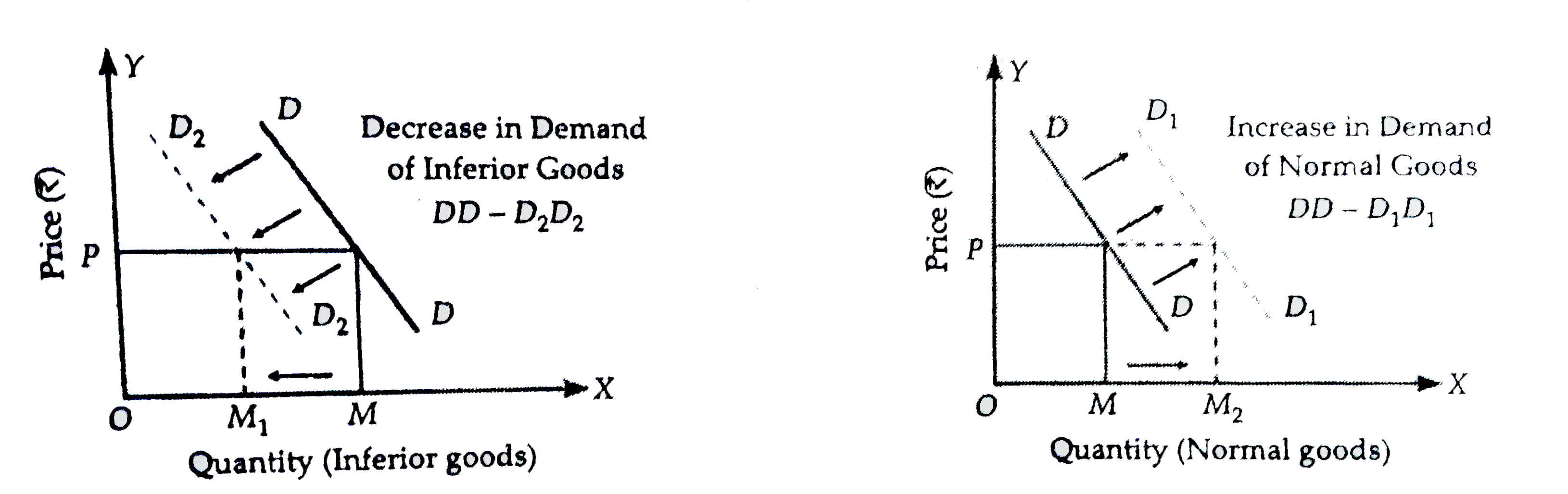
With increase in his income, there will be two effects.
(a) His demand for inferior good will fall and the demand curve would shift to left. DD-`D_(2)D_(2)`

(b) His demand for normal good would rise and the demand curve will shift to the right.
Promotional Banner

Topper's Solved these Questions

  • THEORY OF DEMAND

    RADHA BHUGANA|Exercise VALUE BASED QUESTIONS|5 Videos
  • THEORY OF DEMAND

    RADHA BHUGANA|Exercise GUIDELINES TO NCERT QUESTIONS|3 Videos
  • THEORY OF DEMAND

    RADHA BHUGANA|Exercise CONCEPTUAL QUESTIONS|6 Videos
  • SIMPLE APPLICATIONS OF TOOLS OF DEMAND AND SUPPLY

    RADHA BHUGANA|Exercise Long answer|3 Videos
  • THEORY OF SUPPLY : LAW OF SUPPLY AND ELASTICITY OF SUPPLY

    RADHA BHUGANA|Exercise LET US RECAPITULATE|9 Videos

Similar Questions

Explore conceptually related problems

Explain the chain effects on demand, supply and price of a commodity caused by a leftward shift of a demand curve. Use diagram. OR A product market is in equilibrium. Suppose the demand for the product decreases. What changes will take place in the market? Use diagram.

Government brings down income tax rates. What is likely to be the impact of this move on the market of a product which most of the consumers treat as a normal product, Explain. Use diagram.

How is the equilibrium price and equilibrium quantity of a normal commodity affected by an increase in the income of its buyers? Explain with the help of a diagram. OR x is a normal good for its consumers. Their income increases. Explain its chain of effects on equlltbrium price, demand and supply of X. (use diagram)

Explain with the help of diagrams the effect of the following changes on the demand of commodity : (i) Fall in price of related good. (ii) Rise in income of the consumer.

Directions In the following questions, read the passage carefully and choose the best answer to each question out of the four alternatives. PASSAGE STEM It is strange that, according to his position in He, an extravagant man is admired or despised. A suc cessful businessman does nothing to increase his popularity by being careful with his money. He is ex pected to display his success, to have a smart car, an expensive life, and to be lavish with his hospital ity. If he is not so, he is considered to mean and his reputation in business may even suffer in conse quence. The paradox remains that if he had not been careful with his money in the first place, he would never have achieved his present wealth. Among the two income groups, a different set of values ex ists. The young clerk who makes his wife a present of a new dress when he hadn't paid his house rent, is condemned as extravagant. Care fulness with money to the point of meanness is applauded as a virtue. Nothing in his life is considered more worthy than paying his bills. The ideal wife for such a man separates her housekeeping money into joyless little piles, and she is able to face the milkman with equanimity and never knows the guilt of buying something she can't really afford. How does the housewife, according to the writer, feel when she saves money?

Directions In the following questions, read the passage carefully and choose the best answer to each question out of the four alternatives. PASSAGE It is strange that, according to his position in He, an extravagant man is admired or despised. A successful businessman does nothing to increase his popularity by being careful with his money. He is expected to display his success, to have a smart car, an expensive life, and to be lavish with his hospitality. If he is not so, he is considered to mean and his reputation in business may even suffer in consequence. The paradox remains that if he had not been careful with his money in the first place, he would never have achieved his present wealth. Among the two income groups, a different set of values exists. The young clerk who makes his wife a present of a new dress when he hadn't paid his house rent, is condemned as extravagant. Care fulness with money to the point of meanness is applauded as a virtue. Nothing in his life is considered more worthy than paying his bills. The ideal wife for such a man separates her housekeeping money into joyless little piles, and she is able to face the milkman with equanimity and never knows the guilt of buying something she can't really afford. The phrase 'lavish with his hospitality' here means :

