Home
Class 9
MATHS
In parallelogram ABCD two points P and Q...

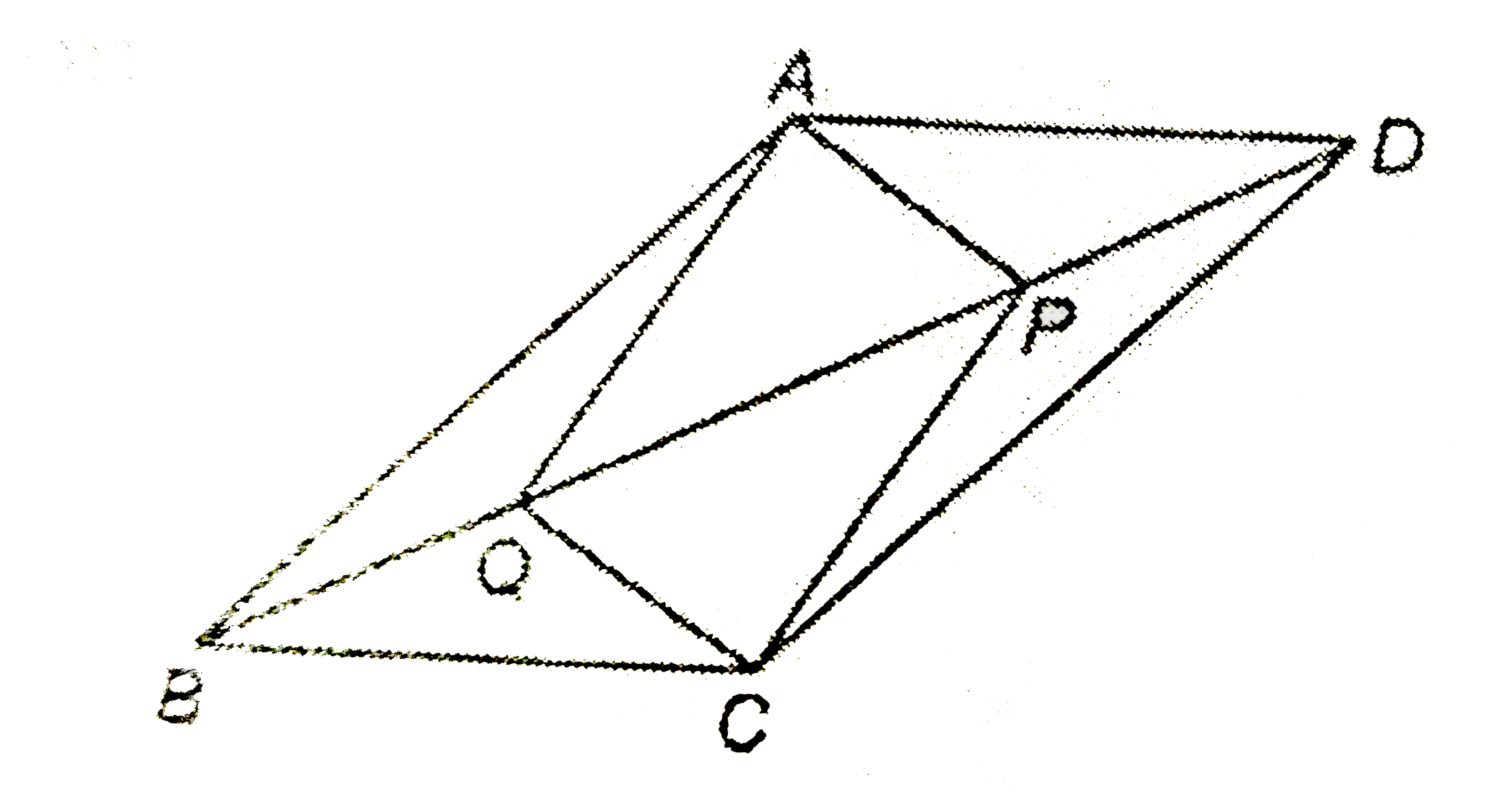
In parallelogram ABCD two points P and Q are taken on diagonal BD such that DP = BQ (set figure). Show that:
`{:((i)DeltaAPD~=CQB,(ii)AP=CQ),((iii)DeltaAQB~=DeltaCPD,(iv)AQ=CP),((v)APCQ "is a parallelogram.",):}` ltbegt

Text Solution

Verified by Experts
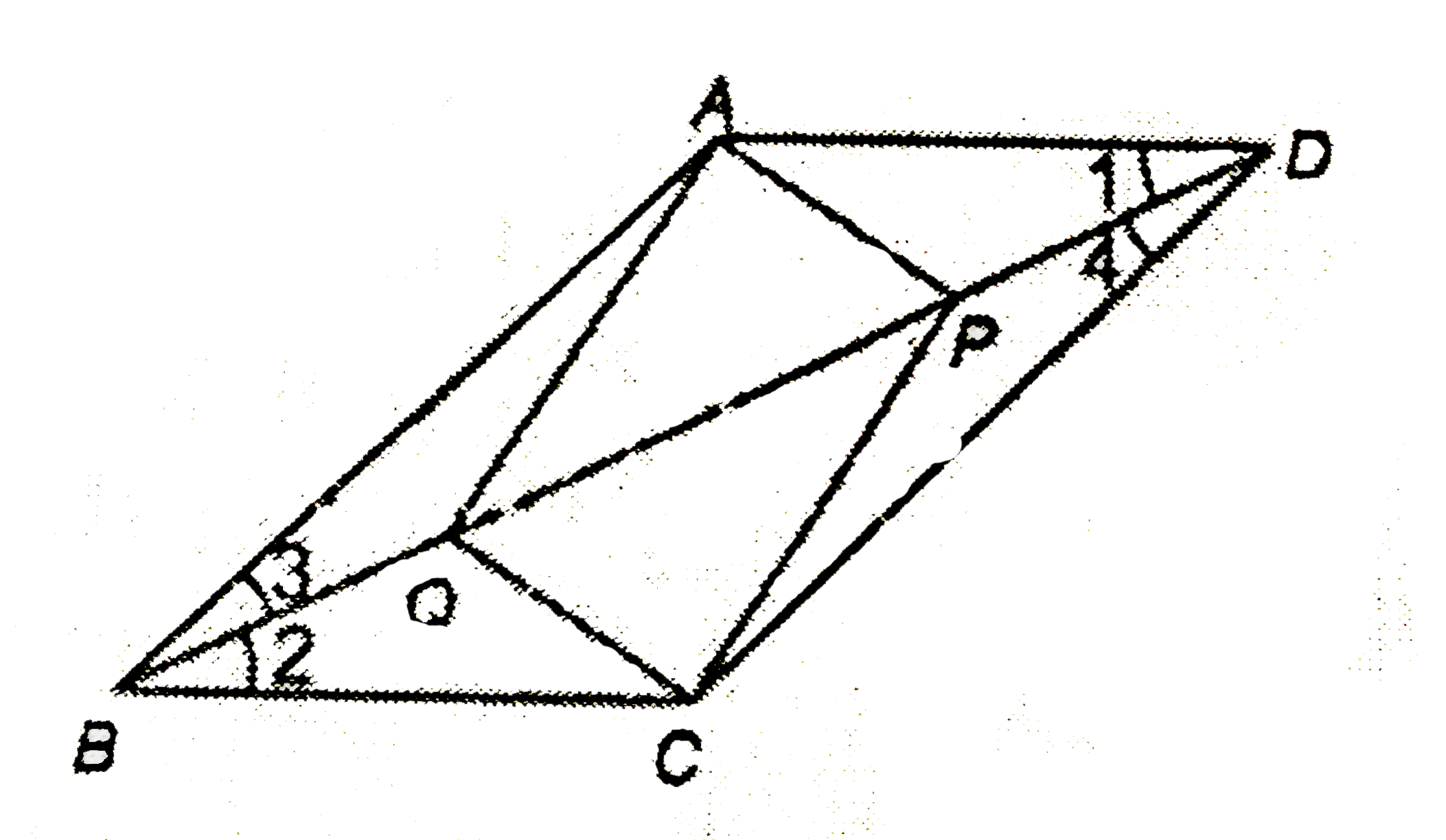
ABCD is a parallelogram and P and Q are lie on BD such that
DP = BQ
(i) We have to show,
`" "DeltaAPD~= DeltaCQB`
Now, in `DeltaAPDand DeltaCQB,` we have
`because{:{(DP=AQ,("give")),(AD=BC,("opposite sides of parallelogram")),(angle1=angle2,("alterate angle")):}`

`therefore" "DeltaPAD~=DeltaCQB" "("by SAS")`
(ii) `"Since"" "DeltaAPD~=DeltaCQB" "("just proved")`
`therefore" "AP=CQ`
(iii) Here, we have to show, `DeltaAQB~=DeltaCPD`
Now, in `DeltaAQBand DeltaCPD,` we have
`because{:{(BQ=DP,("given")),(AB=CD,("opposite sides of parallelogram")),(angle3=angle4,("alternate angles")):}`
`therefore" "DeltaAQB~=DeltaCPD" "("by SAS")`
(iv) `"since"" "DeltaAQB~=DeltaCPD`
`therefore" "AQ=Cp`
(v) Now, since AP = CQ
and AQ = CP
`thereforesquareAPCQ "is a parallelogram." " "(because"pairs of opposite sides are equal")`
Promotional Banner

Topper's Solved these Questions

  • QUADRILATERALS

    NAGEEN PRAKASHAN|Exercise Exercise 8a|29 Videos
  • QUADRILATERALS

    NAGEEN PRAKASHAN|Exercise Exercise 8b|15 Videos
  • QUADRILATERALS

    NAGEEN PRAKASHAN|Exercise Revision Exercise (long Answer Questions)|5 Videos
  • PROBABILITY

    NAGEEN PRAKASHAN|Exercise Revision Exercise (very Short Answer /short Answer Questions)|10 Videos
  • STATISTICS

    NAGEEN PRAKASHAN|Exercise Revision Exercise|10 Videos

Similar Questions

Explore conceptually related problems

In parallelogram ABCD, two points P and Q are taken on diagonal BD such that D P = B Q . Show that: (i) DeltaA P D~= DeltaC Q B (ii) A P = C Q (iii) DeltaA B C (iv) A Q = C P (v) APCQ is a parallelogram.

In a parallelogram ABCD,points P and Q are points of trisection of diagonal BD.Prove that CQ is parallel to AP.

ABCD is a parallelogram and AP and CQ are perpendiculars from vertices A and C on diagonal BD . Show that (i) DeltaA P B~=\ DeltaC Q D (ii) A P\ =\ C Q

In the given figure, ABCD is a parallelogram in which AN and CP are perpendiculars on diagonal BD. Prove that : (i) DeltaADN =DeltaCBP (ii) AN=CP

In the figure, ABCD is a parallelogram and BC is produced to a point Q such that AD = CQ. If AQ intersect DC at P, show that ar( Delta BPC) = ar( Delta DPQ).

ABCD is a parallelogram. Tow points P and Q are taken on sides AD and BC respectively such that AP 1/3ADand CQ=1/3BC. Prove that squareAQCP is a parallelogram.

In the adjoining figure, P and Q are two points on equal sides AB and AC of an isosceles triangle ABC such that AP = AQ. Prove that BQ = CP.

ABCD is a parallelogram in which P and Q are midpoints of opposite sides AB and CD respectively (see figure). If AQ intersects DP at S and BQ intersects CP at R, show that: (i) APCQ is a parallelogram.

ABCD is a parallelogram in which P and Q are mid-points of opposite sides AB and CD (see Fig. 8.18). If AQ intersects DP at S and BQ intersects CP at R, show that: (i) APCQ is a parallelogram. (ii) DPBQ is a parallelogram. (iii) PSQR is a parallelogram

DeltaABC and DeltaDBC are two isosceles triangles on the same base BC and vertices A and D are on the same side of BC (see figure). If AD is extended to intersect BC at P, show that : (i) DeltaABD cong DeltaACD (ii) DeltaABP cong DeltaACP (iii) AP bisects angleA as well as angleD (iv) AP is the perpendicular bisector of BC.

