


Topper's Solved these Questions
QUADRILATERALS
NAGEEN PRAKASHAN|Exercise Exercise 8b|15 VideosQUADRILATERALS
NAGEEN PRAKASHAN|Exercise Revision Exercise (very Short Answer Questions)|10 VideosQUADRILATERALS
NAGEEN PRAKASHAN|Exercise Problems From NCERT/exemplar|11 VideosPROBABILITY
NAGEEN PRAKASHAN|Exercise Revision Exercise (very Short Answer /short Answer Questions)|10 VideosSTATISTICS
NAGEEN PRAKASHAN|Exercise Revision Exercise|10 Videos
Similar Questions
Explore conceptually related problems
NAGEEN PRAKASHAN-QUADRILATERALS-Exercise 8a
- Find x,y and z in each of the following figure:
Text Solution
|
- In the given figure, find (i) angleXOD(ii) angleXOC
Text Solution
|
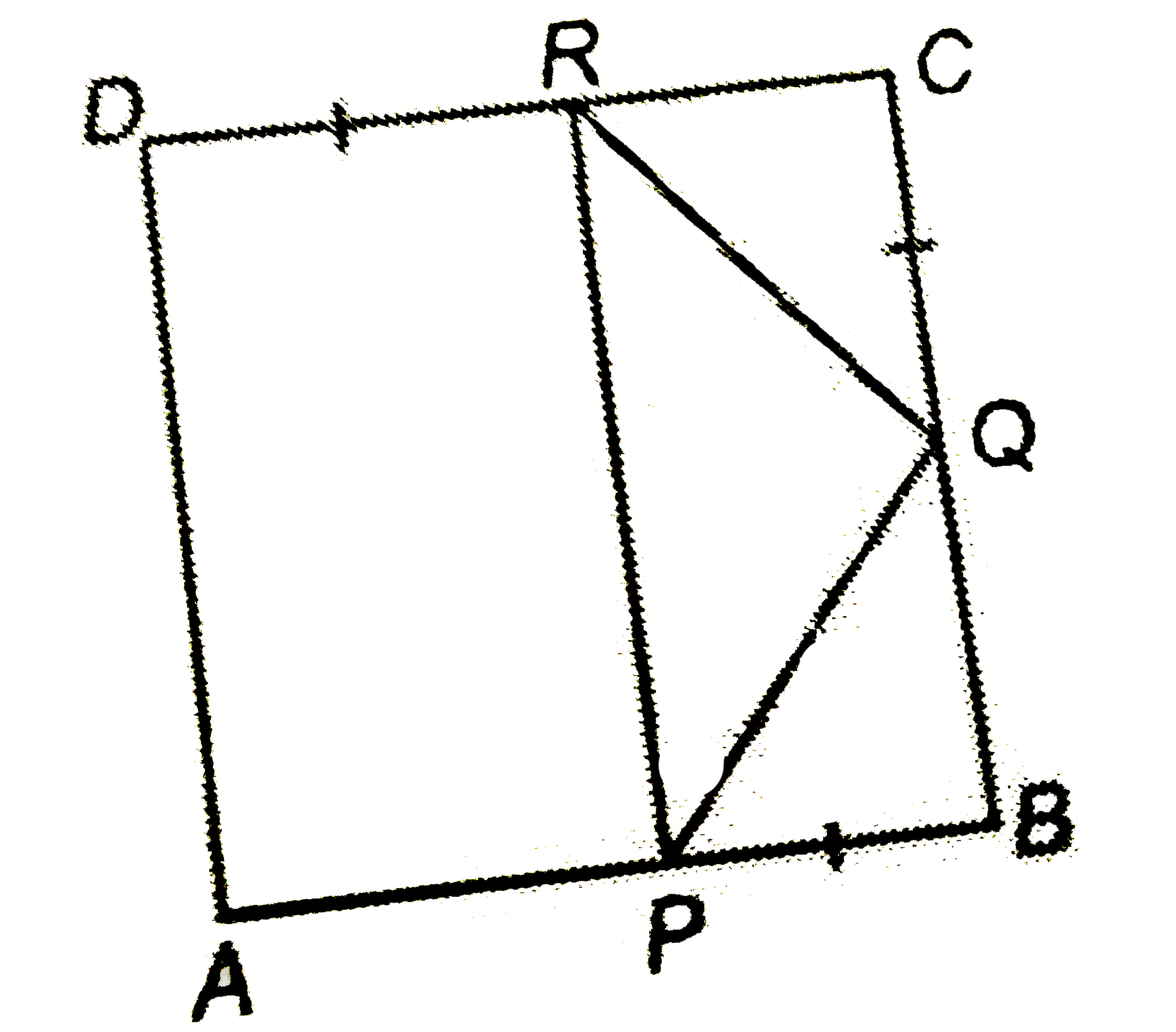
- In the given figure, ABCD is a square and anglePQR=90^(@).If PB=QC=DR,...
Text Solution
|
- In a square ABCD, diagonals meet at O. P is point on BC such that OB =...
Text Solution
|
- The give figure shows a square ABCD and an equilayeral teiangle APB. C...
Text Solution
|
- In the given figure, ABCD is a rohombus with A=67^(@). If DEC is an eq...
Text Solution
|
- If the adjacent angles of a parallelogram are in the ratio 1/3:1/2. Fi...
Text Solution
|
- Prove that the sum of two consecutive angles of a parallelogram is 180...
Text Solution
|
- One angle of a parallelogram is 60^(@). Find its remaining angles.
Text Solution
|
- One diagonal of a parallelogram biscets its one of the angles. Show th...
Text Solution
|
- The opposite angles of a parallelogram are (3x-2)^(@)and(150-x)^(@). F...
Text Solution
|
- In the adjoining figure, ABCD is a parallelogram. If angleABC=125^(@),...
Text Solution
|
- In a parallelogram, one angleis twice of its consecutiv angle. Find al...
Text Solution
|
- In a parallelogram ABCD, AX and CY are the bisectors of angleAandangle...
Text Solution
|
- In a parallelogram PQRS, PX and QY are the perpendiculars drawn from P...
Text Solution
|
- In a parallelogram ABCD, the bisector of angleA bisects the line Bcat ...
Text Solution
|
- In a parallelogram ABCD, angleBCD=60^(@) If the bisectors AP and BP of...
Text Solution
|
- In the adjoining figure, DeltaPQR is formed by the sides PQ, QR and RP...
Text Solution
|
- X and Y are the mid-points of the opposite sides AB and DC of a parall...
Text Solution
|
- Two points X and Y lie on the diagonal BD of a parallelogram ABCD such...
Text Solution
|