Home
Class 12
CHEMISTRY
Reduction with aluminium isopropoxide in...

Reduction with aluminium isopropoxide in excess of Isopropyl alcohol is called Meerwein Ponndorff-Verley reduction (MPV). What will be the final product when cyclohex-2-enone is selectively reduced in MPV reaction ?

A

Cyclohexanol

B

Cyclohex-2-enol

C

Cyclohexanone

D

Benzene.

Text Solution

Verified by Experts

The correct Answer is:
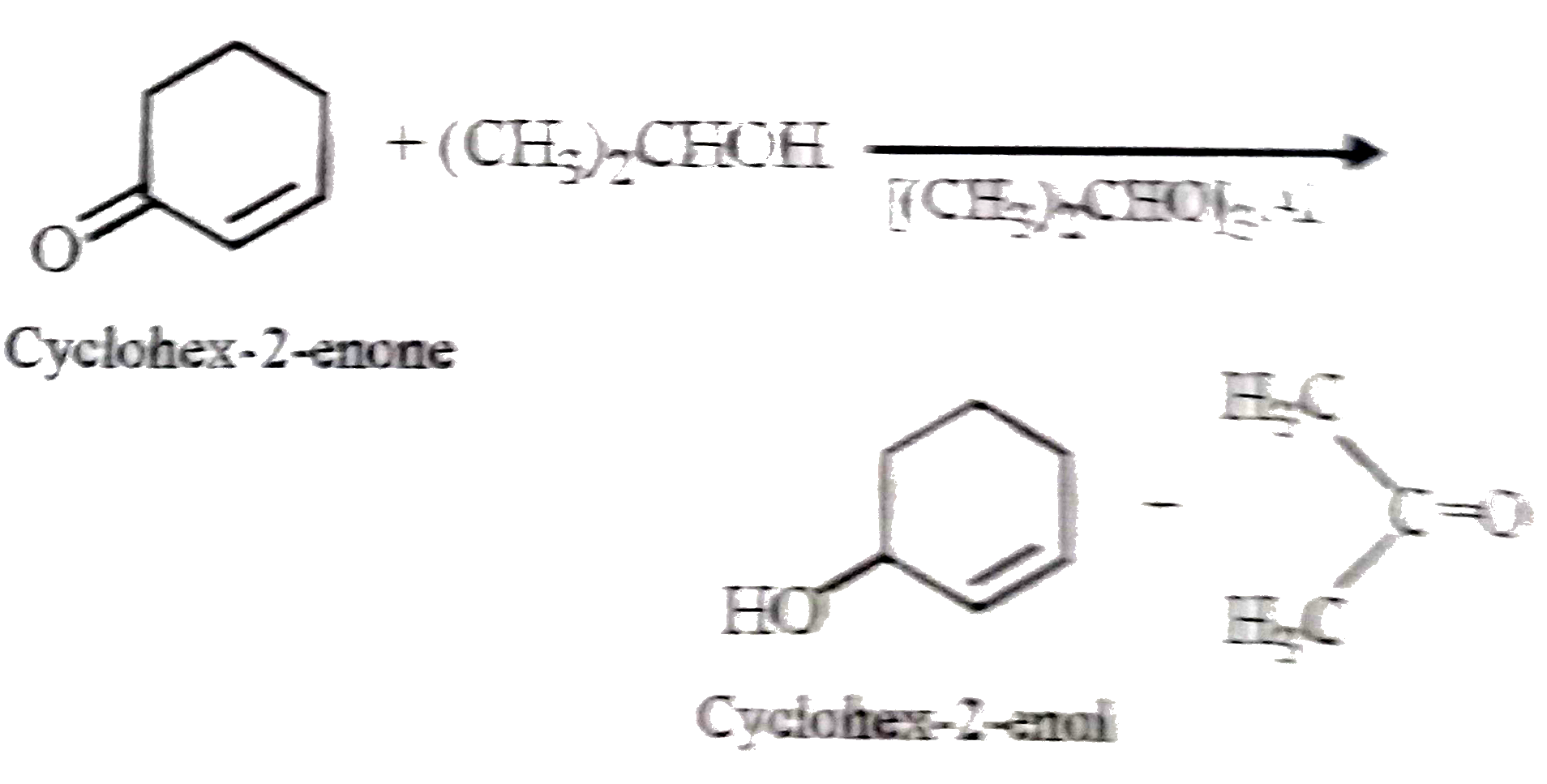
A


Here only `gtC=O` group is reduced to `gtCHOH` group. However group like `CH_(2)=CH_(2)` does not get reduced.
Promotional Banner

Similar Questions

Explore conceptually related problems

Reduction of cyclohex-2-enone with aluminium isopropoxide in excess of isopropyl alcohol with produce

Nitrous acid reacts with all classes of amines. The product obtained from these reactions depend on whether primary, secondary or tetriary and ,wheather the amine or aliphatic or aromatic. Aliphalic primary amines react with acid (NaNO_(2)+HCl) to form alcohol as major product. In , addition to alcohol, alkene and alkyl halides are also formed as minor product. Certain cyclic primary amines can undergo either ring expansion or ring contraction reactions on treatment with acid. This reaction is called Demajanov ring expansion or contraction. What will be the major product when 2-aminopropane is treated with nitrous acid?

Oxidation and reduction process involves the transaction of electrons. Loss of electrons is oxidation and the gain of electrons is reduction. It is thus obvious that in a redox reaction, the oxidant is reduced by accepting the electrons and the reductant is oxidised by losing electrons. The reactions in which a species disproportionates into two oxidation states (lower and higher) are called disproportionation reactions. In electrochemical cells, redox reaction is involved, i.e., oxidation takes place at anode and reduction at cathode. Select the correct statement:

Oxidation and reduction process involves the transaction of electrons. Loss of electrons is oxidation and the gain of electrons is reduction. It is thus obvious that in a redox reaction, the oxidant is reduced by accepting the electrons and the reductant is oxidised by losing electrons. The reactions in which a species disproportionates into two oxidation states (lower and higher) are called disproportionation reactions. In electrochemical cells, redox reaction is involved, i.e., oxidation takes place at anode and reduction at cathode. The reaction Cl_(2)to Cl^(-)+ClO_(3)^(-) is:

Oxidation and reduction process involves the transaction of electrons. Loss of electrons is oxidation and the gain of electrons is reduction. It is thus obvious that in a redox reaction, the oxidant is reduced by accepting the electrons and the reductant is oxidised by losing electrons. The reactions in which a species disproportionates into two oxidation states (lower and higher) are called disproportionation reactions. In electrochemical cells, redox reaction is involved, i.e., oxidation takes place at anode and reduction at cathode. Detennine the change in oxidation number of sulphur in H_(2)S and SO_(2) respectively in the following reaction: 2H_(2)S+SO_(2) to 2H_(2)O+3S

Oxidation and reduction process involves the transaction of electrons. Loss of electrons is oxidation and the gain of electrons is reduction. It is thus obvious that in a redox reaction, the oxidant is reduced by accepting the electrons and the reductant is oxidised by losing electrons. The reactions in which a species disproportionates into two oxidation states (lower and higher) are called disproportionation reactions. In electrochemical cells, redox reaction is involved, i.e., oxidation takes place at anode and reduction at cathode. In the reaction: I_(2)+2S_(2)O_(3)^(2-) to 2I^(-)+S_(4)O_(6)^(2-)

Nitrous acid reacts with all classes of amines. The product obtained from these reactions depend on whether primary, secondary or tetriary and ,wheather the amine or aliphatic or aromatic. Aliphalic primary amines react with acid (NaNO_(2)+HCl) to form alcohol as major product. In , addition to alcohol, alkene and alkyl halides are also formed as minor product. Certain cyclic primary amines can undergo either ring expansion or ring contraction reactions on treatment with acid. This reaction is called Demajanov ring expansion or contraction. Which of the following product(s) will be obtained when isopropylamine is treated with sodium nitrite and hydrochloric acid?

