

Home
Class 11
PHYSICS
A bead of mass m is released from rest a...

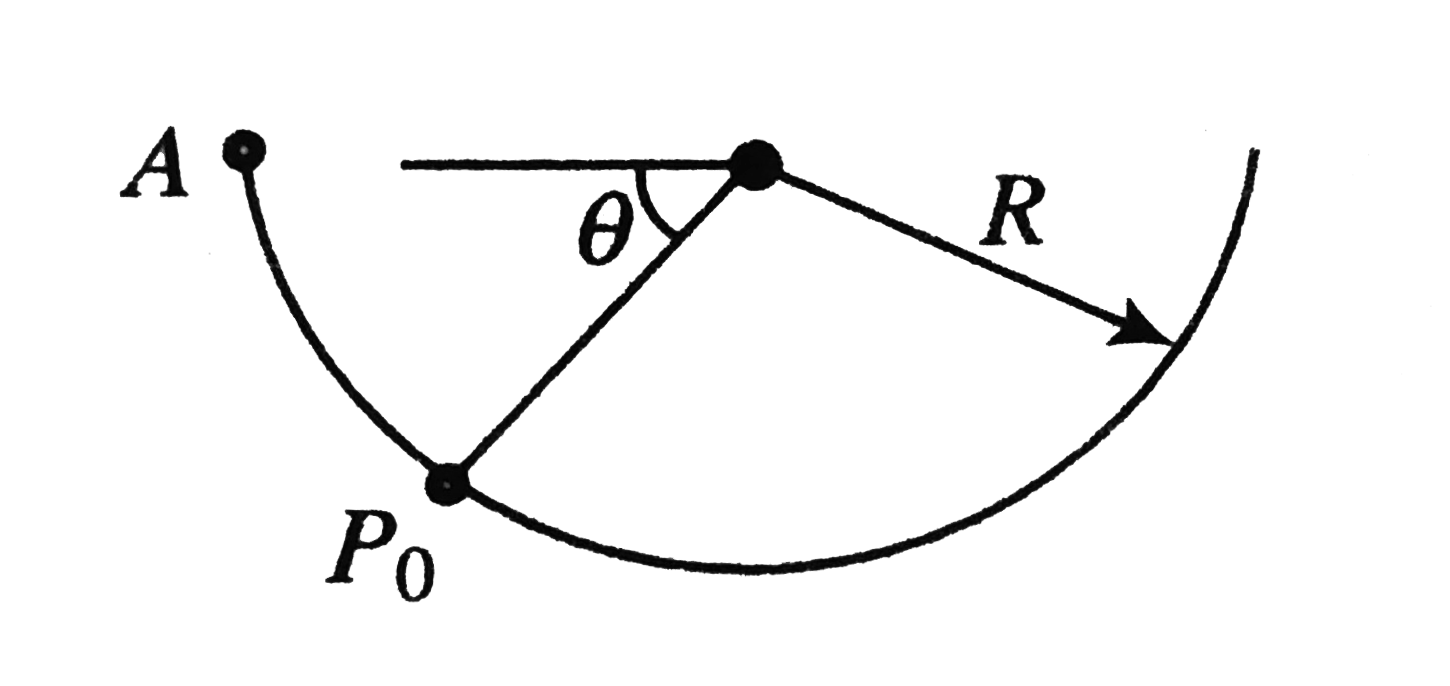
A bead of mass m is released from rest at A to move along the fixed smooth circular track as shown in figure. The ratio of magnitudes of centripetal force and normal reaction by the track on the bead at any point `P_0` described by the angle `theta(!=0)` would

Promotional Banner

Similar Questions

Explore conceptually related problems

A small block of mass m is released from rest from point A inside a smooth hemisphere bowl of radius R , which is fixed on group such that OA is horizontal. The ratio (x) of magnitude of centripetal force and normal reaction on the block at any point B varies with theta as :

A small block of mass m is released from rest from point A inside a smooth hemisphere bowl of radius R , which is fixed on group such that OA is horizontal. The ratio (x) of magnitude of centripetal force and normal reaction on the block at any point B varies with theta as :

A small block of mass m is released from rest from point A inside a smooth hemisphere bowl of radius R , which is fixed on group such that OA is horizontal. The ratio (x) of magnitude of centripetal force and normal reaction on the block at any point B varies with theta as :

A bead of mass m is released from height h on smooth thread as shown in figure.The minimum value of h such that bead completes the circular arc is

A small ball of mass m is released in a smooth circular tube as shown in figure. The minimum height h such that bead can complete the circle is

In the shown figure, a small mass m starts sliding down a smooth and stationary circular track. Which of the following graph best represents the variation of magnitude of the force applied by the track on the mass and the angle theta ?

A smooth block of mass m is held stationary on a smooth wedge of mass M and inclination theta as shown in figure .If the system is released from rest , then the normal reaction between the block and the wedge is

A smooth block of mass m is held stationary on a smooth wedge of mass M and inclination theta as shown in figure .If the system is released from rest , then the normal reaction between the block and the wedge is

A small block of mass m slides along a smooth frictional track as shown in the figure. If it starts from rest at P, what is the resultant force acting on it at Q?

A small block of mass m slides along a smooth frictional track as shown in the figure. If it starts from rest at P, what is the resultant force acting on it at Q?