

Home
Class 12
PHYSICS
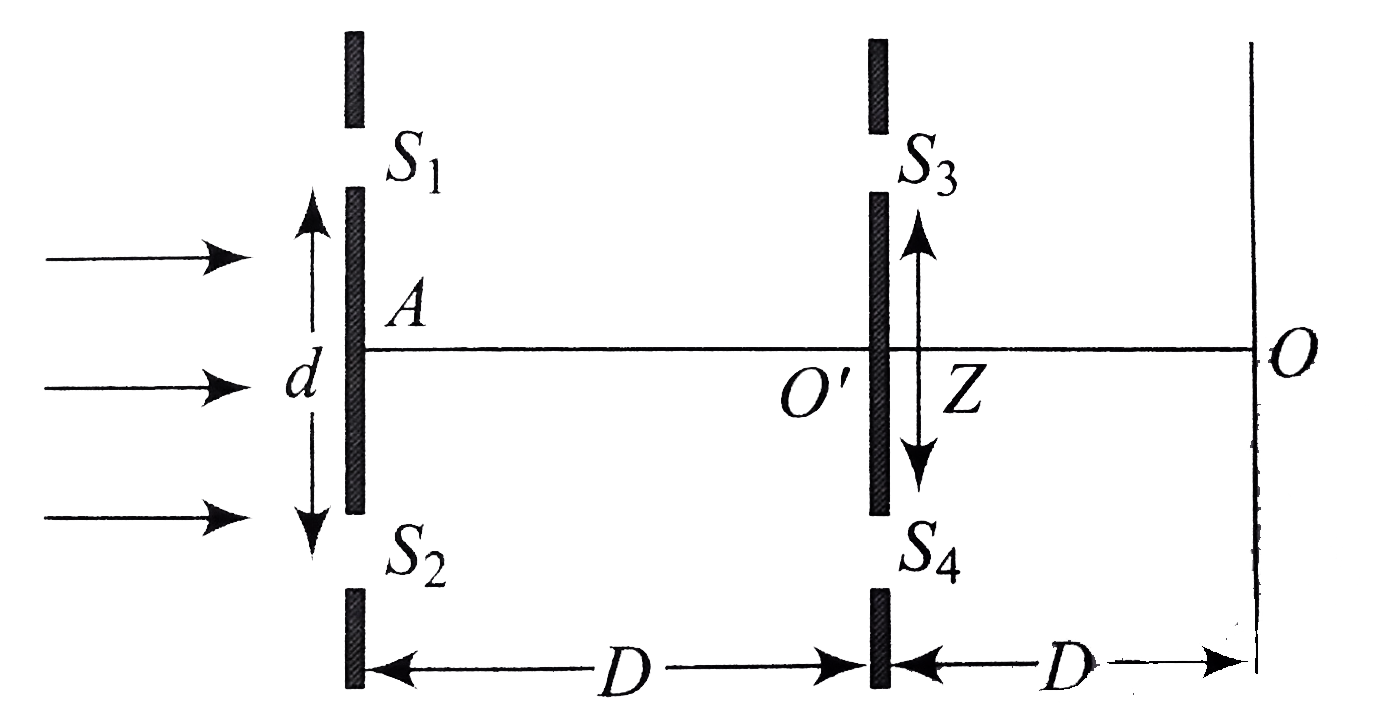
In the arrangement shown in Fig., slits ...

In the arrangement shown in Fig., slits `S_(1)` and `S_(4)`are having a variable separation Z. Point O on the screen is at the common perpendicular bisector of `S_(1) S_(2)` and `S_(3) S_(4)`.

When `Z = (lambda D)/(2d)`, the intensity measured at O is `I_(0)`. The intensity at O When `Z = (2 lambda D)/(d)` is

Promotional Banner

Similar Questions

Explore conceptually related problems

In the arrangement shown in Fig., slits S_(1) and S_(4) are having a variable separation Z. Point O on the screen is at the common perpendicular bisector of S_(1) S_(2) and S_(3) S_(4) . The minimum value of Z for which the intensity at O is zero is

In the arrangement shown in Fig., slits S_(1) and S_(4) are having a variable separation Z. Point O on the screen is at the common perpendicular bisector of S_(1) S_(2) and S_(3) S_(4) . The minimum value of Z for which the intensity at O is zero is

In the arrangement shown in Fig., slits S_(1) and S_(4) are having a variable separation Z. Point O on the screen is at the common perpendicular bisector of S_(1) S_(2) and S_(3) S_(4) . If a hole is made at O' on AO' O and the slit S_(4) is closed, then the ratio of the maximum to minimum observed on screen at O , if O' S_(3) is equal to (lambda D)/(4d) , is

In the arrangement shown in Fig., slits S_(1) and S_(4) are having a variable separation Z. Point O on the screen is at the common perpendicular bisector of S_(1) S_(2) and S_(3) S_(4) . If a hole is made at O' on AO' O and the slit S_(4) is closed, then the ratio of the maximum to minimum observed on screen at O , if O' S_(3) is equal to (lambda D)/(4d) , is

Parallel monochromatic beam is falling normally on two slits S_(1) and S_(2) separated by d as shown in figure. By some mechanism, the separation between the slits S_(3) and S_(4) can be changed. The intensity is measured at the point P which is at the common perpendicular bisector of S_(1)S_(2) and S_(3)S_(4) . When z=(Dlambda)/(2d) , the intensity measured at P is I. and when z is equal to (4Dlambda)/(d) , Intensity is x l. Find x.

Consider the arrangement shown in figure. By some mechanism, the separation between the slits S_3 and S_4 can be changed. The intensity is measured at the point P which is at the common perpendicular bisector of S_1 S_2 and S_3 S_4 . When z=(Dlambda)/(2d) , the intensity measured at P is I. Find the intensity when z is equal to (a)(Dlambda)/d (b)(3Dlambda)/(2d) (c) (2Dlambda)/d .

Consider the arrangement shownin figure. By some mechanism,the separation between the slits S_3 and S_4 can be changed. The intensity in measured at the point P which is at the common perpendicular bisector of S_1S_2 and S_3S_4. When z=(Dlamda)/(2d) the intensity measured at P is I. Find this intensity when z is equal to a. (Dlamda)/d, b. (3Dlamda)/(2d), c. (2Dlamda)/d