

Home
Class 11
PHYSICS
Consider the system shown below, with tw...

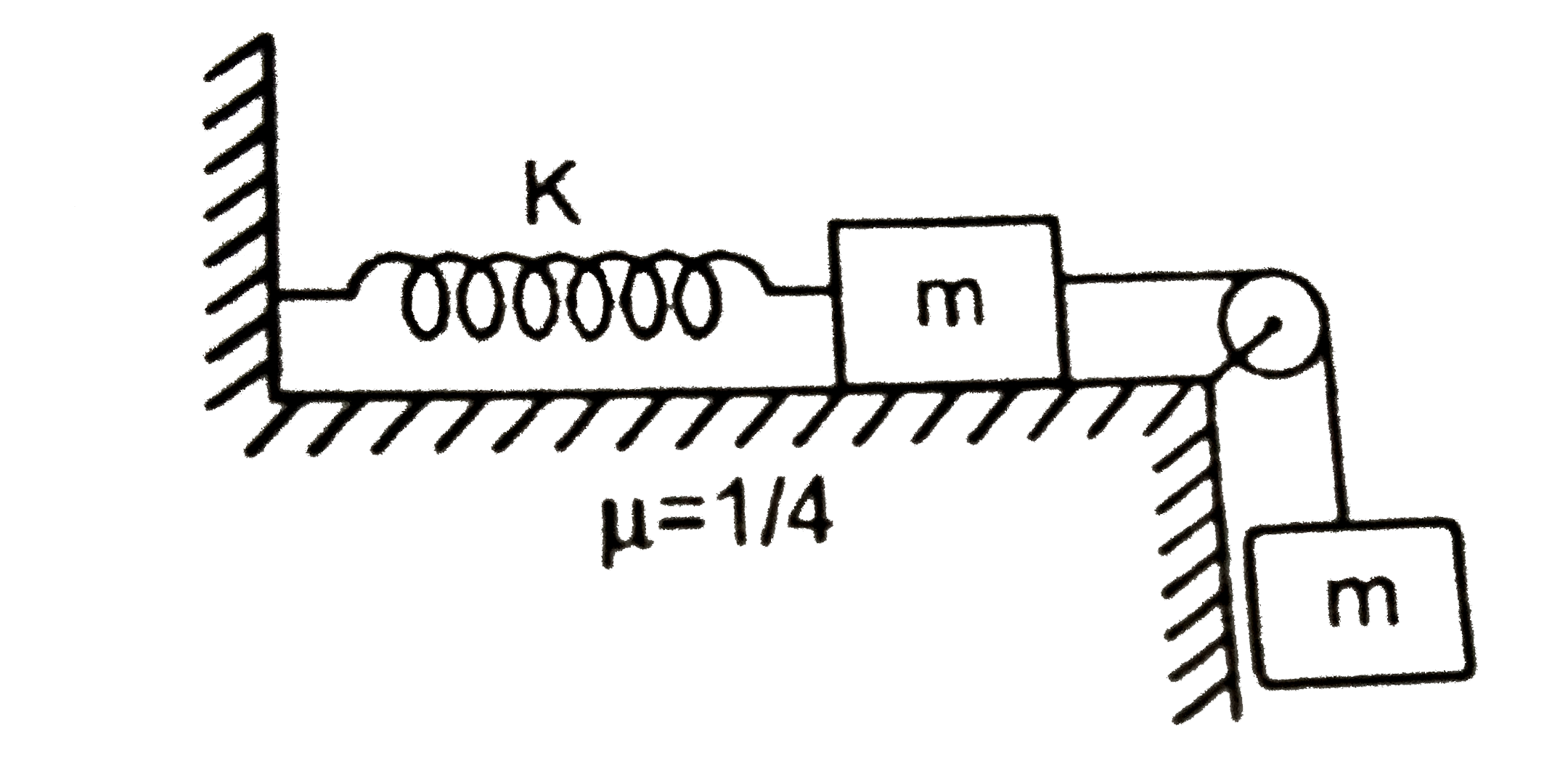
Consider the system shown below, with two equal masses `m` and a spring with spring constant `K`. The coefficient of friction between the left mass and horizontal table is `mu=1//4`, and the pulley is frictionless. The spring connecting both the blocks is massless and inelastic. The system is held with the spring at its unstretched length and then released.

The extension in spring when the masses come to momentary rest for the first time is

Promotional Banner

Similar Questions

Explore conceptually related problems

Consider the system shown below, with two equal masses m and a spring with spring constant K . The coefficient of friction between the left mass and horizontal table is mu=1//4 , and the pulley is frictionless. The spring connecting both the blocks is massless and inelastic. The system is held with the spring at its unstretched length and then released. If the string connecting both the masses is cut just at the instant both masses came to momentary rest for the first time in question 5, then maximum compression of spring during resulting motion is (Take mu=1//4 )

Consider the system shown below, with two equal masses m and a spring with spring constant K . The coefficient of friction between the left mass and horizontal table is mu=1//4 , and the pulley is frictionless. The spring connecting both the blocks is massless and inelastic. The system is held with the spring at its unstretched length and then released. The minimum value of mu for which the system remains at rest once it has stopped for the first time is

In the system as shown in figure, the blocks have masses m_(1) and m_(2) , the spring constant is k, coefficient of friction between the block of mass m_(1) and the surface is mu . The system is released with zero initial speed from the position where the spring is in its natural length.

An ideal spring with spring constant k is hung from the ceiling and a block of mass M is attached to its lower end. The mass is released when the spring is initially unstretched. Then the maximum extension in the spring is

An ideal spring with spring constant k is hung from the ceiling and a block of mass M is attached to its lower end. The mass is released with the spring initially unstretched. Then the maximum extension in the spring is

An ideal spring with spring constant k is hung from the ceiling and a block of mass M is attached to its lower end. The mass is released with the spring initially unstretched. Then the maximum extension in the spring is

An ideal spring with spring constant k is hung from the ceiling and a block of mass M is attached to its lower end. The mass is released with the spring initially unstretched. Then the maximum extension in the spring is