Home
Class 12
CHEMISTRY
A graph of volume of hydrogen released ...

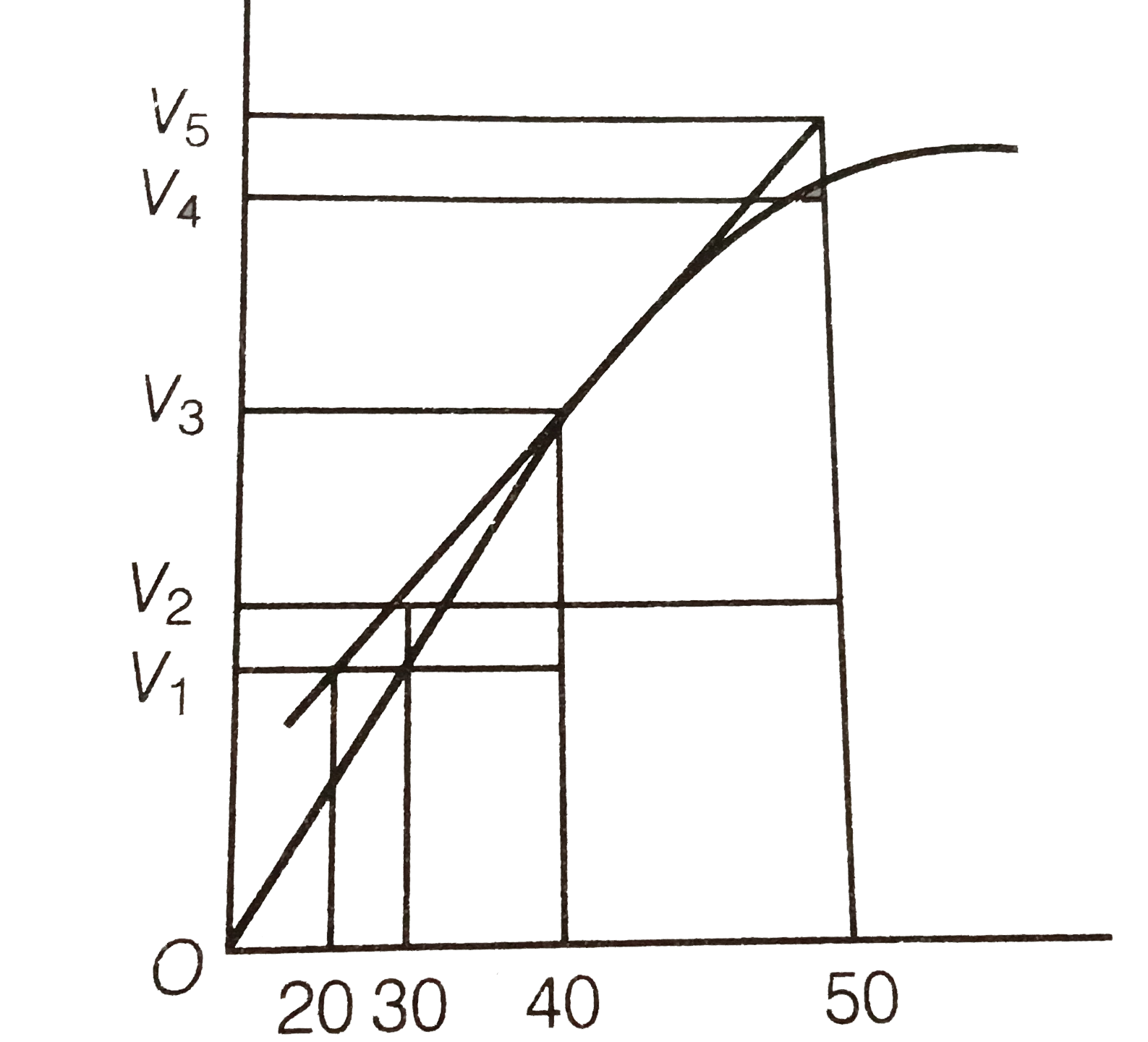
A graph of volume of hydrogen released vs time for the reaction between zinc and dil. HCl is given in figure . On the basis of this markt the correct options.

A

Average rate upto 40 s is `(V_(3) - V_(2))/(40)`

B

Average rate upto 40 s is `(V_(3)-V_(2))/(40-30)`

C

Average rate upto 40 s is `(V_(3))/(40)`

D

Average rate upto 40 s is `(V_(3)- V_(1))/(40-20)`

Text Solution

Verified by Experts

The correct Answer is:

C

`Zn + dil . HCL to ZnCl_(2) + H_(2) uarr`
`"Average rate of reaction" =("change in concentration of"H_(2))/("Change in time ")=(V_(3) -0)/(10-0) =(V_(3))/(40)`
Promotional Banner

Topper's Solved these Questions

  • BIOMOLECULES

    NCERT EXEMPLAR|Exercise Biomolecules|71 Videos
  • CHEMISTRY IN EVERYDAY LIFE

    NCERT EXEMPLAR|Exercise Chemistry In Everyday Life|101 Videos

Similar Questions

Explore conceptually related problems

A graph of volume of hydrogen released vs time for the reaction between zinc and dil. HCI is given in figure. On the basic of this mark the correct option.

Read the following and answer the questions. The reaction between MnO_(2) with HCl is depicted in the following diagram. It was observed that a gas with bleaching abilities was released. Identify the correct statement from the following:

For a general reaction A to B , plot of concentration of A vs time is given in figure. Answer the following questions on the basis of this graph. (i) what is the order of the reaction? (ii) What is the slope of the curve ? (iii) What are the units of rate constant?

Force acting on a block versus time graph is as shown in figure Choose the correct options. (g = 10 m//s^(-2))

A particle is thrown vertically upwards. The correct graph between its speed (v) and time (t) is given by (neglecting air resistance)

In the figure, the block of mass m, attached to the spring of stiffness k is in correct with the completely elastic wall, and the compression in the spring is e. The spring is compressed further by e by displacing the block towards left and is then released. If the collision between the block and the wall is completely eleastic then the time period of oscillation of the block will be

NCERT EXEMPLAR-CHEMICAL KINETICS-Chemical Kinetics
  1. According to Arrhenius equation rate constant K is equal to A e.^(-...

    Text Solution

    |

  2. Consider the Arrhenius equation given below and mark the correct op...

    Text Solution

    |

  3. A graph of volume of hydrogen released vs time for the reaction b...

    Text Solution

    |

  4. Which of the following statement is not correct about order of a ...

    Text Solution

    |

  5. Consider the graph given in figure . Which of the following optio...

    Text Solution

    |

  6. Which of the following statements is correct ?

    Text Solution

    |

  7. Which of the following expression is correct for the rate of reac...

    Text Solution

    |

  8. Which of the following graph represents exothermic reaction ?

    Text Solution

    |

  9. Rate law for the reaction, A + 2B to C is found to be Rate = k [A] [...

    Text Solution

    |

  10. Which of the following statements is incorrect about the collision...

    Text Solution

    |

  11. A first order reaction is 50% completed in 1.26 xx 10^(14)s. How much ...

    Text Solution

    |

  12. Compounds 'A' and 'B' react according to the following chemical eq...

    Text Solution

    |

  13. Which of the following statement is not correct for the catalyst ...

    Text Solution

    |

  14. The value of rate constant of a pseudo first order reaction

    Text Solution

    |

  15. Consider the reaction A to B. The concentration of both the reactan...

    Text Solution

    |

  16. Rate law cannot be determined form balanced chemical equation if â...

    Text Solution

    |

  17. Which of the following statements are applicable to a balanced chem...

    Text Solution

    |

  18. In any unimoelcular reaction ……. .

    Text Solution

    |

  19. For a complex reaction ……… .

    Text Solution

    |

  20. At high pressure the following reaction is zero order. " "2N...

    Text Solution

    |
