Home
Class 11
PHYSICS
Car A and car B start moving simultaneou...

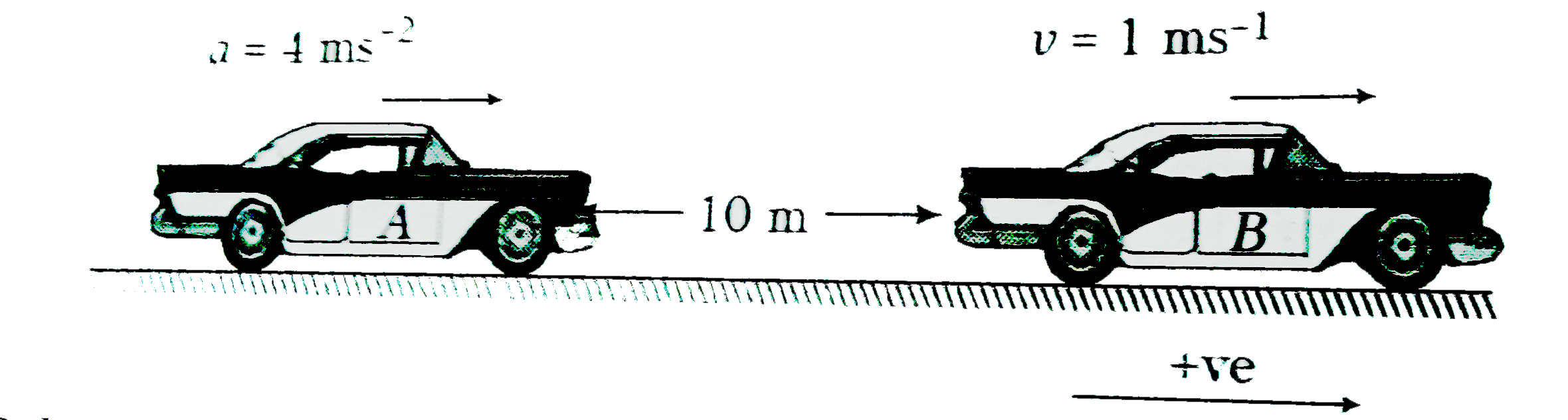
Car A and car B start moving simultaneously in the same direction along the line joining them. Car A moves with a constant acceleration `a=4 m//s^2,` while car B moves with a constant velocity `v=1 m//s.` At time `t=0,` car A is `10 m` behind car B. Find the time when car A overtake car B.

A

`2.5 s`

B

`2 s`

C

`3 s`

D

`3.5 s`

Text Solution

Verified by Experts

The correct Answer is:
A

Given, `u_(A)=0, u_(B)=1 ms^(-1), a_(A) = 4 ms^(-2)` and `a_(B) = 0`
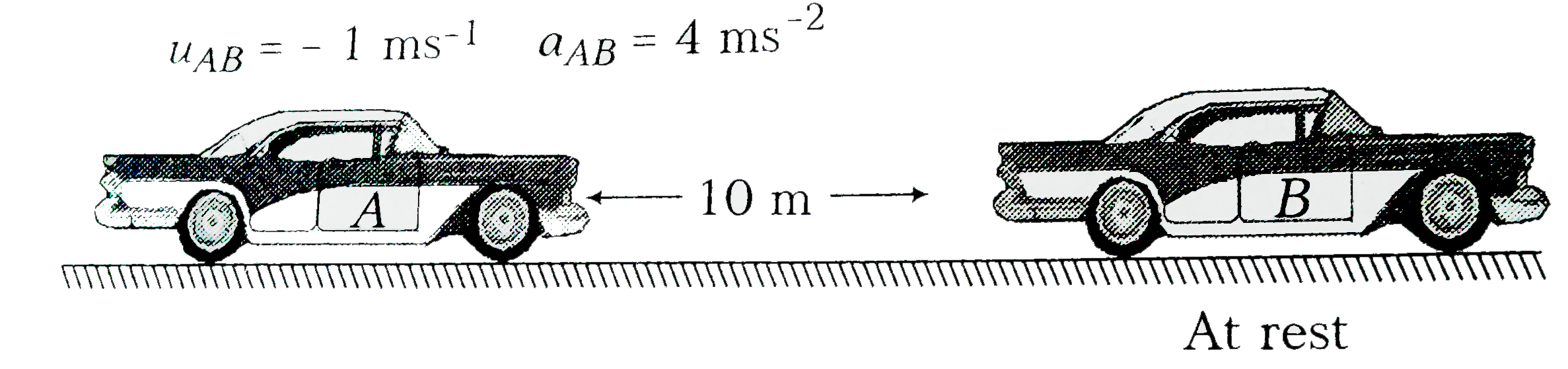
Assuming car B to be rest, we have
`u_(AB)=u_(A)=0-1=-1 ms^(-1)`
`a_(AB)=a_(A)-a_(B)=4-0=4 ms^(-2)`
Now, the problem can be assumed in simplified from as follows

Substituting the proper values in equation
`s=ut+(1)/(2)at^(2)`
we get, `10 =-t+(1)/(2)(4)(t^(2))` or `2t^(2)-t-10=0`

or `t=(1+-sqrt(1+80))/(4)=(1+-sqrt(81))/(4)=(1+-9)/(4)`
or `t=2.5s` and `-2 s`
Ignoring the negative value, the desired time is `2.5 s`
Note : The above problem can also be solved without using the concept of relative motion as under.
At the time when A overtakes B, `S_(A)=S_(B)+10`
`therefore (1)/(2)xx4xxt^(2)=1xxt+10` or `2t^(2)-t-10=0`
Which on solving gives `t = 2.5 s` and `-2 s`, the same as we found above. As per my opinion, this approach (by taking values) is more suitable in case of two body problem in one dimensional motion. Let us see one more example in support of it.
Promotional Banner

Topper's Solved these Questions

  • MOTION IN A PLANE

    DC PANDEY|Exercise Check point 3.1|10 Videos
  • MOTION IN A PLANE

    DC PANDEY|Exercise Check point 3.2|10 Videos
  • MOTION

    DC PANDEY|Exercise Medical entrances gallery|19 Videos
  • PROJECTILE MOTION

    DC PANDEY|Exercise Level - 2 Subjective|10 Videos

Similar Questions

Explore conceptually related problems

Car A and car B start moving simultaneously in the same direction along the line joining them. Car A with a constant acceleration a = 4 m//s^2 , while car B moves with a constant velocity v = 1 m/s. At time t = 0, car A is 10 m behind car B. Find the time when car A overtakes car B.

Two cars A and B are moving on parallel roads in the same direction. Car A moves with constant velocity 30m//s and car B moves with constant acceleration 2.5 m//s^(2) . At , car A is ahead of car B and car B is moving with 12 m//s velocity . The distance travelled by car B until it overtakes car A is

In the previous problem if the car is moving with a constant acceleration of 2 m//s^(2) , the ball will fall behind the person at a distance

A bus starts from rest and moves with constant acceleration 8 m//s^(2) . At the same time, a car traveling with a constant velocity 16 m//s overtakes and passes the bus. After how much time and at what distance the bus overtakes the car?

Two cars a and B starts motion with a velocity of 10 m//s and 20 m//s respectively. Car a moves with a constant acceleration of 2.5 m//s^(2) and car B have constant acceleration of 0.5 m//s^(2) as shown in figure. Find when car A will over take car B. Dimension of car is negligible as compare to distance. Find the time after which car A over takes car B.

Two cars A and B are at rest at the origin O. If A starts with a uniform velocity of 20 m// s and B starts in the same direction with a constant acceleration of 2 m//s^(2) , then the cars will meet after time

Initially car A is 10.5 m ahead of car B . Both start moving at time t = 0 in the same direction along a straight line. The velocity-time graph of two cars is shown in figure. The time when the car B will catch the car A , will be.

Two cars move in the same direction along parallel roads. One of them is a 200m , long travelling with a velocity of 20m//s . The second one is 800m long travelling with a velocity of 7.5m//s . How long will it take for the first car to overtake the second car?

The period of a simple pendulum suspended from the ceiling of a car is T when the car is at rest. If the car moves with a constant acceleration the period of the pendulum

DC PANDEY-MOTION IN A PLANE-(C )Medical entrances gallery
  1. Car A and car B start moving simultaneously in the same direction alon...

    Text Solution

    |

  2. If the velocity of a particle is v = At + Bt^2, where A and B are cons...

    Text Solution

    |

  3. A particle of unit mass undergoes one-dimensional motion such that its...

    Text Solution

    |

  4. The ball is dropped from a bridge 122.5 m above a river, After the ba...

    Text Solution

    |

  5. A ball is thrown vertically upwards from the ground with a speed of 25...

    Text Solution

    |

  6. A particle moves in an XY-plane in such a way that its x and y-coordin...

    Text Solution

    |

  7. A point moving with constant acceleration from A to B in the straight ...

    Text Solution

    |

  8. The displacement-time graph of a particle is as shown below. It indica...

    Text Solution

    |

  9. A car starts from rest and accelerates uniformly to a speed of 180 kmh...

    Text Solution

    |

  10. The velocity - time graph for two bodies A and B are shown in figure. ...

    Text Solution

    |

  11. A particle is moving such that its position coordinates (x, y) are (2m...

    Text Solution

    |

  12. A ball thrown vertically upwards after reaching a maximum height h ret...

    Text Solution

    |

  13. A police jeep is chasing with, velocity of 45 km//h a thief in another...

    Text Solution

    |

  14. A particle moves with constant acceleration along a straight line stre...

    Text Solution

    |

  15. A car covers the first half of the distance between two places at a sp...

    Text Solution

    |

  16. A particle starts moving from rest under uniform acceleration it trave...

    Text Solution

    |

  17. At time t = 0, two bodies A and B at the same point. A moves with cons...

    Text Solution

    |

  18. A motorcyclist drives from A to B with a uniform speed of 30 km h^(-1)...

    Text Solution

    |

  19. A body starts from rest and moves with constant acceleration for t s....

    Text Solution

    |

  20. The acceleration of a moving body can be found from

    Text Solution

    |

  21. A stone falls freely under gravity. It covered distances h1, h2 and h3...

    Text Solution

    |