Text Solution
Verified by Experts
The correct Answer is:



Similar Questions
Explore conceptually related problems
Recommended Questions
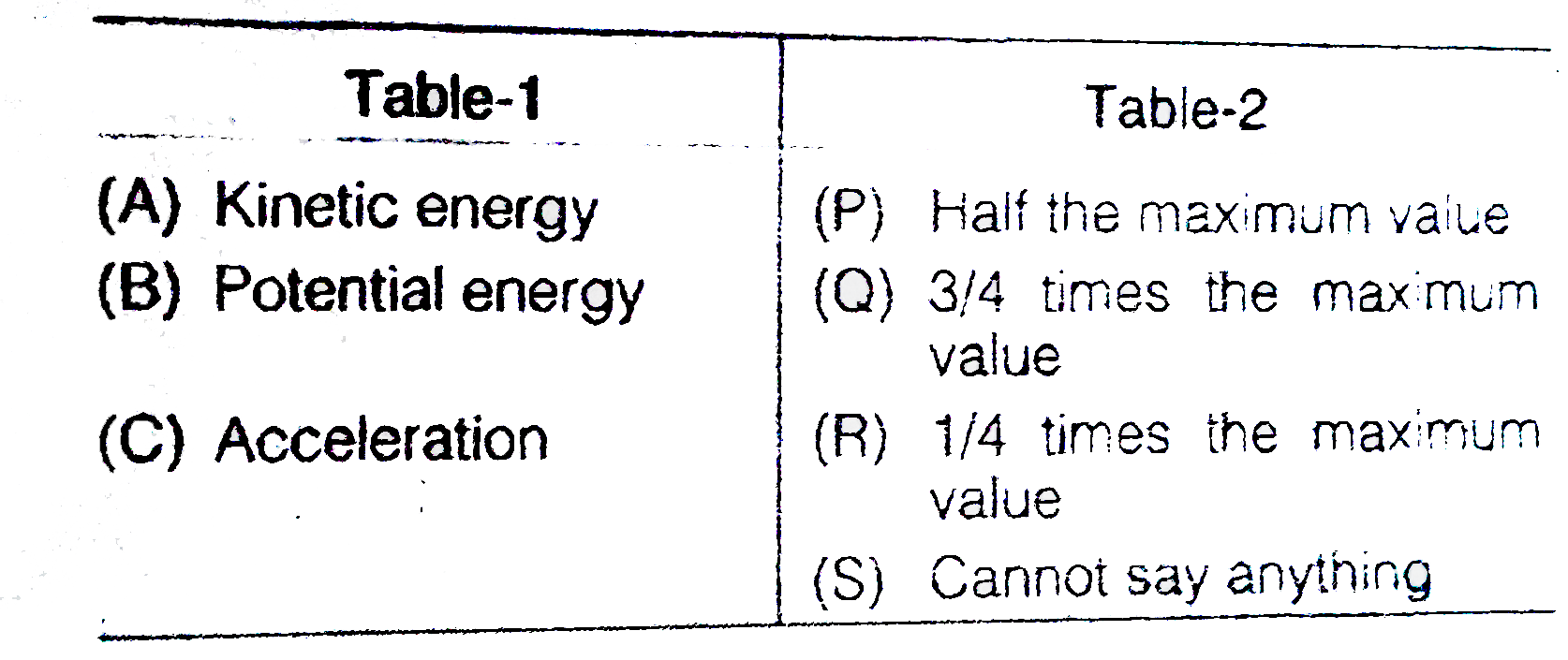
- In the equation y=Asin(omegat+pi/4) match the following for x=A/2.
Text Solution
|
- The equation y=Asin^2(kx-omegat) represents a wave motion with
Text Solution
|
- A travelling wave represented by y=Asin (omegat-kx) is superimpose...
Text Solution
|
- A particle moves in x-y plane according to rule x=asin omegat and y=-a...
Text Solution
|
- In the equation y=Asin(omegat+pi/4) match the following for x= A/2 .
Text Solution
|
- The phase difference between the waves y=acos(omegat+kx) and y=asin(om...
Text Solution
|
- Two sinusoidal waves are superposed. Their equations are y(1)=Asin(k...
Text Solution
|
- दो ध्वनि तरंगो की समीकरणों y=asin(omegat-kx) तथा y=acos(omegat-kx) है,...
Text Solution
|
- समीकरण y=asin(omegat-kx) को दो अन्य रूपों में व्यक्त कीजिय।
Text Solution
|