Home
Class 12
PHYSICS
An inductor X(L) = 2Omega ) , a capacito...

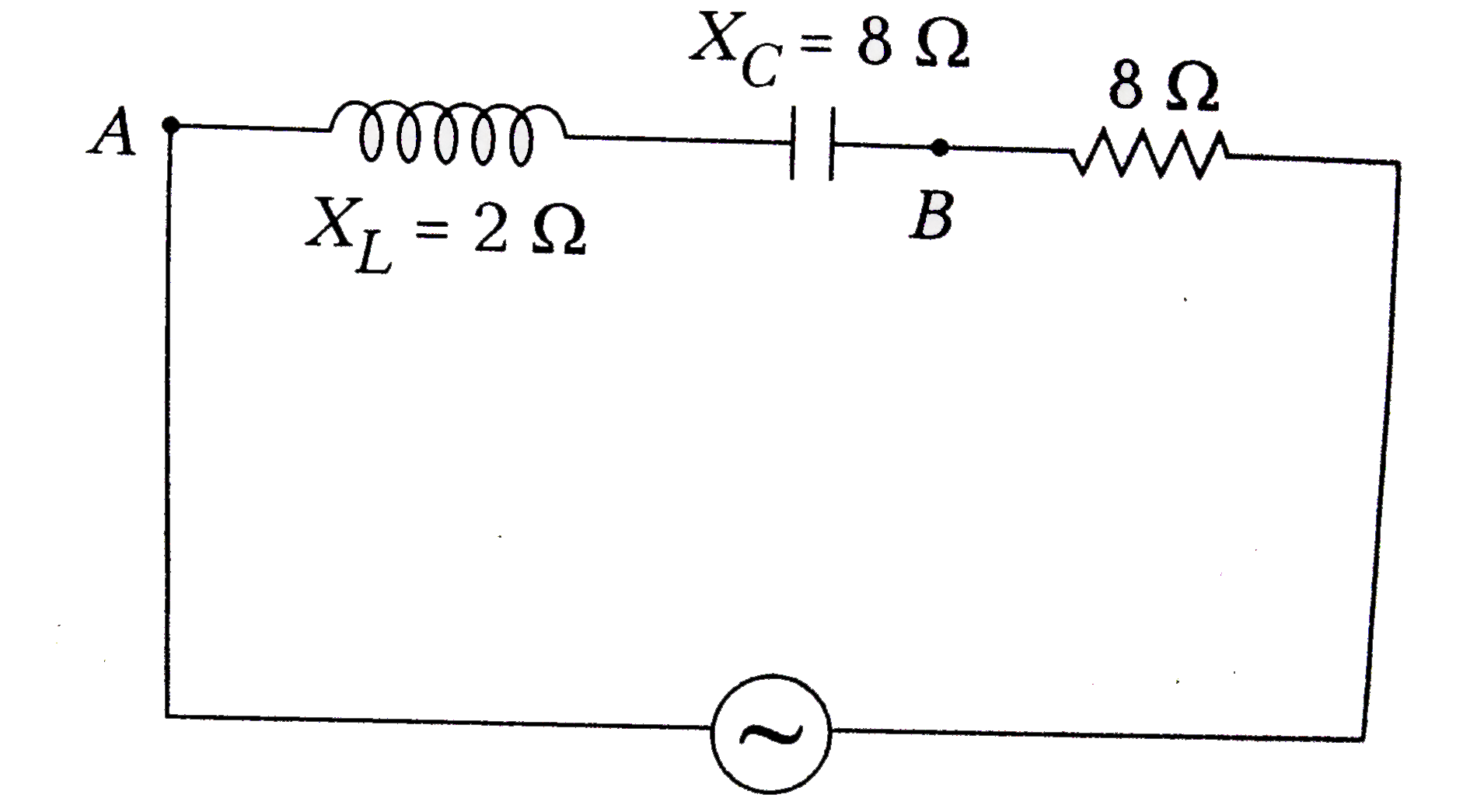
An inductor `X_(L)` = 2`Omega` ) , a capacitor (`X_(C)` = 8`Omega`) and a resistance (R = 8 `Omega` ) are connected in series with an AC source . The voltage output of AC source is given by V = 10 cos(100`pi`t)
The instantaneous potential difference between points A and B, when the applied voltage is 3/5th of the maximum value of applied voltage is

A

0 V

B

6 V

C

8 V

D

None of these

Text Solution

Verified by Experts

The correct Answer is:

B

Z = `sqrt (R^(2) + (X_C - X_L)^(2)) = 10Omega`
cos `phi = R/Z = 4/5`
`therefore phi = 37^(@)`
`I_0 = V_0 / Z = 10/10 = 1A`
`I = 1cos(100pit + 37^(@))`
`V = 10 cos (100pit)`
The applied voltage is `3/5` th of the maximum applied voltage when , or `100 pit = 53^(@)`
`thereforeI = 1cos(53^(@)+ 37^(@)) = 0`
`therefore V_AB = V_"applied" = 3/5 xx 10 = 6V`
Promotional Banner

Similar Questions

Explore conceptually related problems

An inductor (X_(L) = 2 Omega) a capacitor (X_(C ) = 8 Omega) and a resistance (8 Omega) are connected in series with an ac source. The voltage output of A.C source is given by v = 10 cos 100 pi t . The instantaneous p.d. between A and B when is half of the voltage output from source will be:

An inductor (L = (1)/(100 pi) H) , a capacitor (C = (1)/(500 pi) F) and a resistance (3 Omega) is connected in series with an AC voltage source as shown in the figure. The voltage of the AC source is given as V = 10 cos(100 pi t) volt. What will be the potential difference between A and B ?

A 100 Omega resistance is connected in series with a 4 H inductor. The voltage across the resistor is V_(R) = 2 sin (1000 t) V . The voltage across the inductors is

In an L-R circuit, an inductance of 0.1 H and a resistance of 1 Omega are connected in series with an ac source of voltage V = 5 sin 10 t. The phase difference between the current and applied voltage will be

In an L-R circuit, an inductance of 0.1 H and a resistance of 1 Omega are connected in series with an ac source of voltage V = 5 sin 10 t. The phase difference between the current and applied voltage will be

A capacitor of capacitive reactance 79.62 Omega and a resistance of 100 Omega are connected in series across a.c. source. The phase difference between applied emf and current is

A resistance of 200Omega and capacitor of 15muF are connected in series to a 220 V, 50 Hz AC source. The voltage (rms) across the resistor and capacitor is that

A resistor and a capacitor are connected in series with an a.c. source. If the potential drop across the capacitor is 5 V and that across resistor is 12 V, applied voltage is

A 0.21 H inductor and a 12 Omega resistance are connected in series to a 220 V, 50 Hz ac source. the phase angle between the current and the source voltage is

A resistor 20Omega , inductive reactance 15Omega and capacitive reactance 15Omega are connected in series to an AC voltage source V=200sqrt(2)sin omega t . Then the maximum current in the circuit is
