Home
Class 12
PHYSICS
A small coin is resting on the bottom of...

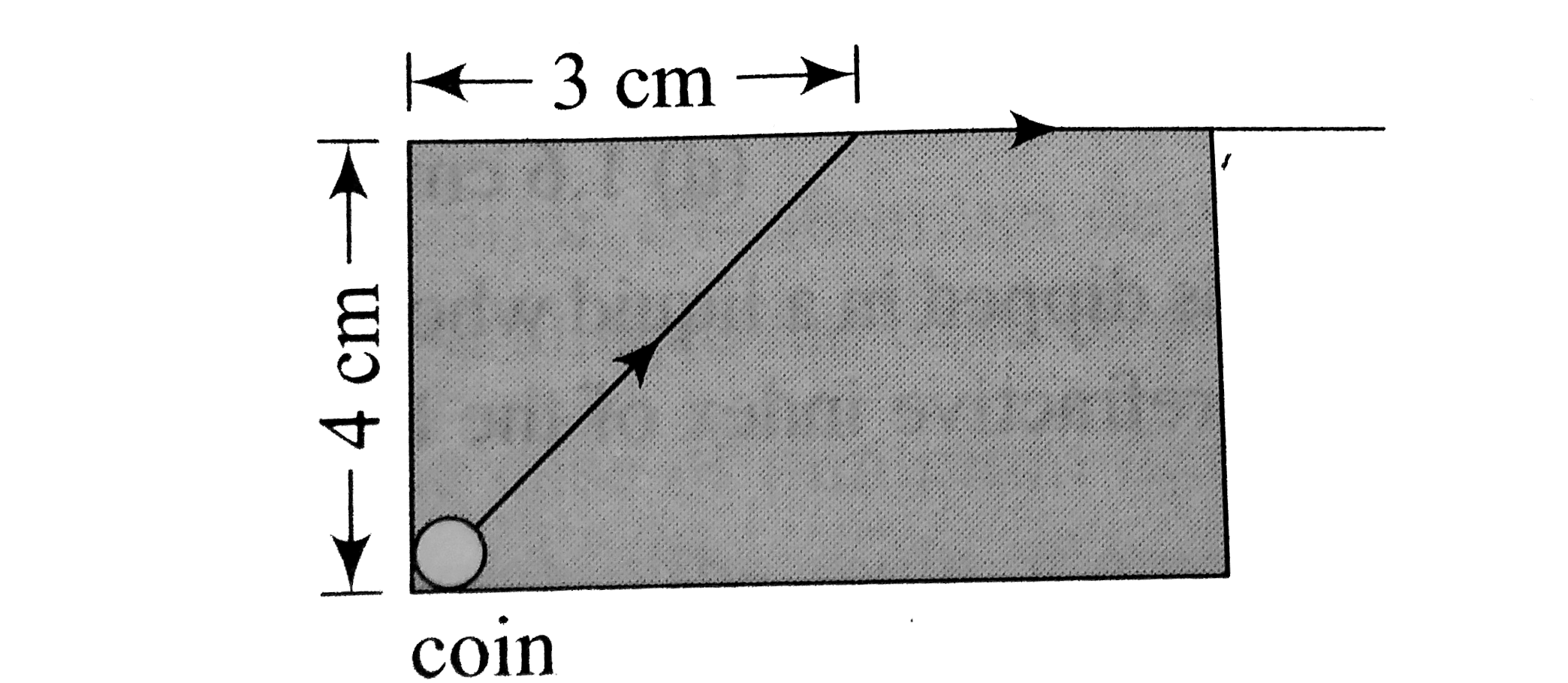
A small coin is resting on the bottom of a beaker filled with a liquid. A ray of light from the coin travels up to the surface of the liquid and moves along its surface (see figure ).
How fast is the light travelling in the liquid ?

Text Solution

Verified by Experts

s shown in the figure, a light ray from the coin will not emerge out of liquid if, `igtC`.

In `DeltaSAB,R/h=tanCrArrR=htanCrArrR=h/(sqrt(mu^(2)-1))`
Given , R= 3 cm and h= 4 cm

`therefore 3/4=1/(sqrt(mu^(2)-1))`
`rArrmu^(2)=25/9rArrmu=5/3`
But, `mu=C/v`
`rArr` Speed of light,v=`C/mu=(3xx10^(8))/(5//3)=1.8xx10^(8) ms^(-1)`
Promotional Banner

Topper's Solved these Questions

  • RAY OPTICS

    DC PANDEY|Exercise Checkpoint 9.1|10 Videos
  • RAY OPTICS

    DC PANDEY|Exercise Checkpoint 9.2|10 Videos
  • NUCLEI

    DC PANDEY|Exercise C MADICAL ENTRANCES GALLERY|46 Videos
  • REFLECTION OF LIGHT

    DC PANDEY|Exercise Subjective|9 Videos

Similar Questions

Explore conceptually related problems

A small coin is resting on the bottom of a beaker filled with a liquid. A ray of light from the coin travels upto the surface of the liquid and moves along its surface How fast is the light travelling the liquid ?

A metal coin at the bottom of a beaker filled with a liquid of refractive index 4//3 to height of 6 cm . To an observer looking from above the surface of the liquid, coin will appear at a depth of (consider paraxial rays).

A beaker of radius 15 cm is filled with a liquid of surface tension 0.075 N/m. Force across an imaginary diameter on the surface of the liquid is

A wooden ball of density sigma is released from the bottom of a tank which is filled with a liquid of density rho (rho>sigma) up to a height h_(1) . The ball rises in the liquid, emerges from its surface and attains a height h_(2) in air.If viscous effects are neglected,the ratio h_(2)/h_(1) is

DC PANDEY-RAY OPTICS-Medical entrance gallary
  1. A small coin is resting on the bottom of a beaker filled with a liquid...

    Text Solution

    |

  2. Two identical glass (mu(g)=3//2) equi- convex lenses of focal length f...

    Text Solution

    |

  3. An air bubble in a glass slab with refractive index 1.5 (near normal i...

    Text Solution

    |

  4. A person can see clearly objects only when they lie between 50 cm and ...

    Text Solution

    |

  5. An astronomical telesope has objective and eyepiece of focal lengths 4...

    Text Solution

    |

  6. Match the corresponding entries of Column I with Column II.

    Text Solution

    |

  7. The angle of incidence for a ray of light at a refracting surface of a...

    Text Solution

    |

  8. Two identical thin planoconvex glass lenses (refractive index 1.5) eac...

    Text Solution

    |

  9. The refracting angle of a prism is A and refractive index of the mater...

    Text Solution

    |

  10. The near point and far point of a person are 40cm and 250cm, respectiv...

    Text Solution

    |

  11. An object is seen thorugh a simple microscope of focal length 12 c. Fi...

    Text Solution

    |

  12. Angle of minimum deviation for a prism of refractive index 1.5 is equa...

    Text Solution

    |

  13. A ray of light passes from a medium A having refractive index 1.6. to ...

    Text Solution

    |

  14. The focal length of a converting lens are f(v) and f(r) for violet and...

    Text Solution

    |

  15. Aperture of human eye is 0.2cm. The minimum magnifying power of a visa...

    Text Solution

    |

  16. An object is located 4cm from the first of two thin converging lenses ...

    Text Solution

    |

  17. If mu(v)=1.530 and mu(R)=1.5145, then disperisve power of a crown glas...

    Text Solution

    |

  18. Disperion of light is caused due to

    Text Solution

    |

  19. Calculate the focal length of a reading glass of a person, if the dist...

    Text Solution

    |

  20. A person wants a real image of his own, 3 times enlarged. Where should...

    Text Solution

    |

  21. The magnification power of a convex lens of focal length 10cm, when th...

    Text Solution

    |

