Home
Class 12
PHYSICS
A concave mirror of radius 40 cm lies on...

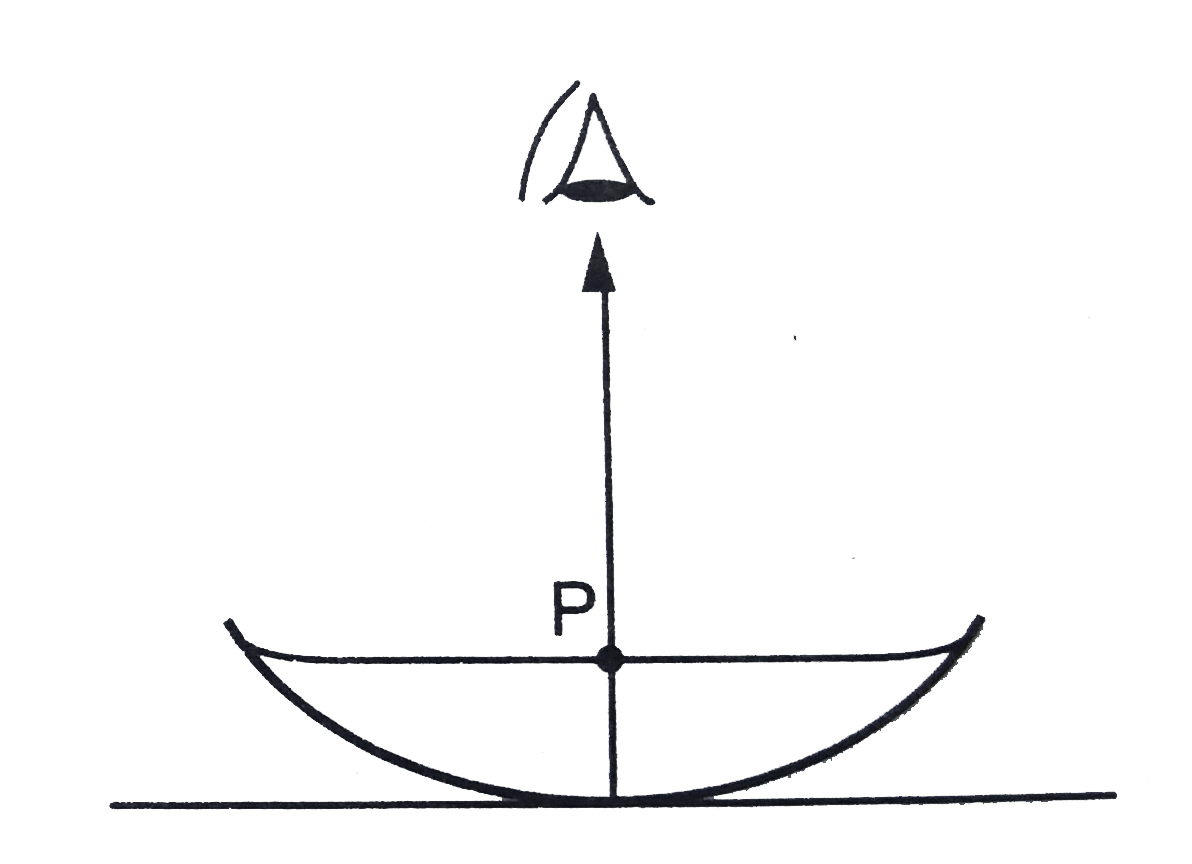
A concave mirror of radius 40 cm lies on a horizontla tale and wateis filled in it up t a heightof 5.00 cm. A small dust particle floats on the water surface at a point P vertically above tge pointof contact of the miror with the table. Locate the image of the dust particle as seen from a point directly above it. tEh refractie index of water is 1.33.

Text Solution

Verified by Experts


The dust particle is in water.
Image by concave mirror
`mu=-5 cm,,f=-20 cm,v=?`
`1/v+1/u=1/f rArr 1/v+1/(-5)=1/(-20)`
`rArr 1/v=1/5-1/20=3/20rArrv=20/3cm`
The image of P is formed at I.
Image by refraction After reflection direction of incident rays is reversed. I serves as an object
`mu_(1)=2/3,u=-(5+20/3)=-35/3`cm
`mu_(2)=1,v=?`
`(mu_(2))/v-(mu_(1))/u=0rArr1/v-(2//3)/((-35//3))rArrv=-35/2=-17.5 cm`
Final image is formed at I'. PI=17.5 cm
Promotional Banner

Topper's Solved these Questions

  • RAY OPTICS

    DC PANDEY|Exercise Checkpoint 9.1|10 Videos
  • RAY OPTICS

    DC PANDEY|Exercise Checkpoint 9.2|10 Videos
  • NUCLEI

    DC PANDEY|Exercise C MADICAL ENTRANCES GALLERY|46 Videos
  • REFLECTION OF LIGHT

    DC PANDEY|Exercise Subjective|9 Videos

Similar Questions

Explore conceptually related problems

A point source of light is located at the bottom of a steel tank, and an opaque circular card of radius 6.00 cm is placed horizontally over it. A transparent fluid is gently added to the tank so that the card floats on the fluid surface with its center directly above the light source. No light is seen by an observer above the surface until the fluid is 5.00 cm deep. What is the index of refraction of the fluid ?

A long cylindrical tube containing water in closed by an equinvex lens of local length 10 cm in air. A point source is placed along the axis of the tube outside it at a distance of 21 cm from the lens. Locate the final image of the source. Refractive index of the materials of the lens =1.5 and that of water =1.33.

A container is filled with water (mu = 1.33) up to height of 33.2 cm . A concave mirror is placed 15 cm above the water level. Image of an object placed at the bottom is formed at the same place. The focal length of mirror is :

A small object is at the bottom of a container which has water filled up to a height of 20 cm. There is a plane mirror inclined at 45° to the horizontal above the container. A convex lens having focal length 15 cm is at a distance of 50 cm from the mirror. The horizontal principal axis of the lens is at a distance of 45 cm from the bottom of the container. Find the distance of the image (from the lens) of the object as seen by an observer to the left of the lens. Light rays from the object hit the lens only after they are reflected from the mirror. (use mu_("water") = 4//3)

A transparent solid sphere of radius 2 cm and density rho floats in a transparent liquid of density 2rho kept in a beaker. The bottom of the beaker is spherical in shape with radius of curvature 8 cm and is silvered to make it concave mirror as shown in the figure. When an object is placed at a distance of 10 cm directly above the centre of the sphere C, its final image coincides with it. Find h (as shown in the figure ), the height of the liquid surface in the beaker from the apex of the bottom. Consider the paraxial rays only. The refractive index of the sphere is 3//2 and that of the liquid is 4//3.

Water is filled in a container upto a height of 5cm . There is a concave mirror of radius of curvature 40cm . A person just above the surface observes image of 'A' . The distance of image from water surface is (mu_("water")=1.33) :

A beaker is filled with water as shown in figure (a). The bottom surface of the beaker is a concave mirror of large radius of curvature and small aperture. The height of water is h = 40 cm . It is found that when an object is placed 4 cm above the water surface, the image coincides with the object. Now the water level h is reduced to zero but there will still be some water left in the concave part of the mirror as shown in figure (b). The new height of the object h' above the new water surface so that the image again coincides with the object, will be (Refractive index of water = 4//3 )

A particle lies on the bottom of a tank T filled with water upto s height of 90 cm . The medium above the surface of water is of R.I = 1.2 above which there is mirror M . Beyond the mirror M the region contains air ( mu =1 ). The distance of the image formed by the mirrro after reflection of the rays coming from P is ____ cm (w.r.t mirror). .

DC PANDEY-RAY OPTICS-Medical entrance gallary
  1. A concave mirror of radius 40 cm lies on a horizontla tale and wateis ...

    Text Solution

    |

  2. Two identical glass (mu(g)=3//2) equi- convex lenses of focal length f...

    Text Solution

    |

  3. An air bubble in a glass slab with refractive index 1.5 (near normal i...

    Text Solution

    |

  4. A person can see clearly objects only when they lie between 50 cm and ...

    Text Solution

    |

  5. An astronomical telesope has objective and eyepiece of focal lengths 4...

    Text Solution

    |

  6. Match the corresponding entries of Column I with Column II.

    Text Solution

    |

  7. The angle of incidence for a ray of light at a refracting surface of a...

    Text Solution

    |

  8. Two identical thin planoconvex glass lenses (refractive index 1.5) eac...

    Text Solution

    |

  9. The refracting angle of a prism is A and refractive index of the mater...

    Text Solution

    |

  10. The near point and far point of a person are 40cm and 250cm, respectiv...

    Text Solution

    |

  11. An object is seen thorugh a simple microscope of focal length 12 c. Fi...

    Text Solution

    |

  12. Angle of minimum deviation for a prism of refractive index 1.5 is equa...

    Text Solution

    |

  13. A ray of light passes from a medium A having refractive index 1.6. to ...

    Text Solution

    |

  14. The focal length of a converting lens are f(v) and f(r) for violet and...

    Text Solution

    |

  15. Aperture of human eye is 0.2cm. The minimum magnifying power of a visa...

    Text Solution

    |

  16. An object is located 4cm from the first of two thin converging lenses ...

    Text Solution

    |

  17. If mu(v)=1.530 and mu(R)=1.5145, then disperisve power of a crown glas...

    Text Solution

    |

  18. Disperion of light is caused due to

    Text Solution

    |

  19. Calculate the focal length of a reading glass of a person, if the dist...

    Text Solution

    |

  20. A person wants a real image of his own, 3 times enlarged. Where should...

    Text Solution

    |

  21. The magnification power of a convex lens of focal length 10cm, when th...

    Text Solution

    |

