Home
Class 12
PHYSICS
A hydrogen like atom (atomic number Z) ...

A hydrogen like atom (atomic number Z) is in a higher excited sate of quantum number n .This excited atom can make a transition to the first excited state by successively emitting two photon of energies `10.20 eV` and `17.00 eV` .Alternatively, the atom from the same excited state can make a transition to the second excited state by successively emitting two photon of energy `4.25 ev` and `5.95 eV` Determine the followings:
The value of atomic number (Z) is

Text Solution

Verified by Experts
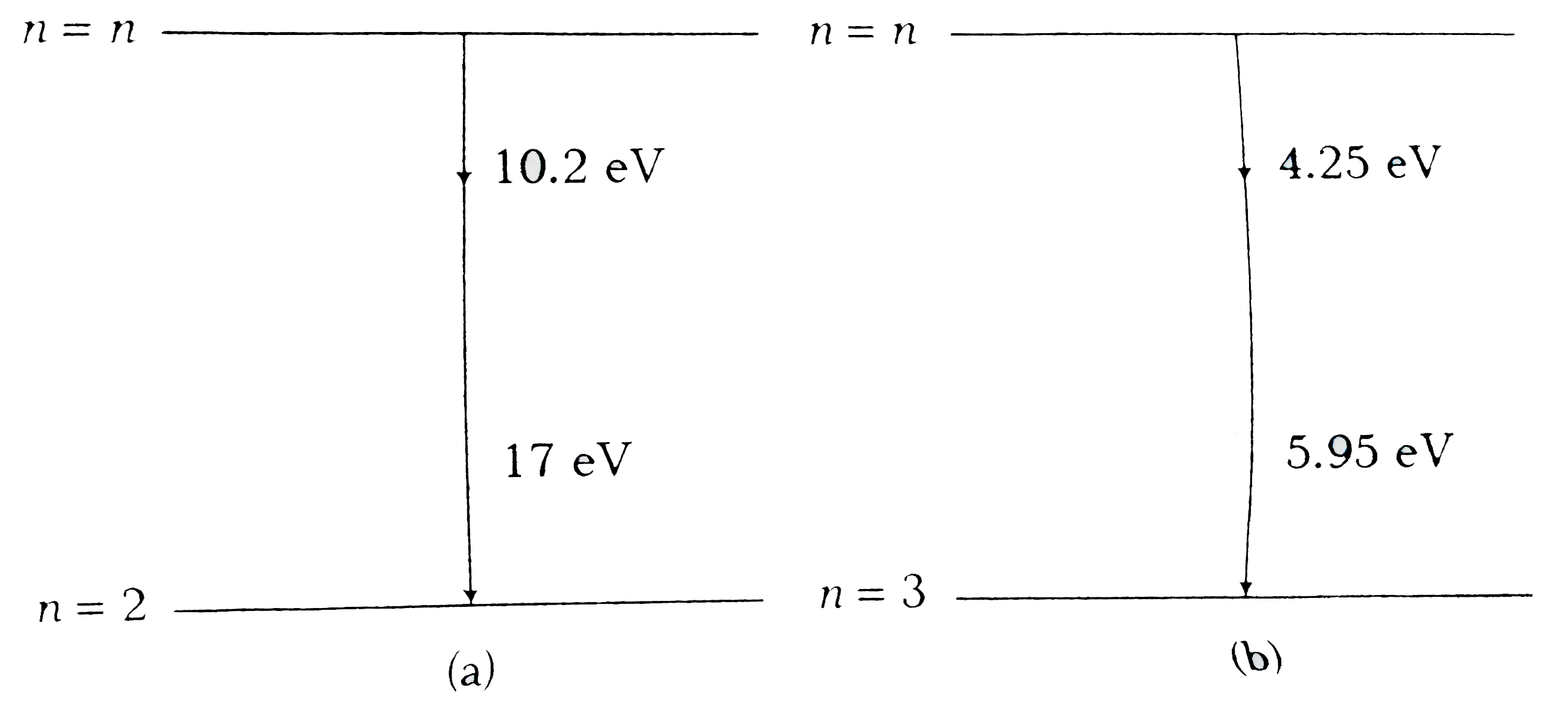
According to the question,

We, know energy of electron in nth is given by
`DeltaE=13.6Z^(2)((1)/(n_(1)^(2))-(1)/(n_(2)^(2)))`
Case I
Energy emitted by photon, `DeltaE=10.20+17`
=27.2 eV
So, `" " 10.2+17=13.6Z^(2)((1)/(2^2)-(1)/(n^(2)))" " ( :.n_(1)=2, n_(2)=n)`
`" " 27.2=13.6Z^(2)((1)/(4)-(1)/(n^(2)))" " ....(i)`
Case II
Energy emitted by photons, `Delta 4.25+5.95=10.2 eV`
`4.25xx5.95=13.6Z^(2)((1)/(3^(2))-(1)/(n^(2)))" " ( :.n_(1)=3,n_(2)=n)`
`10.2=13.6 Z^(2)((1)/(9)-(1)/(n^(2)))" " ....(ii)`
On divinding Eq. (i) by Eq. (ii) we get
`(27.22)/(10.2)=(1//4-1//n^(2))/(1//9-1//n^(2))`
`rArr" "(27.2)/(9)-(27.2)/(n^(2))=(10.2)/(4)-(10.2)/(n^(2))`
`rArr" " (17.2)/(n^(2))=(27.9)/(9)-(10.2)/(4)`
`rArr" " n^(2)=36rArrn=6`
Substituding the value of n in Eq. (i) , we get
`27.2=13.6Z^(2)((1)/(4)-(1)/(n^(2)))=13.6Z^(2)((1)/(4)-(1)/(6^(2)))`
`=13.6 Z^(2)((1)/(4)-(1)/(36))=13.6 Z^(2)((9-1)/(36))=13.6Z^(2)xx(2)/(9)`
`Z^(2)=9rArrZ=3`
Promotional Banner

Topper's Solved these Questions

  • ATOMS

    DC PANDEY|Exercise Check point 12.1|14 Videos
  • ATOMS

    DC PANDEY|Exercise Check point 12.2|16 Videos
  • ALTERNATING CURRENT

    DC PANDEY|Exercise JEE MAIN|63 Videos
  • CAPACITORS

    DC PANDEY|Exercise OBJECTIVE_TYPE|1 Videos

Similar Questions

Explore conceptually related problems

A hydrogen like atom (atomic number Z) is in a higher excited satte of quantum number n .This excited atom can make a transition to the first excited state by succesively emitting two photon of energies 10.20 eV and 17.00 eV .Alternatively, the atom from the same excited state can make a transition to the second excited state by successively emitting twio photon of energy 4.25 ev and 5.95 eV Determine the followings: The excited sate (n) of the atom is

A hydrogen like atom (atomic number Z) is in a higher excited satte of quantum number n .This excited atom can make a transition to the first excited state by succesively emitting two photon of energies 10.20 eV and 17.00 eV .Alternatively, the atom from the same excited state can make a transition to the second excited state by successively emitting twio photon of energy 4.25 ev and 5.95 eV Determine the followings: The hydrogen -like atom in the question is

A hydrogen like atom (atomic number Z) is in a higher excited satte of quantum number n .This excited atom can make a transition to the first excited state by succesively emitting two photon of energies 10.20 eV and 17.00 eV .Alternatively, the atom from the same excited state can make a transition to the second excited state by successively emitting twio photon of energy 4.25 ev and 5.95 eV Determine the followings: The atom during transition from n = 1 to n = 2 emit radiation in the region of

A hydrogen like atom (atomic number z ) is in a higher excited state of quantum number n . This excited atom can make a transition to the first excited state by successively emitting two photons of energies 10.2 eV and 17.0 eV respectively. Alternatively the atom from the same excited state can make a transition to the second excited state by successively emitting 2 photons of energy 4.25 eV and 5.95 eV respectively. Determine the value of (n+z)

A hydrogen like species (atomic number Z) is present in a higher excited state of quantum number n. This excited atom can make a transitionn to the first excited state by successive emission of two photons of energies 10.20 eV and 17.0 eV respectively. Altetnatively, the atom from the same excited state can make a transition to the second excited state by successive of two photons of energy 4.25 eV and 5.95 eVv respectively. Determine the value of Z.

A hydrogen like atom (atomic number Z) is in a higher excited state of quantum number n. The excited atom can make a transition ot the first excited state by successively emitting two photons of energy 10.2 eV and 17.0 eV, respectively. Alternatively, the atom from the same excited state can make a transition to the second excited state by successively emitting two photons of energies 4.25 eV and 5.95 eV, respectivley Determine the values of n and Z. (lonization energy of H-atom = 13.6 eV)

A hydrogen-like atom (aatomic number Z ) is in a hight excited state of quantum number n . This excited atom can make a transition to the first excited state by successively emitting two proton of energy 10.20 e V and 17.00 e V , respectively. Alternatively , the atom from the same excited state can make a transition to the second excited state by successively emitting two proton of energy 4.25 e V and 5.954 e V , respectively. Determine the value of n and Z (ionization energy of hydrogen atom = 13.6 eV)

A hydrogen like atom (atomic number = Z) is in higher excited state of quantum number n. This excited atom can make a transition to first excited state by successively emitting two photons of energy 22.94 eV and 5.15 eV . The atom from the same state n can make transition to second excited state by successively emitting two photons of energies 2.4 eV and 8.7 eV . Find values of n and Z.

DC PANDEY-ATOMS-MEDICAL ENTRANCES GALLERY
  1. A hydrogen like atom (atomic number Z) is in a higher excited sate o...

    Text Solution

    |

  2. Given the value of Rydberg constant is 10^(7)m^(-1), the waves number ...

    Text Solution

    |

  3. When an alpha particle of mass m moving with velocity v bombards on a ...

    Text Solution

    |

  4. Electrons with de- Broglie wavelength lambda fall on the target in an ...

    Text Solution

    |

  5. If an electron in a hydrogen atom jumps from the 3rd orbit to the 2nd ...

    Text Solution

    |

  6. Number of spectral lines in hydrogen atom is

    Text Solution

    |

  7. Minimum excitation potential of Bohr's first orbit hydrogen atom is

    Text Solution

    |

  8. If the frequency of K(alpha), K(beta) and L(alpha) , X-ray lines of a...

    Text Solution

    |

  9. The magntic moment (mu) of a revolving electron around the mucleaus v...

    Text Solution

    |

  10. The ionization enegry of the electron in the hydrogen atom in its grou...

    Text Solution

    |

  11. A photon of wavelength 300nm interacts with a stationary hydrogen atom...

    Text Solution

    |

  12. Consider 3rd orbit of He^(+) (Helium) using nonrelativistic approach t...

    Text Solution

    |

  13. What is the wavelength of ligth for the least energetic photon emitted...

    Text Solution

    |

  14. The wavelength of k(alpha) X- rays produced by an X - rays tube is 0....

    Text Solution

    |

  15. The de-Broglie wavelength of an electron in 4th orbit is (where, r=rad...

    Text Solution

    |

  16. The de-Broglie wavelength of an electron is the same as that of a 50 k...

    Text Solution

    |

  17. The ionisation energy of hydrogen is 13.6 eV . The energy of the photo...

    Text Solution

    |

  18. Hydrogen atom in ground state is excited by a monochromatic radiation ...

    Text Solution

    |

  19. If, an electron in hydrogen atom jumps from an orbit of lelvel n=3 to ...

    Text Solution

    |

  20. In the spectrum of hydrogen atom, the ratio of the longest wavelength ...

    Text Solution

    |

  21. The Rutherford charge experiment proves than an atom consists of

    Text Solution

    |

