

Home
Class 12
PHYSICS
Consider an interference arrangement sim...

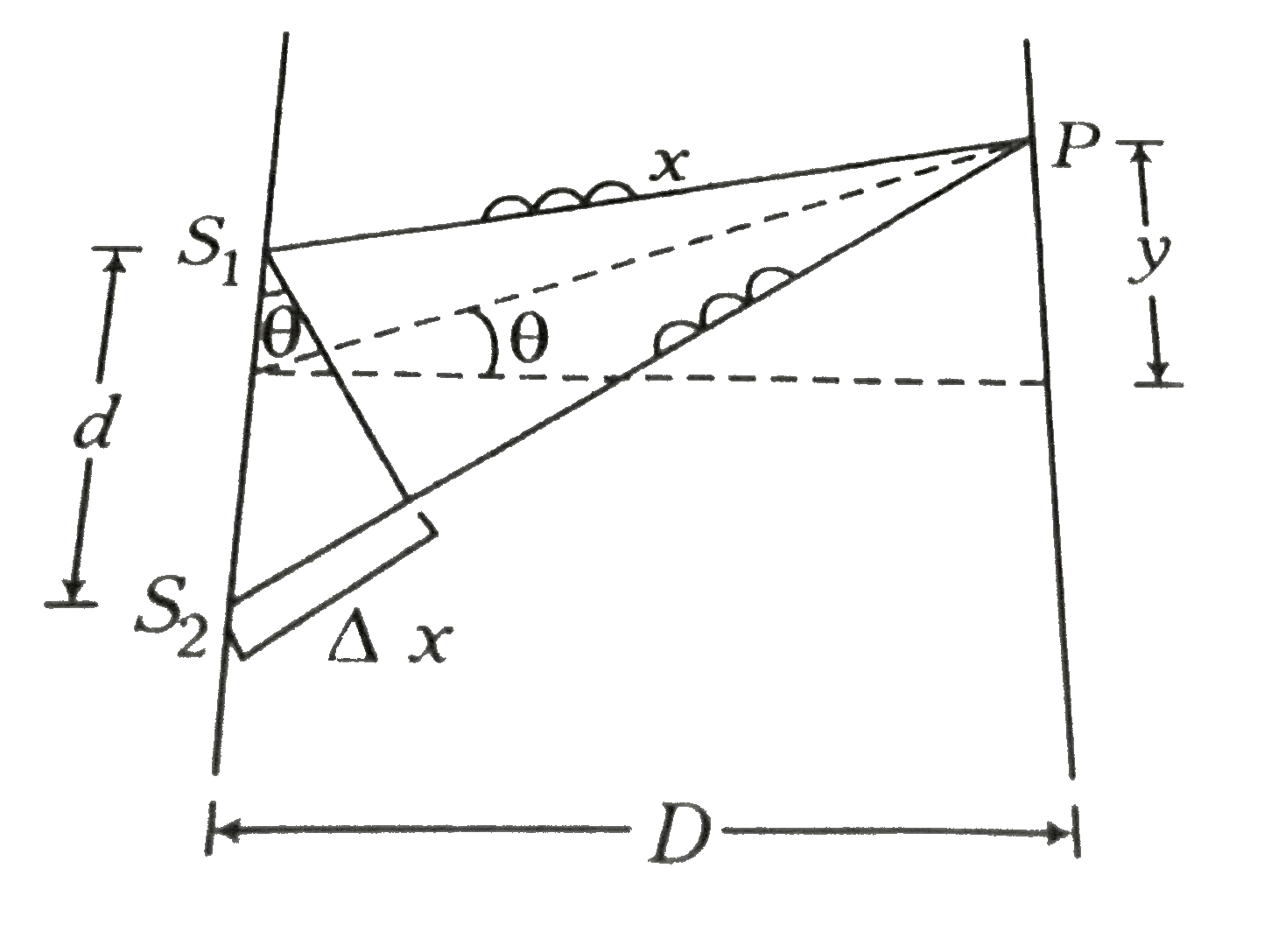
Consider an interference arrangement similar to YDSE. Slits `S_(1)` and `S_(2)` are illuminated with coherent microwave sources each of frequency 2 MHz. The sources are synchronised to have zero phase difference. The slits are separated by distance d= 75m. The intensity `I_((theta))` is measured as a function of `theta` where `theta` is defined as shown in figure. if `I_(0)` is maximum intensity then calculated `I_((theta))` for `(i) theta= 0^(@), (ii) theta=pi//6 and (iii) theta = pi//2`

Text Solution

Verified by Experts

Given `v=2` MHz`=10^(6)` Hz `d=75m`
As, `c=vlambda`
`rArrlambda=c/v=(3xx10^(8))/(2xx10^(6))=150m`
Path difference `Deltax=dsin theta`
Phase difference `theta =(2pi)/lambdaDeltax=(2pi)/lambdad sin theta=(2pi)/150xx75 sin theta`
`=pi sin theta`
Intensity at point P, `I=I_(0)cos^(2)(theta//2)=I_(0)cos^(2)((pisin theta)/2)`
`(i) theta=0, I=I_(0)`
`(ii) theta=pi/6=30^(@)`
`I=I_(0)cos^(2)((pi sin 30^(@))/2)=I_(0)cos^(2)(pi//4)=I_(0)/2`
`(iv) theta=pi/2=90^(@), I=0`
Promotional Banner

Topper's Solved these Questions

  • WAVE OPTICS

    DC PANDEY|Exercise Check point|65 Videos
  • WAVE OPTICS

    DC PANDEY|Exercise taking it together|47 Videos
  • SOLVED PAPERS 2018

    DC PANDEY|Exercise JIPMER|22 Videos

Similar Questions

Explore conceptually related problems

In an interference arrangement similar to double-slit experiment, S_(1) and S_(2) are illuminated with coherent source microwave source each of frequency 1 MHz. the sources are synchronized to have zero phase difference . This slits are separated by distance d = 150.0m The intensity I (theta) is measured as a funciton of theta , where theta is defined as shown in figure. If I_(0) is maximum intensity, calculate I (theta) For : a. theta = 0 b. theta = 30^(@) c. theta = 90^(@)

In an interference arrangement similar to young's double slit experiment the slits S_(1) and S_(2) are illuminated with coherent microwave sources each of frequency 10^(6)Hz the sources are synchronized to have zero phase difference. the slits are separated by a distance d=150.0m. The intensity I(theta) is measured as a funtion of theta , where theta is defined as shown. if I_(0) is the maximum intensity then I(theta) for 0lethetale90^(@) is given by:

In an interference arrangement similar to Young's double-slit experiment, the slits S_1 and S_2 are illuminated with coherent microwave sources, each of frequency 10^6 Hz. The sources are synchronized to have zero phase difference. The slits are separated by a distance d=150.0 m. The intensity I (theta) is measured as a function of theta, where theta is defined as shown. If I_0 is the maximum intensity, then I (theta) for 0lethetale90degree is given by

In a interference arrangement similar to Young's double-slit experiment ,the slits S_(1) and S_(2) are illuminated with coheremt microwave source ,each of frequencies 10^(6) Hz.The source are syhronized to have zero phase difference.The slits are separated by a distance from S_(1) and S_(2) where theta is defined as shown if I_(0) is the maximum intensity then

S_(1) and S_(2) are two coherent sources of sound of frequency 110Hz each they have no initial phase difference. The intensity at a point P due to S_(1) is I_0 and due to S_2 is 4I_0 . If the velocity of sound is 330m//s then the resultant intensity at P is

Consider interference between waves form two sources of intensities I&4I .Find intensities at point where the phase difference is pi

If theta = 45^0 , then : (i) tan^2 theta + 1/(sin^2 theta) (ii) cos^2 theta - sin^2 theta