Home
Class 12
PHYSICS
Consider a light beam incident from air ...

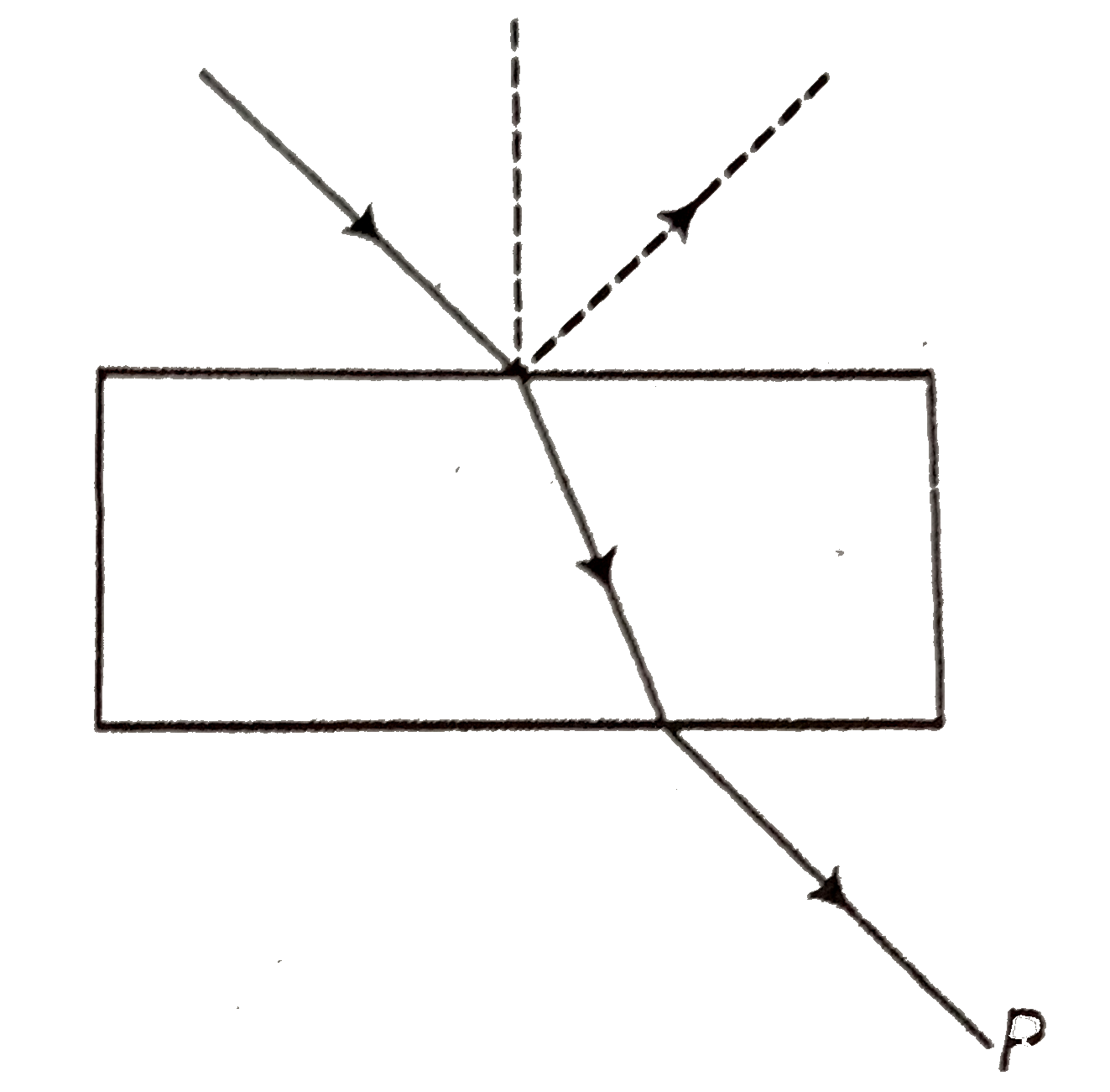
Consider a light beam incident from air to a glass slab at Brewster's angle as shown in figure.
A polaroid is placed in the path of the emergent ray at point P and rotated about an axis passing through the centre and pependicular to the plane of the plaroid.

A

For a particular orientation, there shall be darkness as observed through the polaroid

B

The intensity of light as seen through the polaroid shall be independent of the rotation

C

The intensity of light as seen through the polaroid shall go through a minimum byt not zero for two orientations of the polaroid

D

The intensity of light as seen through the polaroid shall go through a minimum for four orientations of the polaroid

Text Solution

Verified by Experts

The correct Answer is:
C

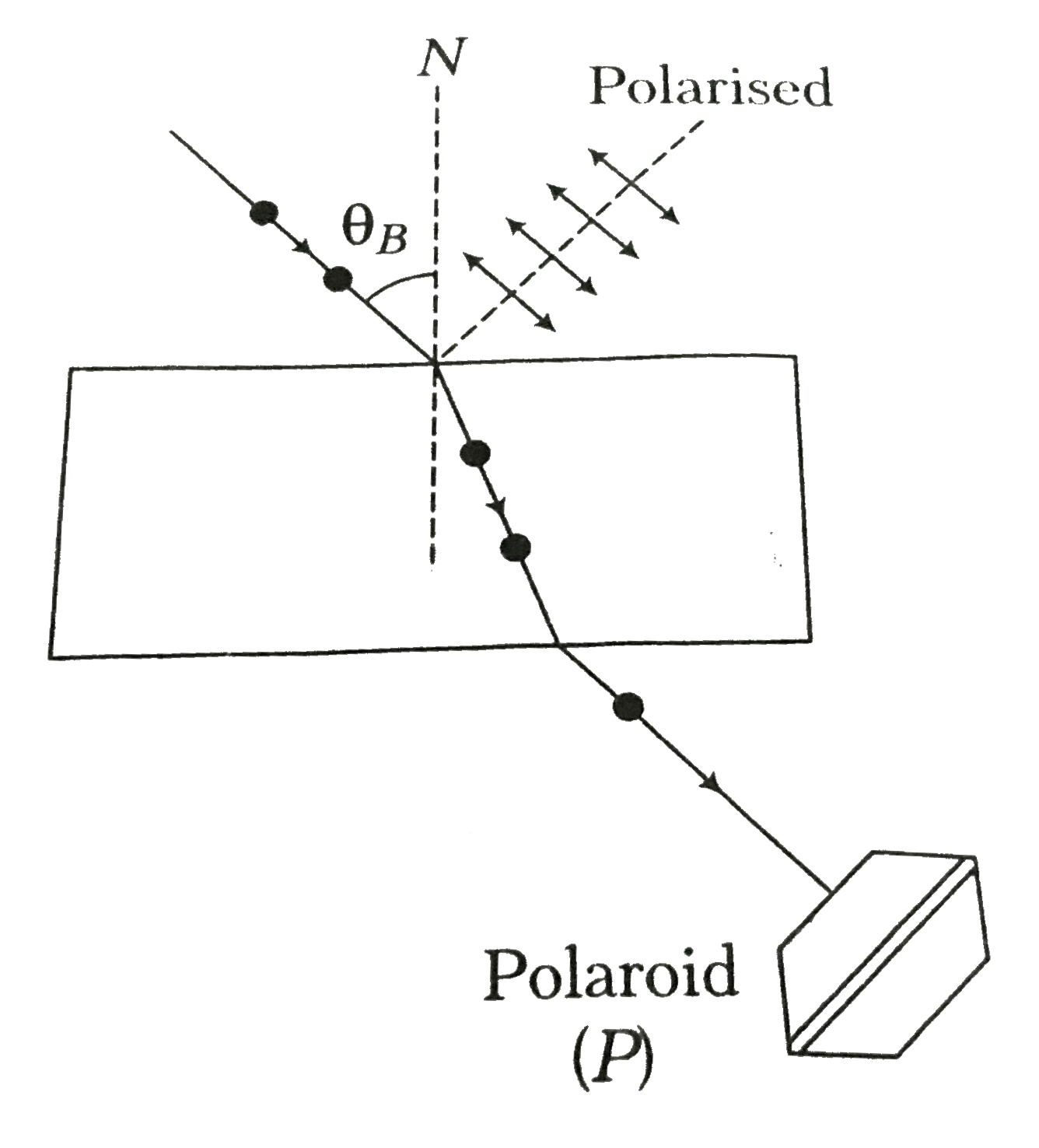
Consider the diagram the light beam the incident from air to the glass slab at Brewster's angle `(i_(P))` The incident ray is unpolarised and is re[resented by dot (.)
The reflected light is plane polarised represented by arrows As the emergent ray is plane polarised represented by arrows As the emergent ray is unpolarised hence intensity cannot be zero when passes through polaroid
Promotional Banner

Topper's Solved these Questions

  • WAVE OPTICS

    DC PANDEY|Exercise Assertion reason|10 Videos
  • WAVE OPTICS

    DC PANDEY|Exercise match column|4 Videos
  • WAVE OPTICS

    DC PANDEY|Exercise Check point|65 Videos
  • SOLVED PAPERS 2018

    DC PANDEY|Exercise JIPMER|22 Videos

Similar Questions

Explore conceptually related problems

Consider a light beam incident from air to a glass slab at Brewster's angle as shown in Figure. A polaroid is placed in the path of the emergent ray at point P and rotated an axis passing through the centre and perpendicular to the plane of the polaroid.

White light is incident on the interface of glass and air as shown in figure. If green ligth is just totally internally reflected then the emerging ray in air contains

A short pulse of white light is incident from air to a glass slab at normal incidence. After travelling through the slab, the first colour to emerge is.

A plane mirror, reflecting a ray of incident light, is rotated through an angle theta about an axis through the point of incidence in the plane of the mirror perpendicular to the plane of incidence, then

A light ray is incident on a plane glass slab of thickness ‘t’ at an angle of incidence ‘i’ as shown in the figure. If mu is the refractive index of glass. Then find time taken by the light ray to travel through the slab.

A plane mirror reflecting a ray of incident light is rotated through an angle of 30^@ about an axis through the point of incidence in the plane of the mirror and perpendicular to the plane of incidence then

A ray of light is incident on a parallel-sided glass slab as shown in the figure. The angle of refraction for this ray of light is likely to be :

A ray of light AO in vacuum is incident on a glass slab at angle 60^(@) and refracted at angle 30^(@) along OB as shown in the figure.The optical path length of light ray from A to B is

DC PANDEY-WAVE OPTICS-taking it together
  1. Consider sunlight incident on a slit of width 10^(4) Å . The image see...

    Text Solution

    |

  2. In Young's double-slit experiment the angular width of a fringe formed...

    Text Solution

    |

  3. Consider a light beam incident from air to a glass slab at Brewster's ...

    Text Solution

    |

  4. Two waves of same frequency and same amplitude from two monochromatic ...

    Text Solution

    |

  5. What is the minimum thickness of a soap bubble needed for constructive...

    Text Solution

    |

  6. Monochromatic light from a narrow slit illuminates two parallel slits ...

    Text Solution

    |

  7. Lights of wavelengths lambda(1)=4500 Å, lambda(2)=6000 Å are sent thro...

    Text Solution

    |

  8. Estimate how large can be the aperture opening to work with laws of ra...

    Text Solution

    |

  9. Two slits at a distance of 1mm are illuminated by a light of wavelengt...

    Text Solution

    |

  10. In a Young's double slit experiment, 12 fringes are observed to be for...

    Text Solution

    |

  11. A parallel beam of monochromatic light of wavelength 5000Å is incident...

    Text Solution

    |

  12. In Young's double slit experiment, the 10th maximum of wavelength lamb...

    Text Solution

    |

  13. It is found that what waves of same intensity from two coherent source...

    Text Solution

    |

  14. The two slits are 1 mm apart from each other and illuminated with a li...

    Text Solution

    |

  15. What is the minimum thickness of a soap bubble needed for constructive...

    Text Solution

    |

  16. A thin mica sheet of thickness 4xx10^(-6) m and refractive index (mu=1...

    Text Solution

    |

  17. Light of wavelength 589.3nm is incident normally on the slit of width ...

    Text Solution

    |

  18. Young's double slit experiment is made in a liquid. The tenth bright f...

    Text Solution

    |

  19. Two beams of ligth having intensities I and 4I interface to produce a ...

    Text Solution

    |

  20. In a Young's double slit experiment using red and blue lights of wavel...

    Text Solution

    |

