Home
Class 12
PHYSICS
Colours of thin soap bubbles are due to...

Colours of thin soap bubbles are due to

A

interference

B

scattering

C

diffraction

D

dispersion

Text Solution

Verified by Experts

The correct Answer is:
A

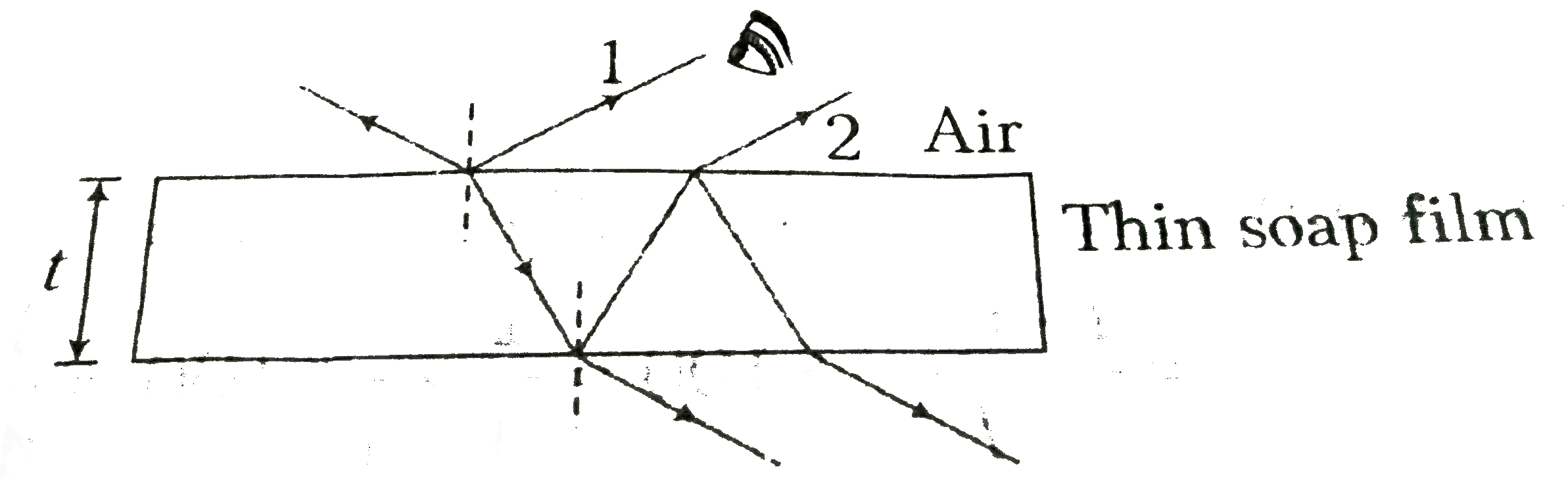
The diagram below shows a thin soap film and a soap bubble

The rays 1 and 2 produce the phenomenon of interference when they meet. The path difference between the rays are proportional to thickness of film
i.e., path difference `(Deltax)propt`
As, thickness t varies so `Deltax` varies, maximas and minimas appear for different wavelengths in incident white light When white light is to used to the path difference (phase differences) will satisfy the condition of maxima for certain wavelengths and condition of minima for other wavelengths This gives coloured appearance of the film
Promotional Banner

Topper's Solved these Questions

  • WAVE OPTICS

    DC PANDEY|Exercise For JEE main (Only one option is Correct )|22 Videos
  • WAVE OPTICS

    DC PANDEY|Exercise For JEE Advanced Only one option is correct|23 Videos
  • WAVE OPTICS

    DC PANDEY|Exercise match column|4 Videos
  • SOLVED PAPERS 2018

    DC PANDEY|Exercise JIPMER|22 Videos

Similar Questions

Explore conceptually related problems

Coloujrs of thin soap bubbles are due to

Dark and colour patterns on thin soap films are due to-

The radius of a soap bubble is r. the surface tension of soap solution is T, keeping temperature constant, the radius of the soap bubble is doubled the energy necessary for this will be-

If the volume of two soap bubbles are V and 8V bubbles is

Under isothermal condition, energy E is supplied to a soap bubble of surface tension sigma and radius r, to double the radius of the soap bubble. The value of E is

What is the difference in the origin of colours of a soap bubble seen in sun ligth and the colours emerging from a prism ?

When a soap bubble is charged :-

Colours thin films are due to

DC PANDEY-WAVE OPTICS-medical entrances
  1. Two doherent sources of intensity ratio alpha interfere in interferenc...

    Text Solution

    |

  2. Two coherent monochromatic light beams of intensities I and 4I are sup...

    Text Solution

    |

  3. Colours of thin soap bubbles are due to

    Text Solution

    |

  4. In Young's double slit experiment, the ratio of maximum and minimum in...

    Text Solution

    |

  5. In Young's double slit interference experiment, using two coherent wav...

    Text Solution

    |

  6. The angle of incidence at which reflected light is totally polarized f...

    Text Solution

    |

  7. A polarised light intensity I(0) is passed through another polariser w...

    Text Solution

    |

  8. A fringe width of a certain interference pattern is beta=0.002 cm What...

    Text Solution

    |

  9. In Young's double-slit experiment, the slits are 2mm apart and are ill...

    Text Solution

    |

  10. If two slits is Young's experiment are 0.4 mm apart and fringe width o...

    Text Solution

    |

  11. Light of wavelength lambda from a point source falls on a small circul...

    Text Solution

    |

  12. Which of the following phenomena support the wave theory of light? 1...

    Text Solution

    |

  13. lambda(1) and lambda(2) are used to illuminated the slits. beta(1) and...

    Text Solution

    |

  14. When we close one slit in the Young's double slit experiment then

    Text Solution

    |

  15. A beam of light is incident on a glass slab (mu = 1.54) in a direction...

    Text Solution

    |

  16. In Young's double slit experiment, the phase difference between the tw...

    Text Solution

    |

  17. A parallel beam of fast moving electrons is incident normally on a nar...

    Text Solution

    |

  18. White light reflected from a soap film (Refractive index =1.5 ) has a ...

    Text Solution

    |

  19. In Young's double slit experiment, the fringe width is 1 xx 10^(-4) m...

    Text Solution

    |

  20. Assertion: To observe diffraction of light the size of obstacle/apertu...

    Text Solution

    |

