Home
Class 12
PHYSICS
In the given figure ,C is middle point o...

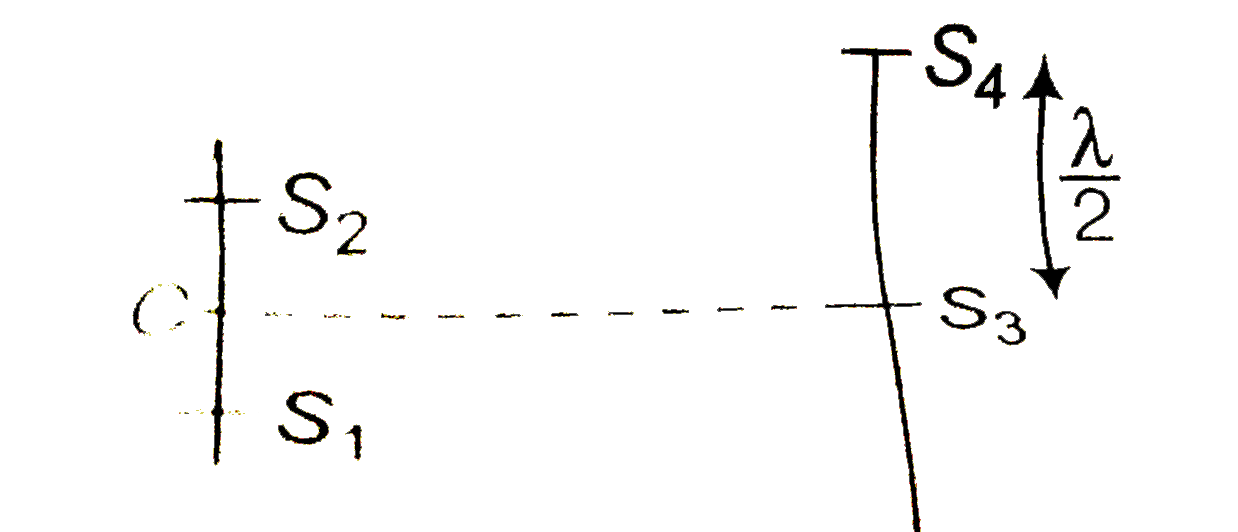
In the given figure ,C is middle point of line `S_(1)S_(2)`.A monochromatic light of wavelength `gamma` is incident on slits.The ratio of intensites of `S_(3) and S_(4)` is

A

0

B

`oo`

C

`4:1`

D

`1:4`

Text Solution

Verified by Experts

The correct Answer is:

B

At `S_(3), trianglex=S_(1)S_(3)-S_(2)S_(3)=0`
`therefore theta = (2pi)/(lamdba) trianglex=0`
`I_(3) =I_(0)+I_(0)+2sqrt(I_(0)xxI_(0)) cos^(@) rArr I_(3)=4I_(0)`
The path difference at `S_(4)` is
`trianglex' =S_(1)S_(4)-S_(2)S_(4)=(dy)/(d)=(d)/(D)=(d)/(D)xx(lambdad)/(2d)=(lambda)/(2) " "(thereforeY)=(lambdaD)/(2d)`
`therefore Phi'=(2pi)/(lambda)xx(lambda)/(2)=pi`
`rArr I_(4)=I_(0)+I_(0)+2I_(0)cospi=0rArr(I_(3))/(I_(4))=(4I_(0))/(0)=oo`
Promotional Banner

Topper's Solved these Questions

  • SOLVED PAPER 2017

    DC PANDEY|Exercise Solved papers 2017(JIPMER)|32 Videos
  • SOLVED PAPER 2017

    DC PANDEY|Exercise Solved papers 2017(JIPMER)|32 Videos
  • SEMICONDUCTORS

    DC PANDEY|Exercise Subjective|12 Videos
  • SOLVED PAPERS 2018

    DC PANDEY|Exercise JIPMER|22 Videos

Similar Questions

Explore conceptually related problems

In YDSE monochromatic light of wavelength 600 nm incident of slits as shown in figure. If S_(1)S_(2) = 3mm, OP=11 mm then

In arrangement shown in figure, plane wavefront of monochromatic light of wavelength lamda is incident on identical slits S_(1) and S_(2) . There is another pair of indentical slits S_(3) and S_(4) which are having separation Z = (lamda D)/(2d) Point O is on the screen at the common perpendicular bisector of S_(1)S_(2) and S_(3) S_(4).I_(1) is the intensity at point O Now the board having slits S_(3)S_(4) is moved upward parallel to itself and perpendicular to line AO till slit S_(4) is on line AO and it is observed that now intensity at point O is I_(2) then (I_(2))/(I_(1)) is :

Figure shows a YDSE setup having identical slits S_(1) and S_(2) with d =5 mm and D = 1 m. A monochromatic light of wavelength lamda = 6000 Å is incident on the plane of slit due to which at screen centre O, an intensity I_(0) is produced with fringe pattern on both sides Now a thin transparent film of 11 mu m thickness and refractive index mu = 2.1 is placed in front of slit S_(1) and now interference patten is observed again on screen. After placing the film of slit S_(1) , the intensity at point O screen is :

Figure shows a YDSE setup having identical slits S_(1) and S_(2) with d =5 mm and D = 1 m. A monochromatic light of wavelength lamda = 6000 Å is incident on the plane of slit due to which at screen centre O, an intensity I_(0) is produced with fringe pattern on both sides Now a thin transparent film of 11 mu m thickness and refractive index mu = 2.1 is placed in front of slit S_(1) and now interference patten is observed again on screen. Due to placement of film in front of S_(1) , how many bright fringes cross the point O of screen excluding the one which was at O earlier :

Consider the situation shown in fig. The two slits S_(1) and S_(2) placed symmetrically around the central line are illuminated by monochromatic light of wavelength lambda . The separation between the slit is d. The ligth transmitted by the slits falls on a screen S_(0) placed at a distance D form the slits. The slit S_(3) is at the central line and the slit S_(4) is at a distance z from S_(3) Another screen S_(c) is placed a further distance D away from S_(c) Find the ratio of the maximum to minimum intensity observed on S_(c) If z = (lambda D)/(4 d)

Consider the situation shown in fig. The two slits S_(1) and S_(2) placed symmetrically around the central line are illuminated by monochromatic light of wavelength lambda . The separation between the slit is d. The ligth transmitted by the slits falls on a screen S_(0) placed at a distance D form the slits. The slit S_(3) is at the central line and the slit S_(4) is at a distance z from S_(3) Another screen S_(c) is placed a further distance D away from S_(c) Find the ratio of the maximum to minimum intensity observed on S_(c) If z = (lambda D)/(2 d)

Consider the situation shown in fig. The two slits S_(1) and S_(2) placed symmetrically around the central line are illuminated by monochromatic light of wavelength lambda . The separation between the slit is d. The ligth transmitted by the slits falls on a screen S_(0) placed at a distance D form the slits. The slit S_(3) is at the central line and the slit S_(4) is at a distance z from S_(3) Another screen S_(c) is placed a further distance D away from S_(c) Find the ratio of the maximum to minimum intensity observed on S_(c) If z = (lambda D)/(d)

Consider two coherent, monochromatic (wavelength lambda ) sources S_(1) and S_(2) , separated by a distance d. The ratio of intensities of S_(1) and that of S_(2) (which is responsible for interference at point P, where detector is located) is 4. The distance of point P from S_(1) is (if the resultant intensity at point P is equal to (9)/(4) times of intensity of S_(1) ) ("Given : "angleS_(2)S_(1)P=90^(@), d gt0 and n" is a positive integer")

Consider the situation shown in figure-6.35. The two slits S_(1) and S_(2) placed symmetrically around the central line are illuminated by a monochromatic light of wavelength lambda . The separation between the slits is d. The light transmitted by the slits falls on a screen E_(1) placed at a distance D from the slits. The slit S_(3) is at the central line and the slit S_(4) is at a distance z from S_(3) . Another screen E_(2) is placed a further distance D away from E_(1) . Find the ratio of the maximum to minimum intensity observed on E_(2) if z is equal is : (a) (lambdaD)/(2d) " "(b) (lambdaD)/(d)" " (c )(lambdaD)/(4d)

DC PANDEY-SOLVED PAPER 2017-Solved papers 2017(AIIMS)
  1. The effective resistance between p and q in given figure is

    Text Solution

    |

  2. Charges +q and -q are placed at points A and B respectively which are ...

    Text Solution

    |

  3. In the given figure ,C is middle point of line S(1)S(2).A monochromati...

    Text Solution

    |

  4. A simple telescope, consisting of an objective of focal length 60 cm a...

    Text Solution

    |

  5. A Specimen of silicon is to be made P-type semiconductor for this one ...

    Text Solution

    |

  6. The angle of dip if dip needleoscillating in vertical plane makes 40 ...

    Text Solution

    |

  7. Two batteries, one of emf 18V and internal resistance 2Omega and the o...

    Text Solution

    |

  8. The Young's experiment is performed with the lights of blue (lambda=43...

    Text Solution

    |

  9. Construct a proper combination of 3 NOT and one AND gates in order to ...

    Text Solution

    |

  10. Assertion A beam of charged particles is employed in the treatment of...

    Text Solution

    |

  11. Assertion In He-Nelaser, population inversion takes place between ener...

    Text Solution

    |

  12. Assertion The average value of alternating emf is 63.39% of the peak v...

    Text Solution

    |

  13. Assertion Photoelectric effect can take place only with an electron bo...

    Text Solution

    |

  14. Assertion: Cyclotron does not accelerate. Reason: Mass of the elect...

    Text Solution

    |

  15. Assertion: The electric field due to dipole on its axis line at a dist...

    Text Solution

    |

  16. Assertion A potentiometer is preferred over that of a voltmeter for me...

    Text Solution

    |

  17. Assetion The magnetism of magnet is due to the spin motion of electron...

    Text Solution

    |

  18. Assertion : The mirrorrs used in search lights are parabolic and not c...

    Text Solution

    |

  19. Assertion : Corpuscular theory fails to explain the velocities of ligh...

    Text Solution

    |

  20. Assetion In alpha-decay atomic number of daughter nucleus reduces by 2...

    Text Solution

    |
