

Home
Class 11
PHYSICS
A steel wire AB of length 85cm at 10^(@)...

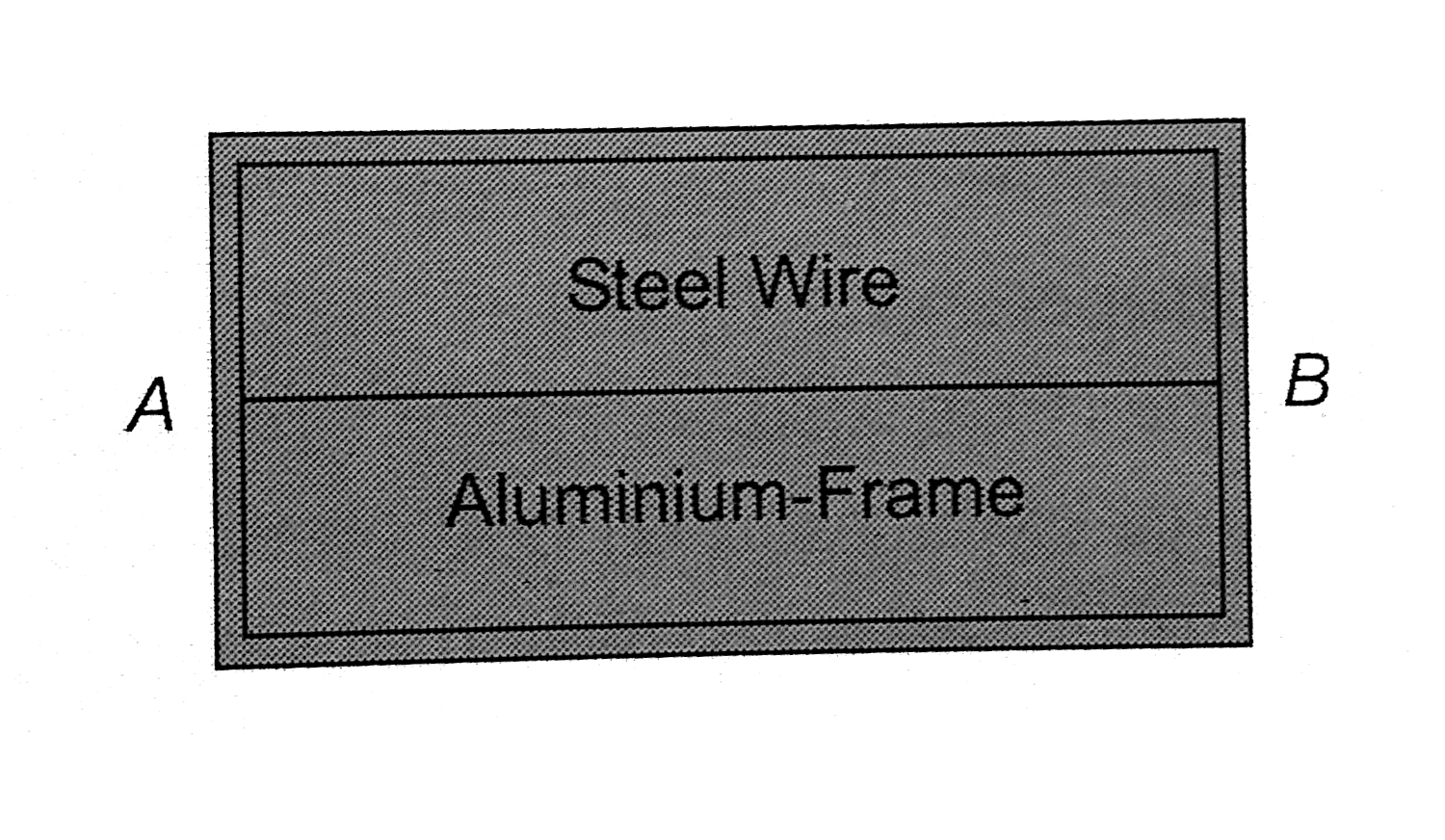
A steel wire `AB` of length `85cm` at `10^(@)C` is fixed rigidly at points `A` and `B` in an aluminium frame as shown. If the temperature of the system is raised to `110^(@)C` , what extra stress will be produced in the wire relative to aluminium frame. Assume that coefficient of linear expansion for aluminium and steel are `23xx10^(-6)//^(@)C` and `11xx10^(-6)//^(@)C` respectively and Young's moduls for steel is `2xx10^(11)` pa.

Promotional Banner

Similar Questions

Explore conceptually related problems

A steel wire AB of length 100 cm is fixed rigidly at points A and B in an aluminium frame as shown in the figure. If the temperature of the system increases through 100^(@)C , then the excess stress produced in the steel wire relative to the aluminium? alpha_(Al) = 22 xx 10^(-6 //0) C and alpha_(steel) = 11 xx 10^(-6 //0) C young's Modulus of steel is 2 xx 10^(11) Nm^(-2) .

What should be the sum of lengths of an aluminium and steel rod at 0^(@)C is, so that all the temperature their difference in length is 0.25m . (Take coefficient of linear expansion for aluminium and steel at 0^(@)C as 22 xx 10^(-6)//.^(@)C and 11 xx 10^(-5)//.^(@)C respectively.)

What should be the sum of lengths of an aluminium and steel rod at 0^(@)C is, so that all the temperature their difference in length is 0.25m . (Take coefficient of linear expansion for aluminium and steel at 0^(@)C as 22 xx 10^(-6)//.^(@)C and 11 xx 10^(-5)//.^(@)C respectively.)

A steel scale is correct at 0^(@)C . The length of a brass tube measured by it at 40^(@)C is 4.5 m. The correct length of the tube at 0^(@)C is (Coefficients of linear expansion of steel and brass are 11xx10^(-6)//""^(@)Cand19xx10^(-6)//""^(@)C respectively.)

A steel scale is correct at 0^(@)C . The length of a brass tube measured by it at 40^(@)C is 4.5m . The correct length of the tube at 0^(@)C is (Coefficients of linear expansion of steel and brass are 11 xx 10^(-6//@)C and 19 xx 10^(-6//@)C respectively).

A steel wire of length 20 cm and uniform cross-sectional area of 1 mm^(2) is tied rigidly at both the ends at 45^(@)C . If the temperature of the wire is decreased to 20^(@)C , then the change in the tension of the wire will be [Y for steel = 2 xx 10^(11 Nm^(-2) , the coefficient of linear expansion for steel = 1.1 xx 10^(-5)//.^(@)CC^(-1) ]

A thin brass sheet at 20^(@)C and a thin steel sheet at 30^(@)C have the same surface area. The common tempreture at which both would have the same area is (Coefficient of linear expansion for brass and steel are respectively, 19xx10^(-6)//^(@)C are 11xx10^(-6)//^(@)C )

A steel wire 2 mm in diameter is just stretched between two fixed points at a temperature of 20^(@)C. If the temperature falls to 10^(@)C, then the tension in the wire is (The coefficient of linear expansion of steel = 11xx10^(-6)//^(@)C and Y for steel 2.1 xx10^(11)N//m^(2))