Home
Class 11
ECONOMICS
The monthly per capita expenditure incur...

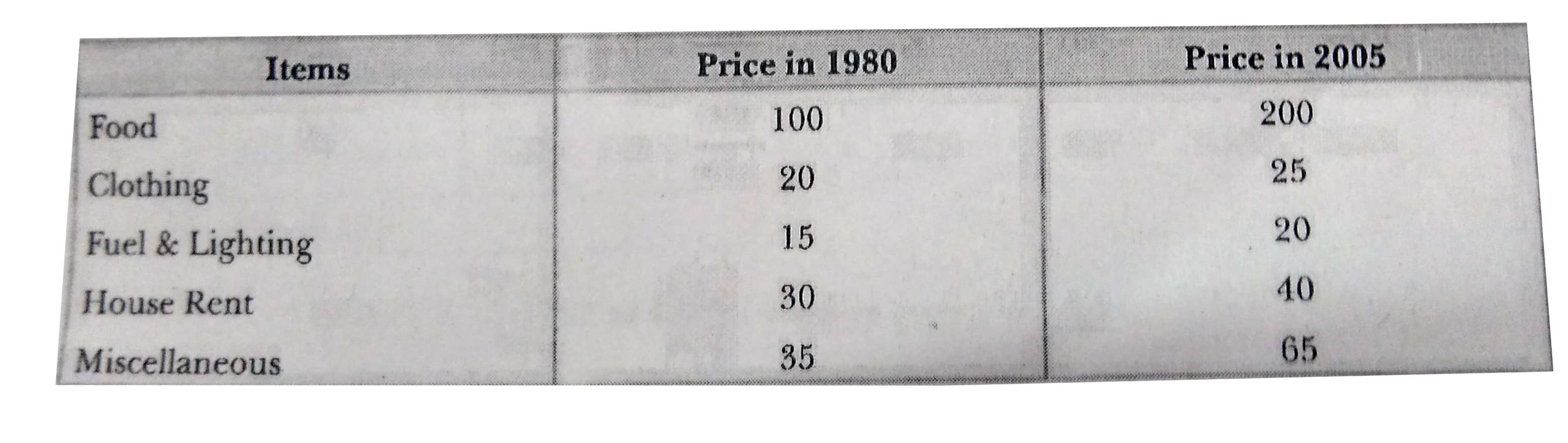
The monthly per capita expenditure incurred by workers for an industrial centre during 1980 and 2005 on the following items are given below. The weights of these items are 75, 10, 5, 6 and 4 respectively . Prepare a weighted index number for cost of living for 2005 with 1980 as the base.

Text Solution

Verified by Experts
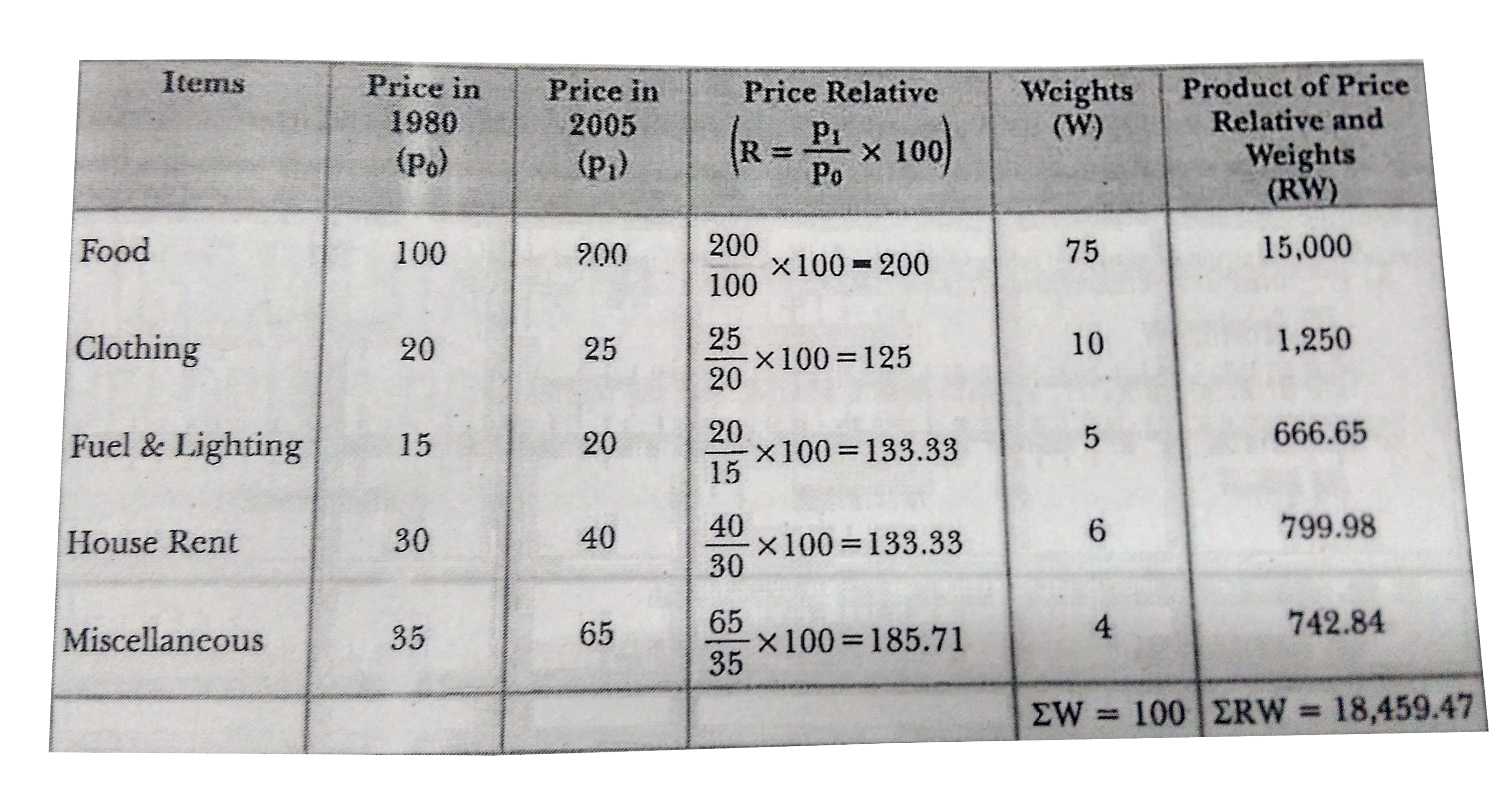

Weighted Index Number `=(sumRW)/(sumW)=(18,459.47)/(100)=184.5947~ 184.6 `
`:.` Weighted index number = 184.6 .
Promotional Banner

Topper's Solved these Questions

  • INDEX NUMBERS

    TARUN JAIN & VK OHRI|Exercise Essential Practicals|18 Videos
  • FREQUENCY DIAGRAMS - HISTOGRAM, POLYGON AND OGIVE

    TARUN JAIN & VK OHRI|Exercise EXERCISE NCERT|7 Videos
  • MEASURES OF CENTRAL TENDENCY - ARITHMETIC MEAN

    TARUN JAIN & VK OHRI|Exercise Illustration|72 Videos

Similar Questions

Explore conceptually related problems

Crisis of June 1991 Major elements of the crisis situation which led the Government of India to announce economic reform were : .A serious fiscal crisis in which the fiscal deficit reached the level of 6.6 per cent of GDP in 1990-91. Heavy internal debt which rose to about 50 per cent of GDP with interest payments draining about 39 percent of total revenue collections of the central government. Low GNP growth rate which fell to 14 per cent from the peak level of 10.5 per cent in 1988-89 (at 1980-81 prices). Low overall agricultural production, foodgrain production and industrial production showed negative growth rates of -2.8 per cent,-5.3 per cent and -0.1 per cent respectively. Soaring inflation rate based both on wholesale price index and consumer price index (for industrial workers) at 13-14 per cent Shrinkage of foreign trade, imports (in terms) fell by 19.4 per cent and exports by 15 per cent. Depreciation of rupee by 26.7 per cent vis-à-vis US dollars. Fall of foreign exchange reserves to such a low level that they were barely adequate to meet the import requirements of a few weeks Non-resident Indians (NRIS) were withdrawing their deposits at an alarmingly high rate The confidence of the international financial institutions was badly shaken and in just over a year its creditworthiness rating fell from AAA to BB+ (put on credit watch). The country was on the verge of defaulting on international financial obligations and the situation warranted immediate policy action to save the situation. In May 1991, the Government had to lease 20 tons of gold out of its stock to the State Bank of India to enable it to sell the gold with repurchase option after six months. In addition, Reserve Bank of India was allowed to pledge 47 tones of gold to the Bank of England to raise a loan of $600 million Name one component of business environment affected in the above case. Explain it briefly

Crisis of June 1991 Major elements of the crisis situation which led the Government of India to announce economic reform were : .A serious fiscal crisis in which the fiscal deficit reached the level of 6.6 per cent of GDP in 1990-91. Heavy internal debt which rose to about 50 per cent of GDP with interest payments draining about 39 percent of total revenue collections of the central government. Low GNP growth rate which fell to 14 per cent from the peak level of 10.5 per cent in 1988-89 (at 1980-81 prices). Low overall agricultural production, foodgrain production and industrial production showed negative growth rates of -2.8 per cent,-5.3 per cent and -0.1 per cent respectively. Soaring inflation rate based both on wholesale price index and consumer price index (for industrial workers) at 13-14 per cent Shrinkage of foreign trade, imports (in terms) fell by 19.4 per cent and exports by 15 per cent. Depreciation of rupee by 26.7 per cent vis-à-vis US dollars. Fall of foreign exchange reserves to such a low level that they were barely adequate to meet the import requirements of a few weeks Non-resident Indians (NRIS) were withdrawing their deposits at an alarmingly high rate The confidence of the international financial institutions was badly shaken and in just over a year its creditworthiness rating fell from AAA to BB+ (put on credit watch). The country was on the verge of defaulting on international financial obligations and the situation warranted immediate policy action to save the situation. In May 1991, the Government had to lease 20 tons of gold out of its stock to the State Bank of India to enable it to sell the gold with repurchase option after six months. In addition, Reserve Bank of India was allowed to pledge 47 tones of gold to the Bank of England to raise a loan of $600 million State the explain one feature of business environment as reflected in the above para

The cost of living index of the year 2006, taking the year 2005 as the base year, is 225. The total expenditure in 2005 and 2006 are Rs. (2x+7y) and Rs. (7x+y) respectively, where x and y are positive integers. Which of the following can be the total expenditure in 2005 ? (in Rs.)

The distribution of James expenditure during 2005 is given below : His income = Rs. 1,80,000 in 2005. Study the diagram and answer the following questions. The ratio of James' income in the year 2004 and 2005 is 4:5 and the ratio of his expenditure on medicines is 3:2 . Aproximately what % of his income did he spend on medicines in 2004?

From the following items prepare a Bank Reconciliation Statement on 31st May 2015: (a) Bank balance as per Cash Book on 31st May 2015 ₹17,600. (b) Cash and cheques totalling ₹36,000 were sent to bank during May but one cheque of ₹11,800 was shown in the Pass Book on 2nd June. brgt (c ) As per instructions bankers have directly collected ₹4,100 from a a customer but there is no mention of it in the Cash Book. (d) Three cheques for ₹10,000, ₹12,000 and ₹4,800 respectively were drawn on 27th, May but the cheque for ₹4,800 was encashed on 1st June. (e ) On 31st May bankers had debited ₹45 as bank charges but there is no entry for it on 3rd June. (f) ₹16,200 were withdrawn from bank on 25th May but there is no entry for it in the Cash Book.

On certain consumable goods, the total expenditure of a family was found to be Rs. 18,000 in the year 2005. If the cost of living index for the year 2006, taking 2005 as the base year, is 240, then find the expenditure of the family on the same quantity of consumable items in the year 2006.

In India, in the overall Index of Industrial Production, the Indices of Eight Core Industries have a combined weight of 37.90%. Which of the following are among those Eight Core Industries ? 1. Cement 2. Fertilizers 3. Natural gas 4. Refinery products 5. Textiles Select the correct answer using the codes given below:

To maintain his health a person must fulfil certain minimum daily requiremens for several kinds of nutrients. Assuming that there are only thee kinds of nutrients-calcium, protein and calories and the person’s diet consists of only two food items, I and II, whose price and nutrient contents are shown in the table below: , Food I (per Ib), Food II (per Ib), Minimum daily requirement for the nutrient Calcium Protein Calories, 10 5 2, 5 4 6, 20 20 13 Price (Rs.), 60, 100, What combination of two food items will satisfy the daily requirement and entail the least cost? Formulate this as a LPP.

