Home
Class 9
MATHS
The diagonals of a parallelogram A B ...

The diagonals of a parallelogram `A B C D` intersect at `Odot` A line through `O` meets `A B\ ` in `x\ a n d\ C D` in `Ydot` Show that `a r\ (A X Y X)=1/2(a r|""|^(gm)\ \ A B C D)`

Text Solution

Verified by Experts
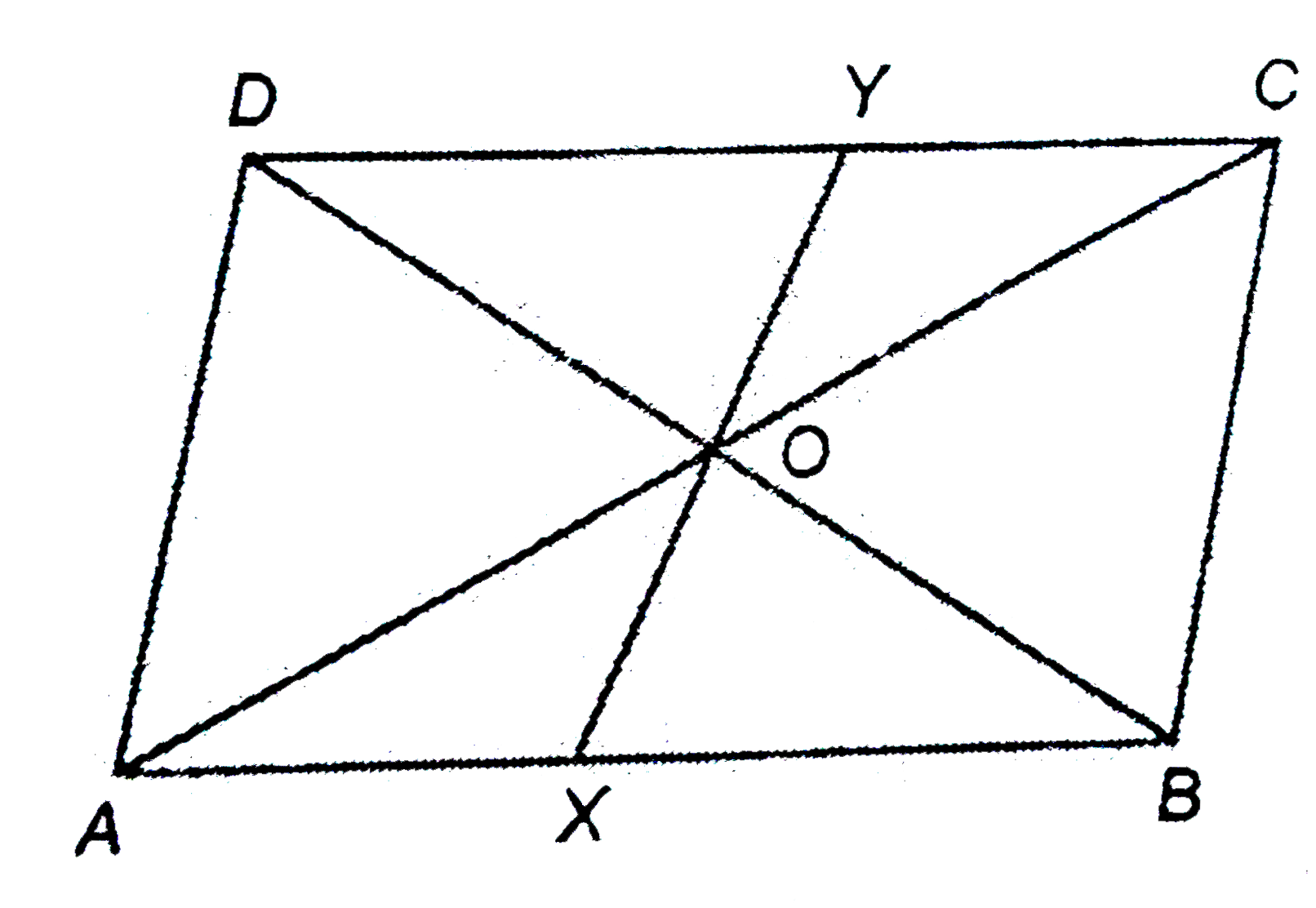

We know that, a diagonal of a parallelogram divides it into two triangles of equal areas.
Now, AC is the diagonal of parallelogram ABCD
`:. " area of "DeltaACD = (1)/(2) xx " are of " square ABCD`...(1)
In `Delta AOX and Delta COY`,
`.:{(AO = CO),(angleAOX = angleCOY),(angleOAX = angleOCY):}`
`:. Delta AOX ~= Delta COY`
`rArr` area of `Delta AOX =` area of `DeltaCOY`
Now, area of `Delta ACD =` are of `squareAOYD + " area of " Delta OCY`
`- " area of " squareAOYD + " area of " Delta AOX` [from (2)]
= area of `squareAXYD`
`:.` From (1), we get
area of `square AXYD = (1)/(2) xx " area of " square ABCD`
Promotional Banner

Topper's Solved these Questions

  • AREA OF PARALLELOGRAMS AND TRIANGLES

    NAGEEN PRAKASHAN|Exercise Problems From NCERT/exemplar|12 Videos
  • AREA OF PARALLELOGRAMS AND TRIANGLES

    NAGEEN PRAKASHAN|Exercise Exercise|34 Videos
  • CIRCLE

    NAGEEN PRAKASHAN|Exercise Revision Exercise (long Answer Questions )|5 Videos

Similar Questions

Explore conceptually related problems

The diagonals of a parallelogram A B C D intersect at Odot A line through O meets A B in X and C D in Ydot Show that a r( A X Y D)=1/2(A R ^(gm)A B C D)

The diagonals of a parallelogram A B C D intersect at OdotA line through O intersects A B\ at X\ a n d\ D C at Ydot Prove that O X=O Y

A B C D is a parallelogram whose A C\ a n d\ B D intersect at Odot A line through O intersects A B\ a t\ P\ a n d\ D C\ at Qdot Prove that a r\ (\ P O A)=\ a r\ (\ Q O C)dot

A B C D is a parallelogram whose diagonals A C and B D intersect at Odot A Line through O intersects A B at P and D C at Qdot Prove that a r( P O A)=a r( Q O C)dot

The diagonals of a parallelogram A B C D intersect at a point Odot Through O , a line is drawn to intersect A D\ at P and B C at Qdot Show that P Q divides the parallelogram into two parts of equal area.

The diagonals of a rectangle A B C D\ meet at O . If /_B O C=44^0, find /_O A D

The side A B of a parallelogram A B C D is produced to any point Pdot A line through A parallel to C P meets C B produced in Q and the parallelogram P B Q R completed. Show that a r(^(gm)A B C D)=a r(^(gm)B P R Q)dot CONSTRUCTION : Join A C and PQ. TO PROVE : a r(^(gm)A B C D)=a r(^(gm)B P R Q)

The diagonals of a parallelogram A B C D intersect at O . If /_B O C=90^0\ a n d\ /_B D C=50^0, then /_O A B= 40^0 (b) 50^0 (c) 10^0 (d) 90^0

A B C D is a trapezium with A B D Cdot A line parallel to A C intersects A B at X and B C at Ydot Prove that a r( A D X)=a r( A C Y)dot

P is the mid-point of side A B of a parallelogram A B C D . A line through B parallel to P D meets D C at Q\ a n d\ A D produced at Rdot Prove that: A R=2B C (ii) B R=2\ B Q

