Home
Class 9
MATHS
The diagonals AC and BD of a quadrilater...

The diagonals AC and BD of a quadrilateral ABCD intersect at point 'O'. If BO = OD, then prove that the areas of `Delta ABC and Delta ADC` are equal

Text Solution

Verified by Experts
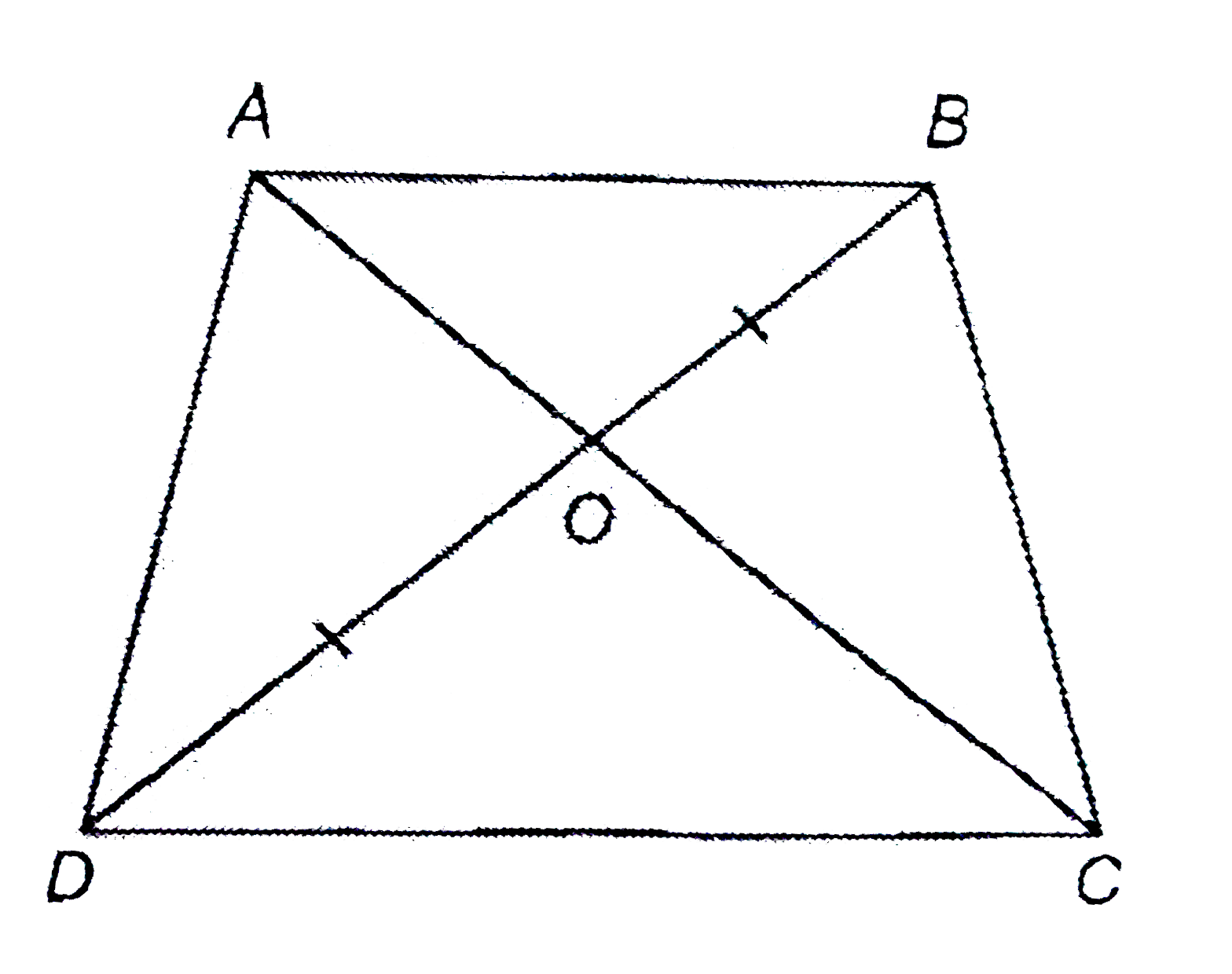
In `square ABCD`, the diagonals AC and BD intersect at 'O' such that
`BO = OD`
Now, in `angle ABD, O` is the mid-point of BD
`:.` are of `Delta ABO = " area of " Delta ADO`
(`:.` median divides the triangle into two equal areas)...(1)
In `Delta CBD, O` is the mid-point of BD
`:.` area of `Delta CBO = " area of " Delta CDO`
(`:.` medians divides the triangle into two equal area)...(2)

Adding (1) and (2)
area of `Delta ABO + " area of " Delta CBO = " area of " Delta ADO + " area of " Delta CDO`
`rArr` area of `Delta ABC = " area of " Delta ADC`
Promotional Banner

Topper's Solved these Questions

  • AREA OF PARALLELOGRAMS AND TRIANGLES

    NAGEEN PRAKASHAN|Exercise Problems From NCERT/exemplar|12 Videos
  • AREA OF PARALLELOGRAMS AND TRIANGLES

    NAGEEN PRAKASHAN|Exercise Exercise|34 Videos
  • CIRCLE

    NAGEEN PRAKASHAN|Exercise Revision Exercise (long Answer Questions )|5 Videos

Similar Questions

Explore conceptually related problems

In the figure, diagonals AC and BD of quadrilateral ABCD intersect at O such that OB = OD. If AB = CD, then show that ar( Delta DOC) = ar( Delta AOB)

In the figur e, diagonals AC and BD of quadrilateral A BCD intersect at 0 such that OB = OD. If AB = CD, then show that ar( Delta DCB) = ar( Delta ACB)

In Fig 9.25 ,diagonals AC and BD of quadrilateral ABCD intersect at O such that OB= OD.If AB=CD, then show that

Diagonals AC and BD of a quadrilateral intersect at O. It AO:OC=1:2=BO:ODandAB=16cm then DC is

Diagonals AC and BD of a parallelogram ABCD intersect at O. If OA = 3 cm and OD = 2 cm, determine the lengths of AC and BD.

The diagonals AC and BD of a cyclic quadrilateral ABCD intersect each other at the point P. Then,it is always true that

In the adjoining figure, the diagonals AC and BD of a quadrilateral ABCD intersect at O. If BO = OD , prove that ar(triangleABC)=ar(triangleADC) .

In the figure, diagonals AC and BD of quadrilateral ABCD intersect at 0 such that OB = OD. If AB = CD, then show that DA I I CB or ABCD is a parallelogram.

Diagonals AC and BD of a quadrilateral ABCD intersect at O in such a way that ar( Delta AOD) = ar( Delta BOC). Prove that ABCD is a trapezium.

In the adjoining figure, the diagonals AC and BD of a quadrilateral ABCD intersect point O. Prove that : AB+BC+CD+DA lt 2(AC+BD)

