Home
Class 9
MATHS
A point D is taken on the side BC of a D...

A point D is taken on the side BC of a `DeltaABC` such that `BD = 2DC.` Prove that `ar(DeltaABD) = 2 ar (DeltaADC)`

Text Solution

Verified by Experts
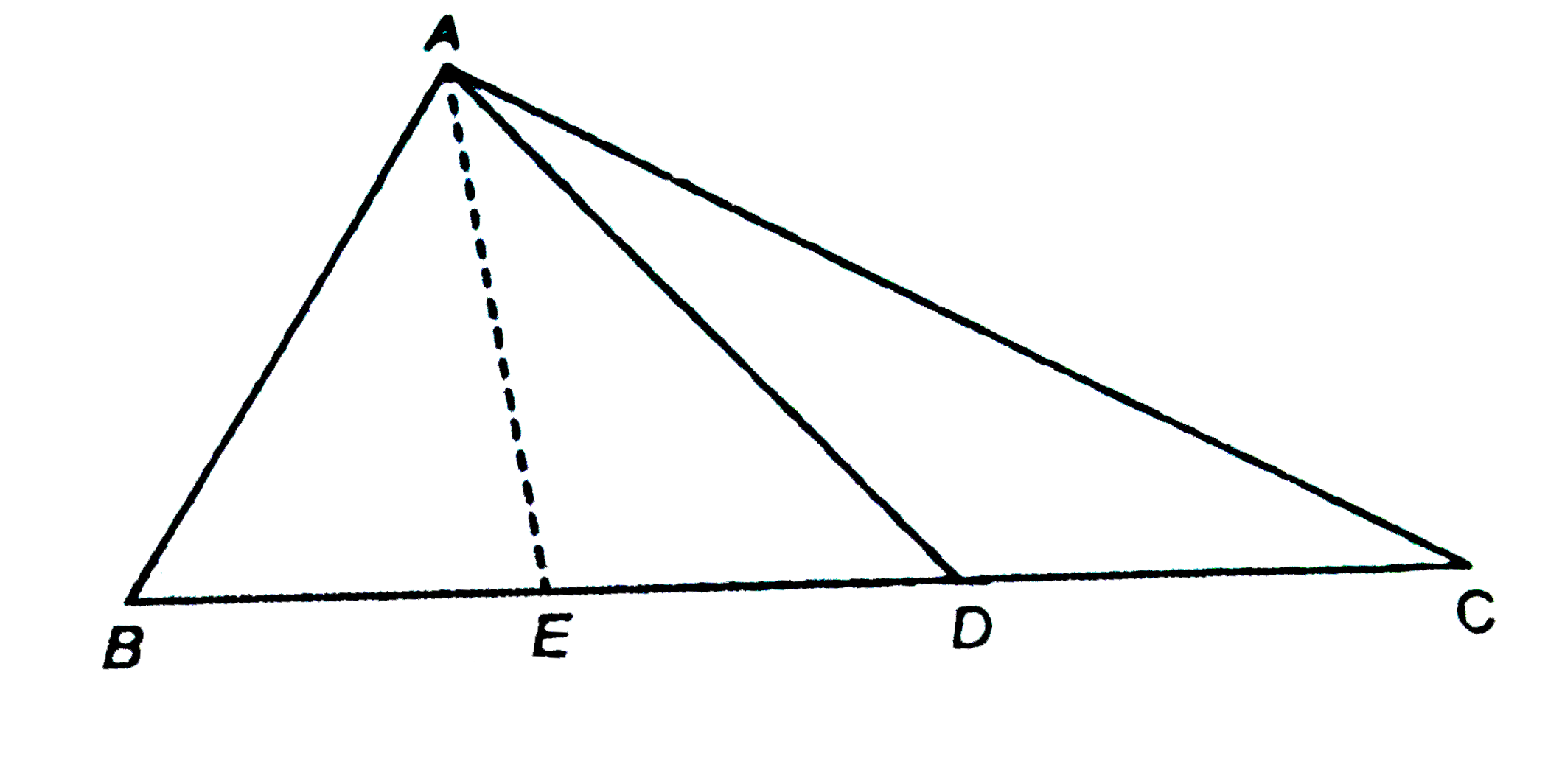
In `DeltaABC`, we have `BD = 2DC`
Let E is the mid-point of BD
Then, `BE = ED = DC`
Since, AE is the median of `DeltaABD`
`:. Ar(DeltaABE) = ar(DeltaAED)`
(median divides the traingle into two equal areas) ...(1)
Also, since AD is the median of `Delta AEC`,
`:. ar (DeltaAED) = ar(DeltaADC)`
(median divides the triangle into two equal areas)...(2)
From eqs. (1) and (2), we have
`ar(DeltaABE) = ar(DeltaAED) = ar(DeltaADC) = x`(say)
Now, `ar(DeltaABD) = ar(DeltaABE) + ar(DeltaAED) = x + x = 2x = 2 xx ar (DeltaADC)`
Promotional Banner

Topper's Solved these Questions

  • AREA OF PARALLELOGRAMS AND TRIANGLES

    NAGEEN PRAKASHAN|Exercise Problems From NCERT/exemplar|12 Videos
  • AREA OF PARALLELOGRAMS AND TRIANGLES

    NAGEEN PRAKASHAN|Exercise Exercise|34 Videos
  • CIRCLE

    NAGEEN PRAKASHAN|Exercise Revision Exercise (long Answer Questions )|5 Videos

Similar Questions

Explore conceptually related problems

In the given figure, D and E are points on the side BC of a DeltaABC such that BD = CE and AD = AE. Show that DeltaABD~=DeltaACE.

The base BC of Delta ABC is divided at D, so that BD=(1)/(2)DC. Prove that ar(Delta ABD)=(1)/(3)ar(Delta ABC)

A point D is on the side BC of an equilateral triangle ABC such that DC=(1)/(4)BC. Prove that AD^(2)=13CD^(2)

A point E is taken on the side BC of a parallelogram ABCD. AE and DC are produced to meet at F. Prove that ar(DeltaADF) = ar (ABFC) .

In DeltaABC , if L and M are the points on AB and AC, respectively such that LM || BC . Prove that ar (DeltaLOB) = ar (DeltaMOC) .

Diagonals AC and BD of a trapezium ABCD with AB || DC intersect each other at O. Prove that ar( Delta AOD) = ar( Delta BOC).

ABCD is a trapezium with AB||DC. A line parallel to AC intersects AB at X and BC at Y. Prove that ar( Delta ADX) = ar( Delta ACY).

In a DeltaABC, BD is the median to the side Ac, BD is produced to E such that BD = DE. Prove that AE is parallel to BC.

In DeltaABC,AD is the bisector of angleA . Then , (ar(DeltaABD))/(ar(DeltaACD))=

In Fig.30D and E are to points on BC such that BD=DE=EC. Show that ar(ABD)=ar(ADE)=ar(AEC)

