Text Solution
Verified by Experts



Topper's Solved these Questions
Similar Questions
Explore conceptually related problems
NAGEEN PRAKASHAN-STRAIGHT LINES-Exercise
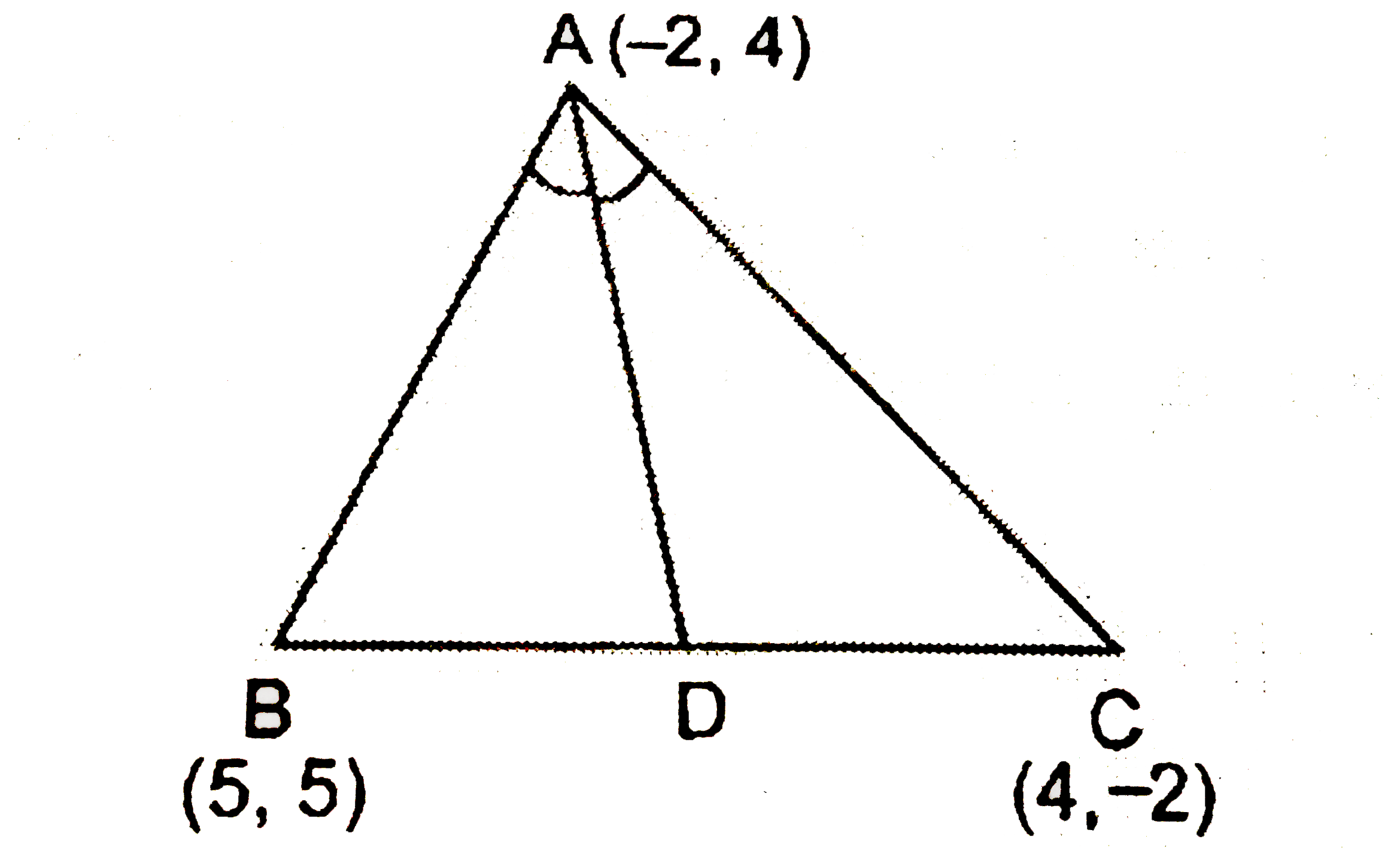
- The vertices of DeltaABC are A(-2,4), B(5,5) and C(4,-2). Find the equ...
Text Solution
|
- Find the new co-ordinates of the following points when origin is shift...
Text Solution
|
- At which point the origin should be shifted such that the new co-ordin...
Text Solution
|
- If the origin is shifted to the point (1,2) then what will be the tran...
Text Solution
|
- Find the point at which origin is shifted such that the transformed e...
Text Solution
|
- Find the point at which is shifted such that the transformed equations...
Text Solution
|
- Find the point at which origin is shifted such that the transformed eq...
Text Solution
|
- Show that the area of triangle whose vertices are (1,0), (2,4) and (3,...
Text Solution
|
- Find the slope of the lines whose iclination is given : (i) 45^(@) (...
Text Solution
|
- Find the inclination of the lines whose slopes are as follows : (i) ...
Text Solution
|
- Find the slopes of the lines passing through the following points : ...
Text Solution
|
- If the slope of a line passing through the points (1,4) and (x,2) is 2...
Text Solution
|
- If the angle of inclination of line joining the points (x,3) and (-2,5...
Text Solution
|
- If the slop of line joining the points (6,-3) and (x,7) is 2, find the...
Text Solution
|
- Show that the line joining the points (4,-1) and (-3,3) is parallel to...
Text Solution
|
- If the line joining the points (5,y) and (4,9) is parallel to the line...
Text Solution
|
- Show that the line joining the points (4,-3) and (0,7) is perpendicula...
Text Solution
|
- If the line joining the points (6,-2) and (8,4) is perpendicular to th...
Text Solution
|
- Without using Pythagoras theorem, show that A(4,4),\ B(3,5)a n d\ C(-1...
Text Solution
|
- Using slopes, show that the points A(0,5), B(3,2) and C(-1,6) are coll...
Text Solution
|
- Using the slope of line, show that the points (-1,-2), (0,4), (3,3) an...
Text Solution
|