

Home
Class 12
PHYSICS
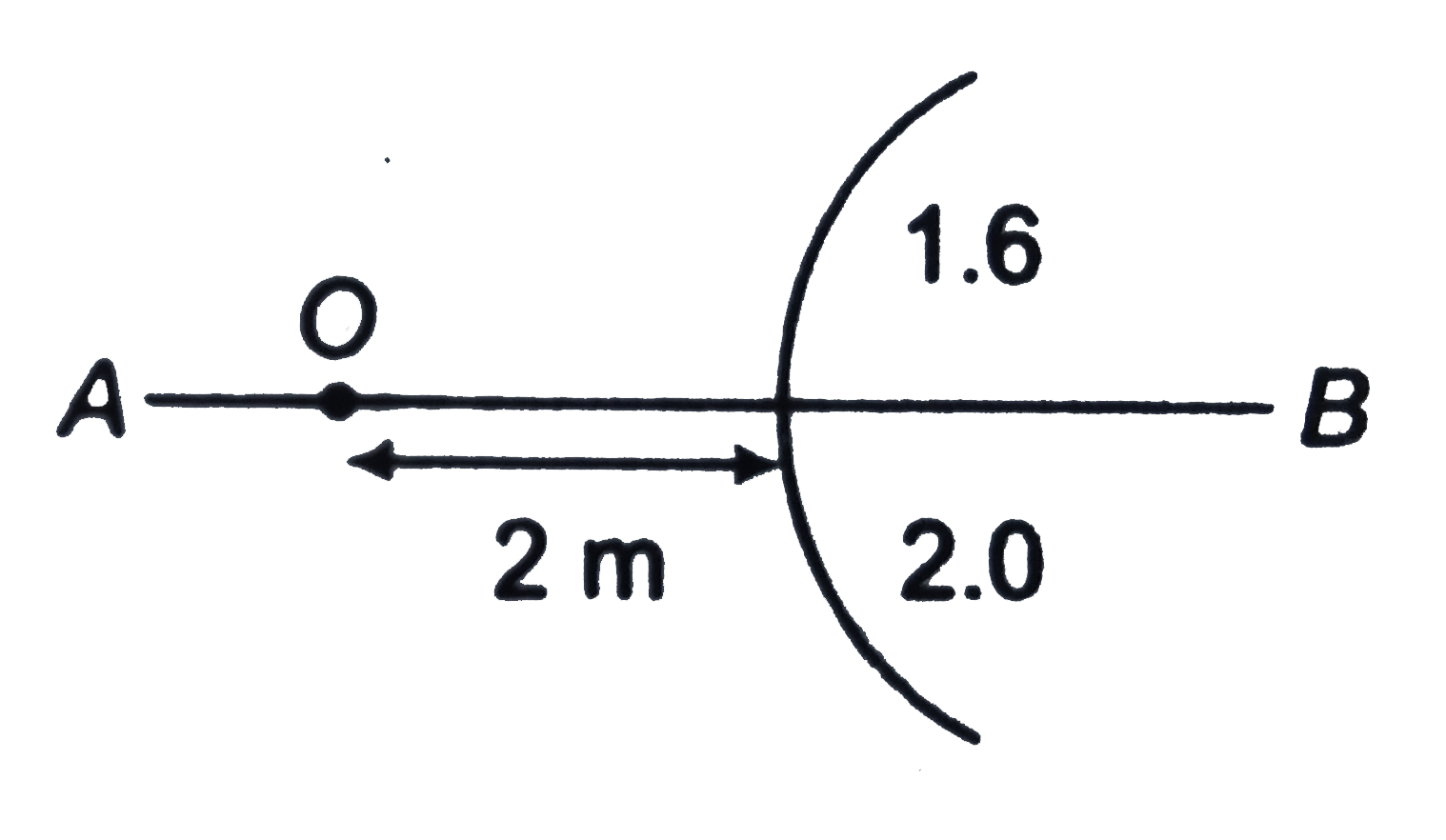
In the figure, a point object O is place...

In the figure, a point object O is placed in air. A spherical boundry separates two media of radius of curvature `1.0 m.` AB is principal axis. The separation between the images formed due to refraction at spherical surface is

Promotional Banner

Similar Questions

Explore conceptually related problems

In Figure, a point object O is placed in air. A spherical boundary separates two media. Ab is the principall axis. The refractive index above AB is 1.6 and below AB is 2.0. The separation between the images formed due to refraction at a the spherical surface is (assume the radius of curvature (R) to be 1 unit)

In Figure, a point object O is placed in air. A spherical boundary separates two media. Ab is the principall axis. The refractive index above AB is 1.6 and below AB is 2.0. The separation between the images formed due to refraction at a the spherical surface is (assume the radius of curvature (R) to be 1 unit)

In the figure shown , a point object O is placed in air on the principal axis. The radius of curvature of the spherical surfaces is 60 cm. I is the final image formed after all reflections and refractions.

In the figure shown , a point object O is placed in air on the principal axis. The radius of curvature of the spherical surfaces is 60 cm. I is the final image formed after all reflections and refractions.

Trace the rays of light showing the formation of an image due to a point object placed on the axis of a spherical surface separating the two media of refractive indices n_(1) and n_(2) . Establish the relation between the distance of the object, the image and the radius of curvature from the central point of the spherical surface. Hence derive the expression of the lens maker's formula

(a) A point object, O is on the principle axis of a spherical surface having a radius of curvature, R. Draw a diagram to obtain the relation between the object and image distances, the refractive indicess of the media and the radius of curvature of the spherical surface.

Figure below shows a parallel beam of monochromatic light incident on a convex spherical surface, radius of curvature R = 30 cm, which separates glass (refractive index - 1 6) from air. Find the position of the image formed due to refraction of light at this single spherical surface.