

Home
Class 11
PHYSICS
Figure shown two pulley arrangments for ...

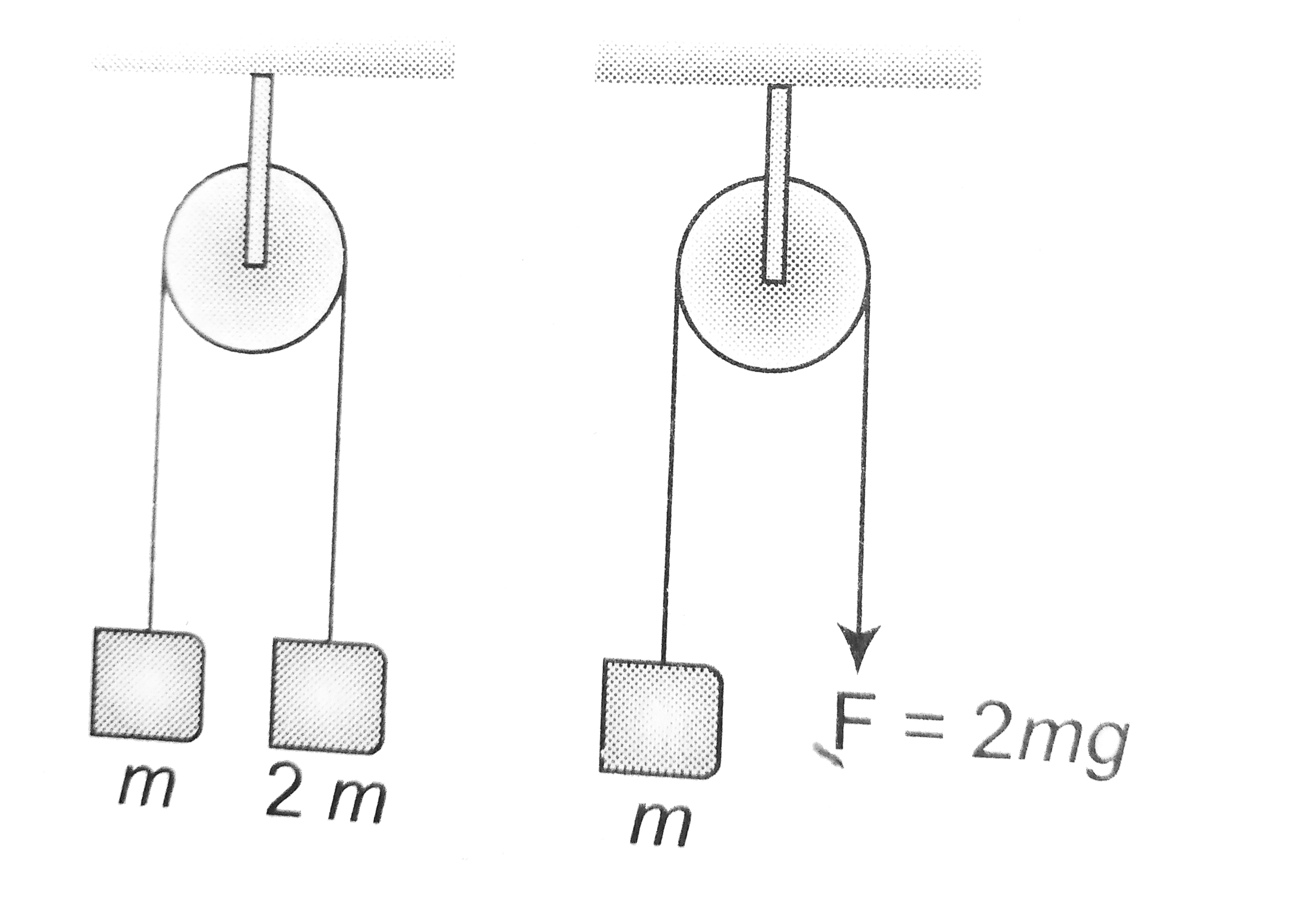
Figure shown two pulley arrangments for lifting a mass `m` . In case-1, the mass is lifting by attaching a mass 2m while in case-2 the mass is lifted by pulling the other end with a downward force `F=2mg` . If `a_(a)` and `a_(b)` are the accelerations of the two masses then (Assumme string is massless and pulley is ideal).

Promotional Banner

Similar Questions

Explore conceptually related problems

In fig mass m is lifted up by attaching a mass 2m to the other end of the string while in fig (b) m is lifted by pulling the other end of the string with a constant force F=2mg then:

The pulley arrangements of Figs. (a) and (b) are identical. The mass of the rope is negligible. In (a) the mass m is lifted up by attaching a mass 2m to the other end of the rope. In (b), m is lifted up by pulling the other end of the rope with a constant downward force F=2mg . The acceleration of m is the same in both cases

The pulley arrangements of Figs. (a) and (b) are identical. The mass of the rope is negligible. In (a) the mass m is lifted up by attaching a mass 2m to the other end of the rope. In (b), m is lifted up by pulling the other end of the rope with a constant downward force F=2mg . The acceleration of m is the same in both cases

The pulley arrangements shown in figure are identical, the mass of the rope being negligible. In case I the mass m is lifted by attaching a mass 2m to the other end of rope with a constant downward force F =2mg , where g is acceleration due to gravity The acceleration of mass m in case I is .

The pulley arrangements shown in figure are identical, the mass of the rope being negligible. In case I the mass m is lifted by attaching a mass 2m to the other end of rope with a constant downward force F =2mg , where g is acceleration due to gravity The acceleration of mass m in case I is .