Home
Class 12
PHYSICS
Obtain an expression for the equivalent ...

Obtain an expression for the equivalent emf and internal resistance of two cells connected in parallel.

Text Solution

Verified by Experts
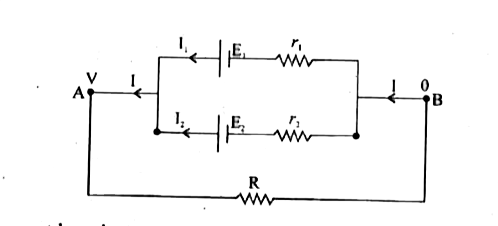
Let `I_(1),I_(2)` represent branch currents,
Let V be the common potentiai, so that,
`I_(1)=(E_(1)-V)/(r_(1)),I_(2)=(E_(2)-V)/(r_(2))`

hence, `I=(E_(1)-V)/(r_(1))+(E_(2)-V)/(r_(2))`
i.e., `I=((E_(1))/(r_(1))+(E_(2))/(r_(2)))-V(1/(r_(1))+1/(r_(2)))`
Comparing this with the terminal potential difference,
`V=E_(eq)-Ir_("eq")`
i.e., `V=E_("eq")-I/((1/(r_("eq"))))`
For two cells in parallel combination,
`(E_("eq"))_(p)=((E_(1))/(r_(1))+(E_(2))/(r_(2)))/(1/(r_(1))+1/(r_(2)))=(E_(1)r_(2)+E_(2)r_(1))/(r_(1)+r_(2))`
`1/((r_(eq))_(p))=1/(r_(1))+1/(r_(2))`, and main current = I = `(E_(eq))/(R+r_(eq))`
Note: (i) For n cells in parallel
`V=[(sum_(i=1)^(n)(E_(i))/(r_(i)))/(sum_(i=1)^(n)1/(r_(i)))]-[I/(sum_(i=1)^(n)1/(r_(i)))]`
`(E_("eq"))_("parallel")=[(sum_(i=1)^(n)(E_(i))/(r_(i)))/(sum_(i=1)^(n)1/(r_(i)))]` and `(1/(r_("eq"))_(p)=sum_(i=1)^(n)(1/(r_(i)))`
(ii) For .n. number of identical cells
E emf of each cell
r internal resistance of each cell.
`(E_("eq"))_(p)=(n(E/r))/(n(1/r))`
Promotional Banner

Topper's Solved these Questions

  • CURRENT ELECTRICITY

    SUBHASH PUBLICATION|Exercise NUMERICAL PROBLEMS AND ANSWERS|29 Videos
  • CURRENT ELECTRICITY

    SUBHASH PUBLICATION|Exercise THREE MARK QUESTIONS AND ANSWERS|11 Videos
  • COMMUNICATION SYSTEMS

    SUBHASH PUBLICATION|Exercise THREE MARKS QUESTIONS WITH ANSWERS|4 Videos
  • DUAL NATURE OF RADIATION AND MATTER

    SUBHASH PUBLICATION|Exercise NUMERICALS WITH SOLUTIONS|21 Videos

Similar Questions

Explore conceptually related problems

Derive the expression for equivalent emf and equivalent internal resistance of two cells connected in series.

Define internal resistance of a cell.

Obtain an expression for equivalent resistance of two resistors connected in a series combination.

a] Obtain an expression for the equivalent resistance of three resistors connected in series. Also write the expressions for current and voltage in the circuit. b] Mention any two advantages of connecting resistors in series.

Obtain an expression for equivalent resistance of two resistors connected in parallel.

If E_(1) , E_(2),E_(3) ... E_(n) represent emfs of a number of cells of internal resistances r_(1) , r_(2) , ... r_(n) then mention their equivalent emf and internal resistance when these are connected in series.

