

Home
Class 12
PHYSICS
A conductor of mass m and length l is sl...

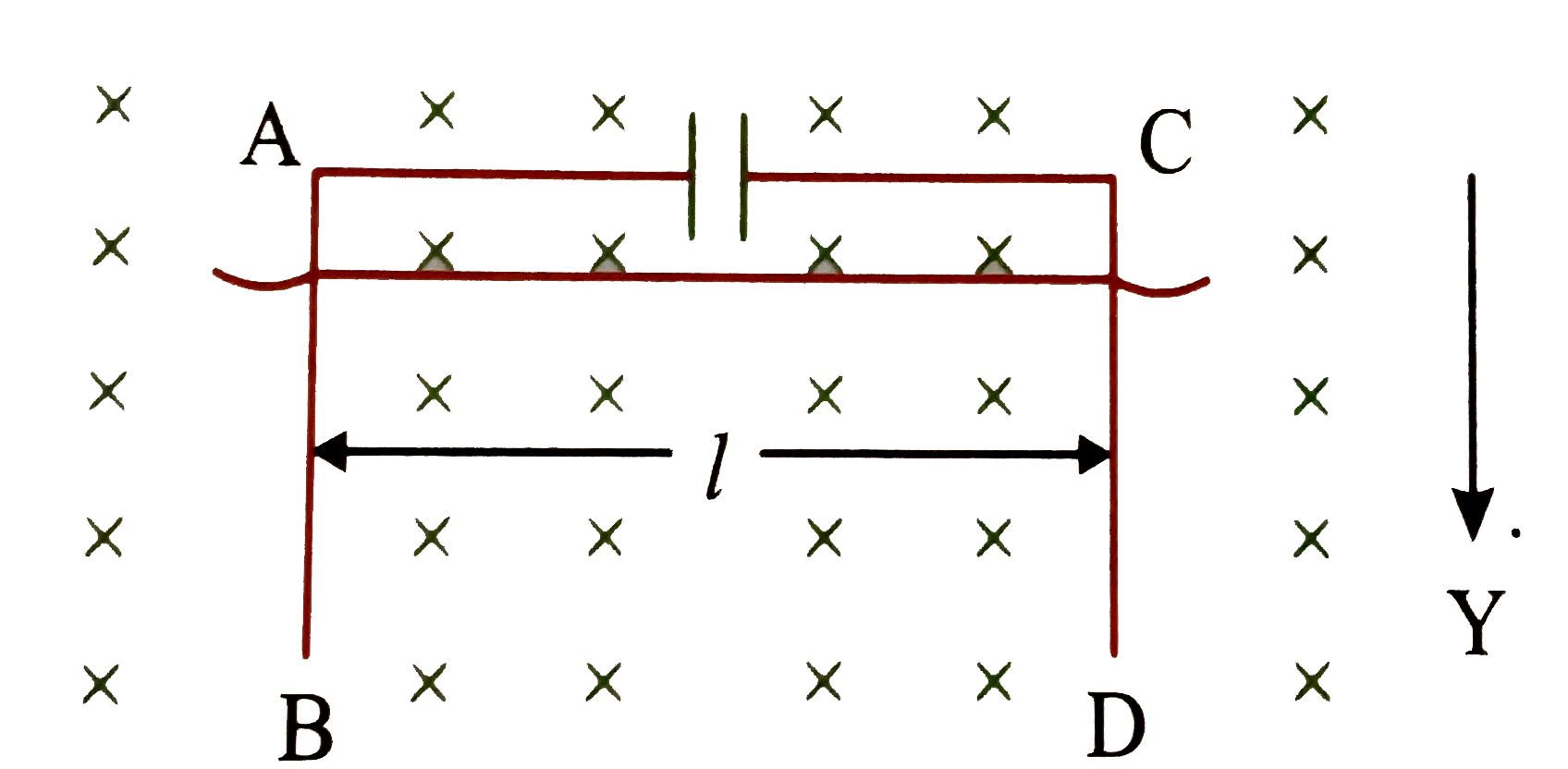
A conductor of mass `m` and length `l` is sliding smoothly an two vertical conducting rails `AB` and `CD` as shown in figure. The top ends of two conducting rails are joined by a capacitor of capacitance `C`. The conductor is relased from rest when it is very close to `AC` i.e., `y = 0`. A uniform magnetic field `B_(0)` perpendicular to plane of figure existing. Neglect the resistance of rails and connecting wires. Take acceleration due to gravity to be `g`.

Based on above information answer the following questions:
Mark the correct statement about the motion of conductor

Promotional Banner

Similar Questions

Explore conceptually related problems

A conductor of mass m and length l is sliding smoothly an two vertical conducting rails AB and CD as shown in figure. The top ends of two conducting rails are joined by a capacitor of capacitance C . The conductor is relased from rest when it is very close to AC i.e., y = 0 . A uniform magnetic field B_(0) perpendicular to plane of figure existing. Neglect the resistance of rails and connecting wires. Take acceleration due to gravity to be g . Based on above information answer the following questions: Current in the circuit is

A conductor of mass m and length l is sliding smoothly an two vertical conducting rails AB and CD as shown in figure. The top ends of two conducting rails are joined by a capacitor of capacitance C . The conductor is relased from rest when it is very close to AC i.e., y = 0 . A uniform magnetic field B_(0) perpendicular to plane of figure existing. Neglect the resistance of rails and connecting wires. Take acceleration due to gravity to be g . Based on above information answer the following questions: Charge on the capacitor as a function of distance travelled y is given by

A conducting wire XY of mass M and negligible resistance slides smothly on two parallel conducting wires as shown in figure. The closed circuit has a resistance R due to AC. AB and CD are perfect conductors. There is a magnetic field B=B(t)hatk

A conducting rod MN of mass m and length 'l' is placed on parallel smooth conducting rails connected to an uncharged capacitor of capacitance C and a battery of emf epsilon as shown. A uniform magnetic field B is existing perpendicular to the plane of the rails. The steady state velocity acquired by the conducting rod MN after closing switch S is (neglect the resistance of the parallel rails and the conducting rod)

A conducting rod MN of mass m and length 'l' is placed on parallel smooth conducting rails connected to an uncharged capacitor of capacitance C and a battery of emf epsilon as shown. A uniform magnetic field B is existing perpendicular to the plane of the rails. The steady state velocity acquired by the conducting rod MN after closing switch S is (neglect the resistance of the parallel rails and the conducting rod)

A conducting rod of length L=0.1 m is moving with a uniform sped v=0.2m//s on conducting raisli a magnetic field B=0.5T as shown. On one side, the end of the rails is connected to a capacitor of capacitance C=20muF . Then, the charge on the capacitor's plates are

A conducting rod of length L=0.1 m is moving with a uniform sped v=0.2m//s on conducting raisli a magnetic field B=0.5T as shown. On one side, the end of the rails is connected to a capacitor of capacitance C=20muF . Then, the charge on the capacitor's plates are

A conducting wire xy of lentgh l and mass m is sliding without friction on vertical conduction rails ab and cd as shown in figure. A uniform magnetic field B exists perpendicular to the plane of the rails, x moves with a constant velocity of

A conducting wire xy of lentgh l and mass m is sliding without friction on vertical conduction rails ab and cd as shown in figure. A uniform magnetic field B exists perpendicular to the plane of the rails, x moves with a constant velocity of

A conducting wire xy of lentgh l and mass m is sliding without friction on vertical conduction rails ab and cd as shown in figure. A uniform magnetic field B exists perpendicular to the plane of the rails, x moves with a constant velocity of