Home
Class 10
PHYSICS
A beam of light is incident through the ...

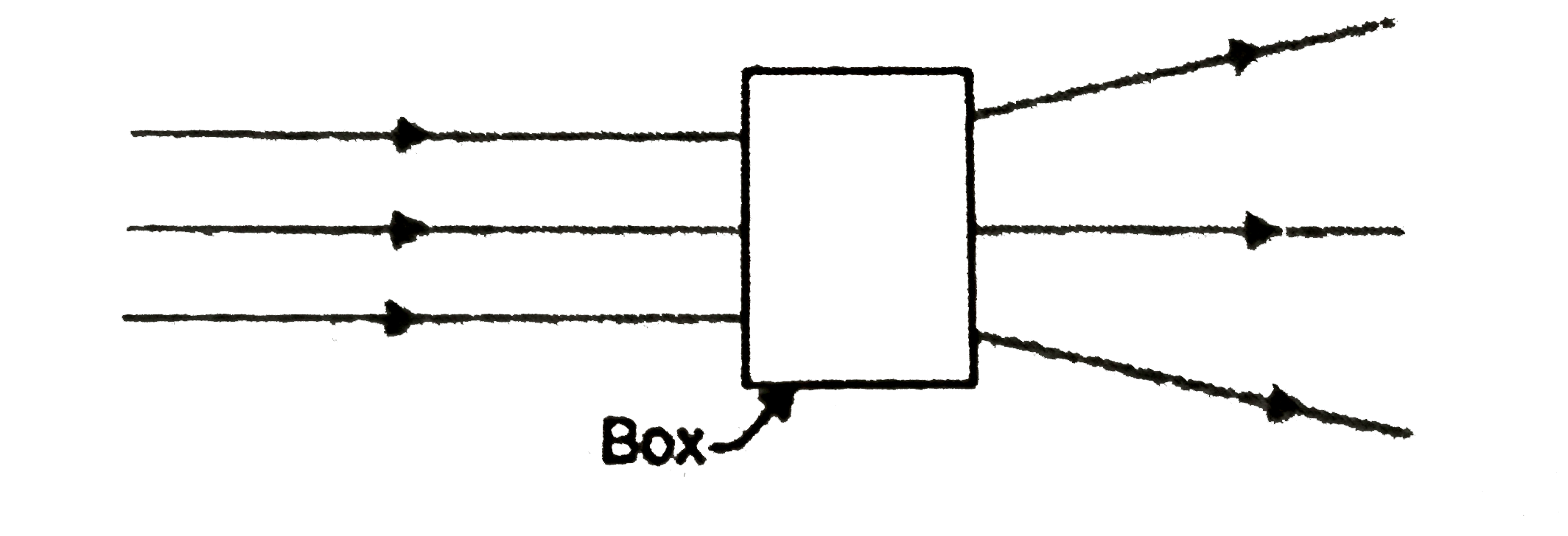
A beam of light is incident through the holes on one side of a box emerges out throught holes on its opposite side as shown in the following figure:

The box contains:

A

a glass prism

B

a concave lens

C

a convex lens

D

a parallel-sided glass slab

Text Solution

Verified by Experts

The correct Answer is:

B

b
Promotional Banner

Topper's Solved these Questions

  • REFRACTION OF LIGHT

    LAKHMIR SINGH & MANJIT KAUR|Exercise LONG ANSWER TYPE QUESTIONS|3 Videos
  • REFRACTION OF LIGHT

    LAKHMIR SINGH & MANJIT KAUR|Exercise SHORT ANSWER TYPE QUESTIONS|1 Videos
  • REFRACTION OF LIGHT

    LAKHMIR SINGH & MANJIT KAUR|Exercise VERY SHORT ANSWER TYPE QUESTIONS|1 Videos
  • REFLECTION OF LIGHT

    LAKHMIR SINGH & MANJIT KAUR|Exercise Very Short Answer Type Questions|1 Videos
  • SOURCES OF ENERGY

    LAKHMIR SINGH & MANJIT KAUR|Exercise NCERT|8 Videos

Similar Questions

Explore conceptually related problems

A beam of parallel light rays is incident through the holes on one side of a box and emerges out through the holes on its opposite side as shown in the diagram below: Which of the following could be inside the box?

A beam of light is incident through the holes on side A and emerges out of the holes on the other face of the box as shown in Figure. Which of the following could be inside the box ?

Beams of light are incident through the holes A and B and emerge out of box through the holes C and D respectively as shown in Figure. Which of the following could be inside the box ?

Noor, a young student, was trying to demonstrate some properties of light in her Science project work. She kept ‘X’ inside the box (as shown in the figure) and with the help of a laser pointer made light rays pass through the holes on one side of the box. She had a small butter-paper screen to see the spots of light being cast as they emerged. If the object inside the box was made of a material with a refractive index less than 1.5 then the

A long, straight wire, carrying a current 200A, runs through a cubical wooden box, entering and leaving through holes in the centre of opposite faces (as shown in Fig). The length of each side of the box is 20 cm. Consider an element dl,0.100 cm long of the wire at the centre of the box. Compute the magnitude dB of the magnetic field produced by this element at the point a, b,c,d and e as shown fig. Points a,c, and dare at the centres of the faces of the cube, point b is at the midpoint of one edge, and point e is at a corner. Copy the figure and show the direction and relative magnitudes of field vectors.

A ray of light, travelling parallel to diameter of a sphere enters the sphere through a hole at point A as shown in the figure. The inner surface of the sphere is made perfectly reflecting. Find the number of reflections suffered by the ray before coming out of the sphere.

Noor, a young student, was trying to demonstrate some properties of light in her Science project work. She kept ‘X’ inside the box (as shown in the figure) and with the help of a laser pointer made light rays pass through the holes on one side of the box. She had a small butter-paper screen to see the spots of light being cast as they emerged. She measured the angles of incidence for both the rays on the left side of the box to be 48.6^(@) . She knew the refractive index of the material ‘X’ inside the box was 1.5. What will be the approximate value of angle of refraction? (use the value: sin 48.6^(@) ~~ 0.75 )

LAKHMIR SINGH & MANJIT KAUR-REFRACTION OF LIGHT-Exercise
  1. When sunlight is concentrated on a piece of paper by a spherical mirro...

    Text Solution

    |

  2. A beam of parallel light rays is incident through the holes on one sid...

    Text Solution

    |

  3. A beam of light is incident through the holes on one side of a box eme...

    Text Solution

    |

  4. Which of the following can form a virtual image which is always smalle...

    Text Solution

    |

  5. When an object is placed 10 cm in front of lens A, the image is real, ...

    Text Solution

    |

  6. When a fork is seen through lenses A and B one by one, it appears as s...

    Text Solution

    |

  7. What kind of lens can form: a) an inverted magnified image? an ere...

    Text Solution

    |

  8. The lens A produces a magnification of, -0.6 whereas lens produces a m...

    Text Solution

    |

  9. A 50 cm tall object is at a very large distance from a diverging lens....

    Text Solution

    |

  10. An object is placed at a distance of 4 cm from a concave lens of focal...

    Text Solution

    |

  11. A concave lens of focal length 15 cm forms an image 10 cm from the len...

    Text Solution

    |

  12. An object 60 cm from a lens gives a virtual image at distance of 20 cm...

    Text Solution

    |

  13. A concave lens of 20 cm focal length forms an image 15 cm from the len...

    Text Solution

    |

  14. A concave lens has focal length of 15 cm. At what distance should an o...

    Text Solution

    |

  15. A concave lens has focal length of 20 cm. At what distance from the le...

    Text Solution

    |

  16. A concave lens has focal length of 20 cm. At what distance from the le...

    Text Solution

    |

  17. An object is placed 15 cm from (alpha) a converging mirror, and (b) a ...

    Text Solution

    |

  18. A 2.0 cm tall object is placed 40 cm from a diverging lens of focal le...

    Text Solution

    |

  19. a) Find the position and size of the virtual image formed when an obje...

    Text Solution

    |

  20. a) A small object is placed 150 mm away from a diverging lens of focal...

    Text Solution

    |
