Home
Class 12
PHYSICS
Obtain the relation between electric fie...

Obtain the relation between electric field and electric potential due to a point charge.

Text Solution

Verified by Experts
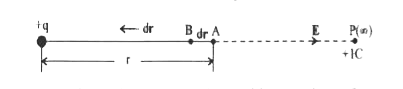
Consider a point charge .+q.. Let .P. be a point initially at infinity. Let .A. be a point inside the field region. Let.+1C. be a unit positive charge moved from the point at infinity to point .A.. Let .A. be at a distance of .r from the given point charge. Let .B. be another point at distance of dr.. from .A. towards the point charge +q.

The work done in moving positive test charge from A to B, against the force of repulsion is dW= Fdr. The-ve sign indicates that the work is done against the direction of the force and dr is the displacement of +1 C Of test charge in the direction opposite to the electric field. But electric potential
`dV=(dW)/(+q_0)` and electric field `E=E/(+q_0)`
When `q_0`=+1C
then dW=dV, E=F
Hence dV=-Edr
or `E=-(dV)/(dr)`
i.e., Electric field intensity at a point is the negative potential gradient at that point and electric field intensity is in the direction of decreasing electrostatic potential.
Promotional Banner

Topper's Solved these Questions

  • SUPPLEMENTARY EXAMINATION QUESTION PAPER (WITH ANSWERS) JULY-2017

    SUBHASH PUBLICATION|Exercise PART-D|13 Videos
  • WAVE OPTICS

    SUBHASH PUBLICATION|Exercise NUMERICALS WITH SOLUTIONS|32 Videos

Similar Questions

Explore conceptually related problems

Derive the relation between electric field and electric potential.

Derive a relation between electric field and potential

Give an expression for the electric potential at a point due to a point charge.

Draw a plot showing the variation of (i) electric field (E ) and (ii) electric potential (V) with distance r due to a point charge Q.

SUBHASH PUBLICATION-SUPPLEMENTARY EXAMINATION QUESTION PAPER JULY 2017-QUESTION
  1. Write Maxwell's equation for the speed of electromagnetic waves and ex...

    Text Solution

    |

  2. What are de-Brogli Waves ? How does the de-Broglie wavelength vary wit...

    Text Solution

    |

  3. Draw the block diagram of generalised communication system.

    Text Solution

    |

  4. Obtain the relation between electric field and electric potential due ...

    Text Solution

    |

  5. Derive the relation vec(j)=sigmavec(E) with terms which has usual mean...

    Text Solution

    |

  6. How can a moving coil galvanometer be converted into a voltmeter? Expl...

    Text Solution

    |

  7. Mention any three application of eddy currents.

    Text Solution

    |

  8. Define critical angle. Write two conditions for total internal reflect...

    Text Solution

    |

  9. Write any three difference between interference and diffraction.

    Text Solution

    |

  10. Define the terms : Threshold frequency

    Text Solution

    |

  11. Define the terms : Work function.

    Text Solution

    |

  12. Define the terms : Stopping potential.

    Text Solution

    |

  13. Explain the use Zener diode as a voltage regulator.

    Text Solution

    |

  14. Derive an expression for electric field due to an electric dipole at a...

    Text Solution

    |

  15. Obtain an expression for the force between two straight parallel condu...

    Text Solution

    |

  16. Show that a current carrying solenoid is equivalent to a bar magnet.

    Text Solution

    |

  17. Derive th lens maker's formula.

    Text Solution

    |

  18. Derive an experession for the total energy of an electron in stationar...

    Text Solution

    |

  19. What is amplification? With a circuit diagram, explain the working of ...

    Text Solution

    |

  20. In a parallel plate capacitor with air between the plates, each has an...

    Text Solution

    |

