Home
Class 12
PHYSICS
Define critical angle. Write two conditi...

Define critical angle. Write two conditions for total internal reflection.

Text Solution

Verified by Experts
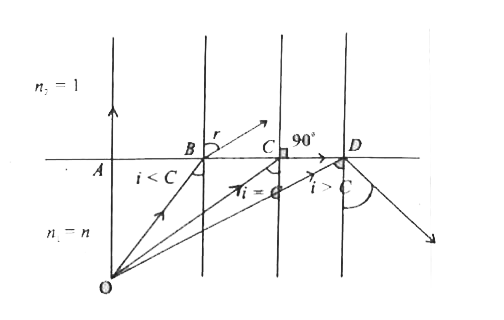
Consider a point object in the denser medium. There will be cone of rays striking the interface. For a ray of light OA, it suffers normal refraction. For any angle of incidence less than critical angle such as ray OB, the refracted ray bends away from the normal. However for a particular angle of incidence called critical angle, the refracted ray of light grazes the interface. Therefore critical angle for the given pair of media and given wavelength of light may be defined as the angle of incidence in the denser medium for which the refracted ray is at right angles to the normal drawn at the point of incidence.
For a ray of light such as OD, whose angle of incidence is greater than the critical angle, there will be no refraction of light, instead the light bounces back into the same denser medium. This phenomenon of light is known as the total internal reflection.

Conditions for the total internal reflection.
(a) Object should be in the denser medium and viewed through rarer medium.
(b) Angle of incidence in the denser medium should be more than the critical angle for the given pair of media and wavelength of light.
Promotional Banner

Topper's Solved these Questions

  • SUPPLEMENTARY EXAMINATION QUESTION PAPER (WITH ANSWERS) JULY-2017

    SUBHASH PUBLICATION|Exercise PART-D|13 Videos
  • WAVE OPTICS

    SUBHASH PUBLICATION|Exercise NUMERICALS WITH SOLUTIONS|32 Videos

Similar Questions

Explore conceptually related problems

Define critical size.

Define critical angle for a pair of media.

Define critical volume [V_(e)]

A, B and C are three optical media of respective critical angles C_1, C_2 and C_3 . Total internal reflection of light can occur from A to B and also from B to C but not from C to A. Then, the correct relation between the critical angles is

Mention three application of total internal reflection of light.

SUBHASH PUBLICATION-SUPPLEMENTARY EXAMINATION QUESTION PAPER JULY 2017-QUESTION
  1. Write Maxwell's equation for the speed of electromagnetic waves and ex...

    Text Solution

    |

  2. What are de-Brogli Waves ? How does the de-Broglie wavelength vary wit...

    Text Solution

    |

  3. Draw the block diagram of generalised communication system.

    Text Solution

    |

  4. Obtain the relation between electric field and electric potential due ...

    Text Solution

    |

  5. Derive the relation vec(j)=sigmavec(E) with terms which has usual mean...

    Text Solution

    |

  6. How can a moving coil galvanometer be converted into a voltmeter? Expl...

    Text Solution

    |

  7. Mention any three application of eddy currents.

    Text Solution

    |

  8. Define critical angle. Write two conditions for total internal reflect...

    Text Solution

    |

  9. Write any three difference between interference and diffraction.

    Text Solution

    |

  10. Define the terms : Threshold frequency

    Text Solution

    |

  11. Define the terms : Work function.

    Text Solution

    |

  12. Define the terms : Stopping potential.

    Text Solution

    |

  13. Explain the use Zener diode as a voltage regulator.

    Text Solution

    |

  14. Derive an expression for electric field due to an electric dipole at a...

    Text Solution

    |

  15. Obtain an expression for the force between two straight parallel condu...

    Text Solution

    |

  16. Show that a current carrying solenoid is equivalent to a bar magnet.

    Text Solution

    |

  17. Derive th lens maker's formula.

    Text Solution

    |

  18. Derive an experession for the total energy of an electron in stationar...

    Text Solution

    |

  19. What is amplification? With a circuit diagram, explain the working of ...

    Text Solution

    |

  20. In a parallel plate capacitor with air between the plates, each has an...

    Text Solution

    |

