Home
Class 12
PHYSICS
Derive an expression for electric field ...

Derive an expression for electric field due to an electric dipole at a point on the axial line.

Text Solution

Verified by Experts
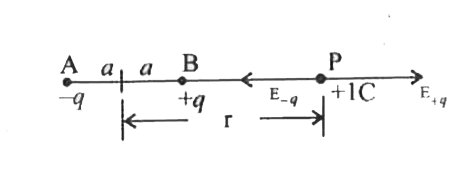
Let +1C be the test charge at P, at a distance r from the centre of an electric dipole. Test charge +1C experiences a force of repulsion along BP due to +g at B and attraction due to -g along PA. Since .+q. is nearer than-q from P, the resultant force points along BP. Force experienced by a unit +ve charge is called electric field.
Net `vecE=vecE_(+q)-vecE_(-q)=q/(4piepsilon_0) [1/((r-a)^2)-1/((r-a)^2)]hatp`
where `hatp` represents the unit vector of dipole moment point from -q to +q.
`therefore vecE=(q/(4piepsilon_0))((2(2ar))/((r^2-a^2)^2))hatp`
i.e., `vecE=("2pr"/(4piepsilon_0)) (1/((r^2-a^2)^2))hatp`
`vecE=(1/(4piepsilon))(2vecpr)/((r^2-a^2)^2)`
where , p=2aq and `vecp=phatp`

`|vecE|=((2pr)/(4piepsilon_0(r^2-a^2)))Vm^(-1)`
`E=(2p)/(4piepsilon_0r^3)` for r > > a (for a short dipole)
Promotional Banner

Topper's Solved these Questions

  • SUPPLEMENTARY EXAMINATION QUESTION PAPER (WITH ANSWERS) JULY-2017

    SUBHASH PUBLICATION|Exercise PART-D|13 Videos
  • WAVE OPTICS

    SUBHASH PUBLICATION|Exercise NUMERICALS WITH SOLUTIONS|32 Videos

Similar Questions

Explore conceptually related problems

Derive an expression for electrical conductivity.

What is an electric dipole ?

Obtain an expression for the electric field intenstiy at a point on the equatorial line of an electric dipole.

Derive an expression for the electric field at a point due to an infinitely long thin charged straight wire using Gauss Law.

Arrive at the expression for electric potential at a point due to a dipole and hence apply the expression for electric potential at a point on the dipole axis and on the equatorial lines.

Write the expression for the electric field at any point due to a short electric dipole. Give the meaning of the symbols used.

SUBHASH PUBLICATION-SUPPLEMENTARY EXAMINATION QUESTION PAPER JULY 2017-QUESTION
  1. Write Maxwell's equation for the speed of electromagnetic waves and ex...

    Text Solution

    |

  2. What are de-Brogli Waves ? How does the de-Broglie wavelength vary wit...

    Text Solution

    |

  3. Draw the block diagram of generalised communication system.

    Text Solution

    |

  4. Obtain the relation between electric field and electric potential due ...

    Text Solution

    |

  5. Derive the relation vec(j)=sigmavec(E) with terms which has usual mean...

    Text Solution

    |

  6. How can a moving coil galvanometer be converted into a voltmeter? Expl...

    Text Solution

    |

  7. Mention any three application of eddy currents.

    Text Solution

    |

  8. Define critical angle. Write two conditions for total internal reflect...

    Text Solution

    |

  9. Write any three difference between interference and diffraction.

    Text Solution

    |

  10. Define the terms : Threshold frequency

    Text Solution

    |

  11. Define the terms : Work function.

    Text Solution

    |

  12. Define the terms : Stopping potential.

    Text Solution

    |

  13. Explain the use Zener diode as a voltage regulator.

    Text Solution

    |

  14. Derive an expression for electric field due to an electric dipole at a...

    Text Solution

    |

  15. Obtain an expression for the force between two straight parallel condu...

    Text Solution

    |

  16. Show that a current carrying solenoid is equivalent to a bar magnet.

    Text Solution

    |

  17. Derive th lens maker's formula.

    Text Solution

    |

  18. Derive an experession for the total energy of an electron in stationar...

    Text Solution

    |

  19. What is amplification? With a circuit diagram, explain the working of ...

    Text Solution

    |

  20. In a parallel plate capacitor with air between the plates, each has an...

    Text Solution

    |

