Home
Class 12
PHYSICS
Derive th lens maker's formula....

Derive th lens maker's formula.

Text Solution

Verified by Experts
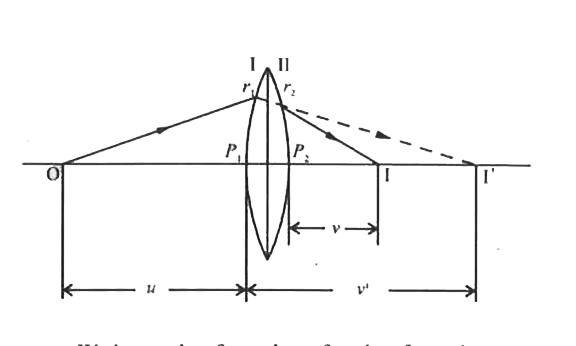
Lens maker.s formula,
Let `r_1` and `r_2` be the radii of curvature of the thin lens.
Let O be the point object at a distance u from the pole of the first curved surface of the lens. Real image is formed at I., at a distance v from the pole `P_1`. This image is formed in the denser medium.

We know that from the refraction formula,
`n_1/(-u) + n_2/v = (n_2-n_1)/r`
i.e., `n_1/(-u) + n_2/(v.) =(n_2-n_1)/r_1` ....(1)
where `n_1` is the refractive index of rarer medium and `n_2` that of the denser medium `(n_2 > n_1)`. For the second surface, real image at I will serve as a virtual object and the distance is taken as -of. The object space is the lens medium for refraction through the second curved surface.
Final image is formed in air at I and at a distance of .v. from `P_2` .

`n_1/(-u) + n_2/v = (n_2-n_1)/ r`
i.e. , `n_2/(-v.)+ n_1/v =(n_2-n_1)/(-r_2)`...(2)
Adding (1) and (2) we get
`n_1/(-u) + n_1 /v = (n_2-n_1) (1/r_1 -1/r_2)`
or `1/(-u)+1/v =(n_2-n_1)/n_1 (1/r_1 -1/r_2)` ....(3)
when `u=oo , v=f `,
when u=f , v=`oo`
`therefore ` The term on the L.H.S. can be replaced by `1/f`
where f is the focal length of lens .
i.e., `1/f =((n_2-n_1)/n_1) (1/r_1 -1/r_2)` ...(4)
The equation (4) is called the lens maker.s formula.
Note:
(1) Using the equation (4), it can be shown that
`._1n_2 = 1-[(r_1r_2)/(f(r_1-r_2))]`
where, `._1n_2 =n_2/n_1 `
(2) For radius of curvature the letter .R. may be used.
Promotional Banner

Topper's Solved these Questions

  • SUPPLEMENTARY EXAMINATION QUESTION PAPER (WITH ANSWERS) JULY-2017

    SUBHASH PUBLICATION|Exercise PART-D|13 Videos
  • WAVE OPTICS

    SUBHASH PUBLICATION|Exercise NUMERICALS WITH SOLUTIONS|32 Videos

Similar Questions

Explore conceptually related problems

(a) A point object is placed in front of a double convex lens ( of refractive index n = n_(2) // n_(1) with respect to air ) with its spherical faces of radii of curvature R_(1) and R_(2) . Show the path of rays due to refraction at first and subsequently at the second surface to obtain the formation of the real image of the object. Hence obtain the lens-maker's formula for a thin lens. A double convex lens having both faces of the same radius of curvature has refractive index 1.55. Find out the radius of curvature of the lens required to get the focal length of 20cm.

Draw a ray diagram showing the formation of the image by a point object on the principal axis of a spherical convex surface separating two media of refractive indices n_(1) and n_(2) , when a point source is kept in rarer medium of refractive index n_(1) . Derive the relation between object and image distance in terms of refractive index of the medium and radium of curvature of the surface. Hence obtain the expression for lens-maker's formula in the case of thin convex lens.

Derive the quadratic formula from the standard form (ax^(2)+bx+c=0) of a quadratic equation.

Derive the section formula for the internal division in three dimensions.

Write the molecular formula of alcohol which can be derived from butane.

SUBHASH PUBLICATION-SUPPLEMENTARY EXAMINATION QUESTION PAPER JULY 2017-QUESTION
  1. Write Maxwell's equation for the speed of electromagnetic waves and ex...

    Text Solution

    |

  2. What are de-Brogli Waves ? How does the de-Broglie wavelength vary wit...

    Text Solution

    |

  3. Draw the block diagram of generalised communication system.

    Text Solution

    |

  4. Obtain the relation between electric field and electric potential due ...

    Text Solution

    |

  5. Derive the relation vec(j)=sigmavec(E) with terms which has usual mean...

    Text Solution

    |

  6. How can a moving coil galvanometer be converted into a voltmeter? Expl...

    Text Solution

    |

  7. Mention any three application of eddy currents.

    Text Solution

    |

  8. Define critical angle. Write two conditions for total internal reflect...

    Text Solution

    |

  9. Write any three difference between interference and diffraction.

    Text Solution

    |

  10. Define the terms : Threshold frequency

    Text Solution

    |

  11. Define the terms : Work function.

    Text Solution

    |

  12. Define the terms : Stopping potential.

    Text Solution

    |

  13. Explain the use Zener diode as a voltage regulator.

    Text Solution

    |

  14. Derive an expression for electric field due to an electric dipole at a...

    Text Solution

    |

  15. Obtain an expression for the force between two straight parallel condu...

    Text Solution

    |

  16. Show that a current carrying solenoid is equivalent to a bar magnet.

    Text Solution

    |

  17. Derive th lens maker's formula.

    Text Solution

    |

  18. Derive an experession for the total energy of an electron in stationar...

    Text Solution

    |

  19. What is amplification? With a circuit diagram, explain the working of ...

    Text Solution

    |

  20. In a parallel plate capacitor with air between the plates, each has an...

    Text Solution

    |

