Home
Class 12
PHYSICS
Arrive at Snell's law of refraction, usi...

Arrive at Snell's law of refraction, using Huygen's principle for refraction of a plane wave.

Text Solution

Verified by Experts
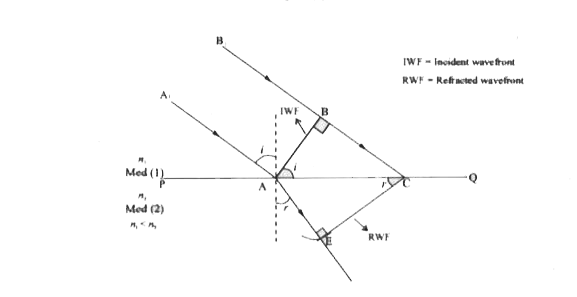

Distance AE=`v_2 tau , tau` - time taken for optical path
Distance BC = `v_1tau, i_1` - angle of incidence in medium (1)
From the right angled `triangleABC` , sin I = `(BC)/(AC)`
and from the right angled `triangleAEC` , sin r =`(AE)/(AC)`
Hence, `(sin i)/(sin r)=(BC)/(AE)=(v_i tau)/(v_2 tau)`
or `(sin i)/(sin r) =v_1/v_2` ....(1)
By definition , absolute R.I of a medium w.r.t air/vacuum=n=`c/v`
for medium (1) = `n_1=c/v_1`
for medium (2)=`n_2=c/v_2`
So that , `v_1/v_2=n_2/n_1` ...(2)
Using (2) in (1) we get
`(sin i)/(sin r)=n_2/n_1`
where , `n_2 > n_1`.
or `n_1 sin i=n_2=sin r` ...(3)
i.e., R.I. of medium (1) times sine of angle in the medium (1)=R.I of medium (2) times sine of angle in the medium 2.
This expression (3) is known as the Snell.s law .
The ratio `n_2/n_1` can be written as `n_2` (R.I. of medium (2) w.r.t medium (1) .
Note: From (1), `n_2=(sin i_1)/(sin i_2)=v_1/v_2=lambda_1/lambda_2`
i.e., `v_1sin i_2=v_2sin i_1, lambda_2sini_1 =lambda_1 sin i_2` and `n_1 sin i_1 = n_2 sin i_2`
Promotional Banner

Topper's Solved these Questions

  • ANNUAL EXAM QUESTION PAPER -MARCH -2017

    SUBHASH PUBLICATION|Exercise PART -D|12 Videos
  • ANNUAL EXAMINATION QUESTION PAPER (WITH ANSWER) MARCH 2018

    SUBHASH PUBLICATION|Exercise Part-C|11 Videos

Similar Questions

Explore conceptually related problems

State Snell's law of refraction of light?

State laws of refraction.

According to Huygens' principle, during refraction of light from air to a denser medium

Huygens principle of secondary waves is used to :

Snell's law of refraction does not hold good when the angle of incidence on a refracting surface is

Using Huygens principle, show that the angle of incidence is equal to angle of reflection during a plane wave front reflected by a plane surface.

SUBHASH PUBLICATION-ANNUAL EXAM QUESTION PAPER MARCH 2018-QUESTION
  1. Mention any three properties of an electric charge.

    Text Solution

    |

  2. State Ampere's circuital law . Using it, derive the expression for mag...

    Text Solution

    |

  3. What is hysterisis? Define the terms 'coercivity' and 'retentivity' of...

    Text Solution

    |

  4. Arrive at Snell's law of refraction, using Huygen's principle for refr...

    Text Solution

    |

  5. Writer Bohr's postulates for the hydrogen atom model.

    Text Solution

    |

  6. State the three postulates of Bohr's theory of hydrogen atom.

    Text Solution

    |

  7. Derive an expression for the half-life of a radio active nuclide.

    Text Solution

    |

  8. Distinguish between p type and n type semiconductors

    Text Solution

    |

  9. Draw the block diagram of a generalised communication system.

    Text Solution

    |

  10. Define electric potential due to a point charge and arrive at the exp...

    Text Solution

    |

  11. Obtain an expression for the equivalent emf and internal resistance of...

    Text Solution

    |

  12. Derive the expression for magnetic field at a point on the axis of a c...

    Text Solution

    |

  13. Obtain an expression for the impedance of a series LCR circuit. (using...

    Text Solution

    |

  14. Deduce the relation between n,u,v, Q, R for refraction at a spherical ...

    Text Solution

    |

  15. What is a rectifier ? With suitable circuit describe the action of a f...

    Text Solution

    |

  16. Three charges each equal to +4nC are placed at the three comers of a s...

    Text Solution

    |

  17. 100 mg mass of nichrome metal is drawn into a wire of area of cross-se...

    Text Solution

    |

  18. A circular coil of radius 10cm and 25 turns is rotated about its verti...

    Text Solution

    |

  19. In Young's double slit experiment the slits are separated by 0.28mm an...

    Text Solution

    |

  20. Light of frequency 8.41xx10^(14)Hz is incident on a metal surface. Ele...

    Text Solution

    |

