Home
Class 12
PHYSICS
State Gauss's theorem. Obtain an express...

State Gauss's theorem. Obtain an expression for elactric field at any point outside a charged spherical hollow conductor (shell).

Text Solution

Verified by Experts
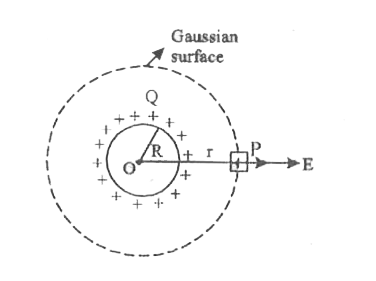
Gauss.s theorem: "The total outward electric flux passing through a closed surface in air is `(1/epsilon_0)` times the total charge enclosed by it..

Let +Q. be the charge enclosed by a hollow conductor of radius .R..
Let .p. be a point at a distance .r. from the centre of the conductor Let .ds be a small element of area surrounding the point. A normal drawn from the point coincides with the direction of E. Hence cos `0^@=1`.
From Gauss. theorem,
`TOEF=phi=(1/epsilon_0)Q` ...(1)
by definition
`phi=E cos theta sum ds`.
where `sumds=4pir^2 , cos theta=cos 0^@ =1`
Hence , `phi=E. 4pir^2` ...(2)
Comparing (1) and (2)
we write `E=(1/(4piepsilon_0))Q/r^2`
For a point on the surface , r =R .
`E=(1/(4piepsilon_0))(Q/R^2)` .
This electric field intensity is maximum. Since electric flux depends on the charge enclosed, and electric field intensity depends on the electric flux, electric field remains zero at all points inside the spherical hollow conductor.
Promotional Banner

Topper's Solved these Questions

  • ELECTROSTATIC POTENTIAL AND CAPACITANCE

    SUBHASH PUBLICATION|Exercise NUMERICALS WITH SOLUTIONS|20 Videos
  • MAGNETISM AND MATTER

    SUBHASH PUBLICATION|Exercise NUMERICALS WITH SOLUTIONS|12 Videos

Similar Questions

Explore conceptually related problems

Write the expression for electric field intensity at any point outside and inside due to a charged spherical shell.

What is the value of Electric field intensity at any point inside a charged hollow spherical conductor?

Obtain an expression for the electric field intenstiy at a point on the equatorial line of an electric dipole.

Using Gauss's law in electrostatics, obtain an expression for electric field due to a uniformly charged thin spherical shell at a point (i) Outside the shell and (ii) Inside the shell

SUBHASH PUBLICATION-II PUC ANNUAL EXAMINATION QUESTION PAPER MARCH 2019-QUESTION
  1. Write the ray diagram for formation of image in the simple microscope.

    Text Solution

    |

  2. What is diffraction of light?

    Text Solution

    |

  3. Write the expression for de-Broglie wavelength of electrons interms of...

    Text Solution

    |

  4. Distinguish between p type and n type semiconductors

    Text Solution

    |

  5. Derive an expression for potential energy of electric - di-pole p...

    Text Solution

    |

  6. Write the expression for force per unit length between two striagh...

    Text Solution

    |

  7. Distinguish between 'dia' and 'ferro' magnetic materials.

    Text Solution

    |

  8. Mention energy losses in a transformer .

    Text Solution

    |

  9. Write any three experimental observations of photoelectric effect

    Text Solution

    |

  10. State the three postulates of Bohr's theory of hydrogen atom.

    Text Solution

    |

  11. Explain the .Conduction band. .Valence band. and .Energy gap. in semi...

    Text Solution

    |

  12. What is modulation ? Write the block diagram of the receiver.

    Text Solution

    |

  13. State Gauss's theorem. Obtain an expression for elactric field at any ...

    Text Solution

    |

  14. Obtain an expression for the equivalent emf and internal resistance of...

    Text Solution

    |

  15. Derive the expression for magnetic field at a point on the axis of a c...

    Text Solution

    |

  16. Derive an expression for the impedance of a series LCR, circuit, when ...

    Text Solution

    |

  17. Derive th lens maker's formula.

    Text Solution

    |

  18. Explain the working of a n-p-n transistor in CE mode as an amplifier.

    Text Solution

    |

  19. In a circular parallel plate capacitor radius of each plate is 5 cm an...

    Text Solution

    |

  20. Two resistors are connected in series with 5V battery of negligible in...

    Text Solution

    |

